You ran the vacuum over the rug twice, wound the cord, and stood back. The floor looks fine. The lampshade doesn't. A gray film sits on the shade, fingerprints smear the switch plate by the door, and the sofa cushions have gone flat and dull along the arms.
Nothing you did was wrong. The order was. Dust doesn't stay where you put it, and every swipe across a shelf sends part of it down onto the rug you already finished.
A living room cleaning checklist earns its keep because it turns tidying into a single top-to-bottom pass. Fixtures and fan blades first, then shelves and tables, then fabric and glass, then the floor. Each task drops material into the path of the next one, and the last task collects everything.
The one rule worth taping to the inside of a cupboard door: never clean the floor before the ceiling fan. You'll end up doing the job twice and calling it bad luck.
Eight tasks follow, in that order. They cover furniture, surfaces, glass, and floors, with extra attention on the spots most routines never touch: fan blades, baseboards, blinds, switch plates, and the crevices of the sofa.
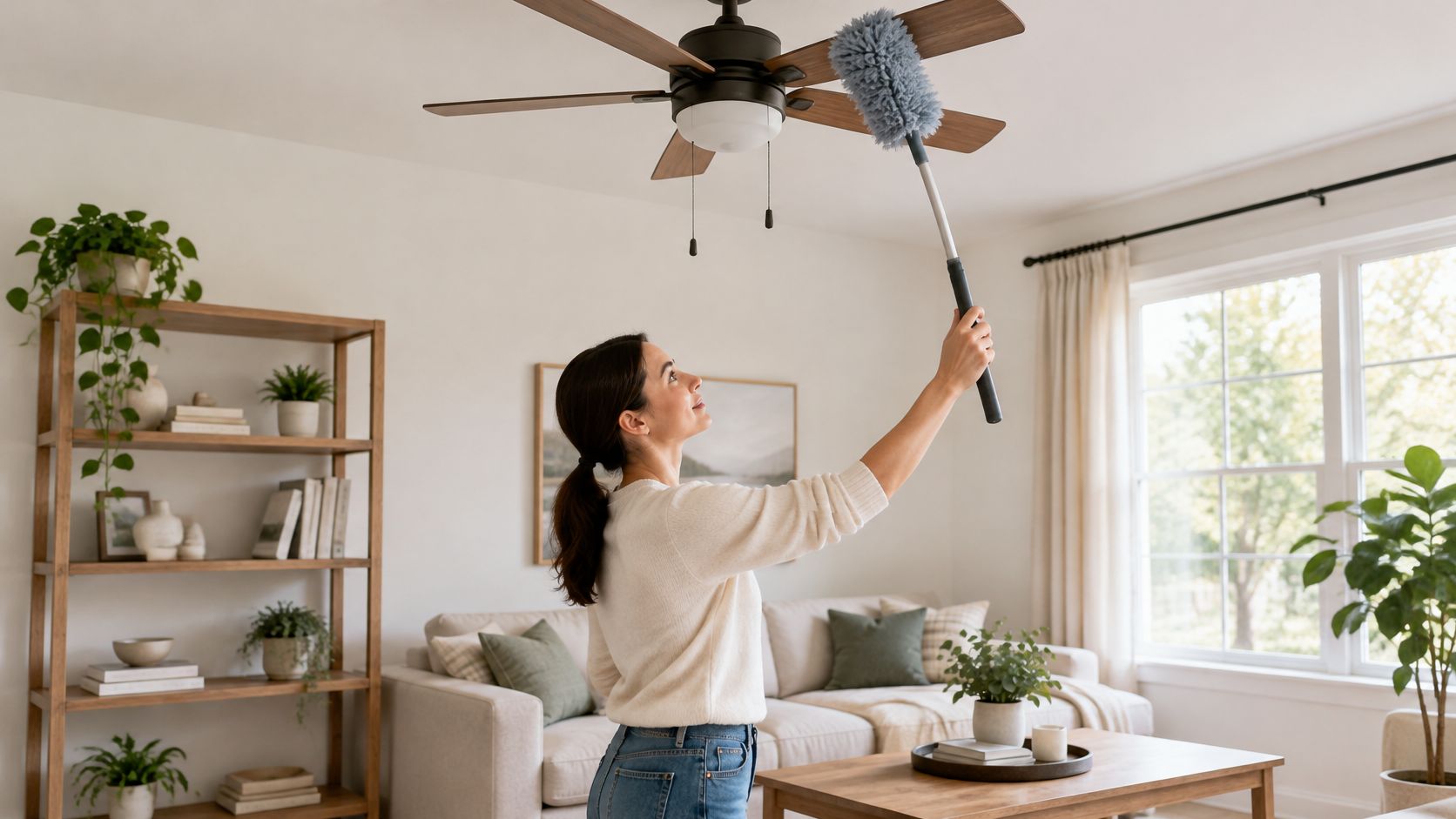
1. Dusting Hard Surfaces, Ceiling Fans, and Light Fixtures
Start at the highest point in the room and work down. Ceiling fan, then fixtures and shades, then the tops of shelving, mantels, and picture frames, then tables and armrests. Anything you knock loose lands on something still dirty below rather than on the rug you're about to vacuum.
Ceiling fans deserve a pass of their own. Blades carry a mat of dust that a dry swipe flings across the room, and a slightly damp cloth drawn along each blade in one stroke takes it off cleanly. If the buildup is thick, slip a pillowcase over a blade and pull it back, then wash the case outside.
Light Fixtures and Shelving
Turn the fixture off and let the glass cool before you touch it. A warm shade cracks under a cold wet cloth, and a warm bulb holds dust like glue. Wipe the shade inside and out, then move down through shelves, frames, and decorative objects.
Microfiber is the right cloth for this because of how it holds what it catches. In a controlled evaluation on contaminated stainless-steel surfaces, microfiber cloths showed nearly twice the absorbency of conventional cloths and produced an extra 10% reduction in residual organic debris when the right technique was used. The same study found no significant microorganism-removal edge over other cleaning methods, so treat microfiber as a dust trap, not a disinfectant.
Fold, don't scrub: fold the cloth into quarters and rotate to a fresh face as each side loads up. New cloth per zone, into the laundry after.
A long-handled duster reaches the line where the wall meets the ceiling, and this guide to getting rid of cobwebs covers corners that are already webbed over. In a home with a shedding dog, or a house near active construction, dusting weekly instead of monthly is the difference between a five-minute pass and a whole afternoon.
2. Vacuuming Upholstery, Rugs, and Carpet with a HEPA Filter
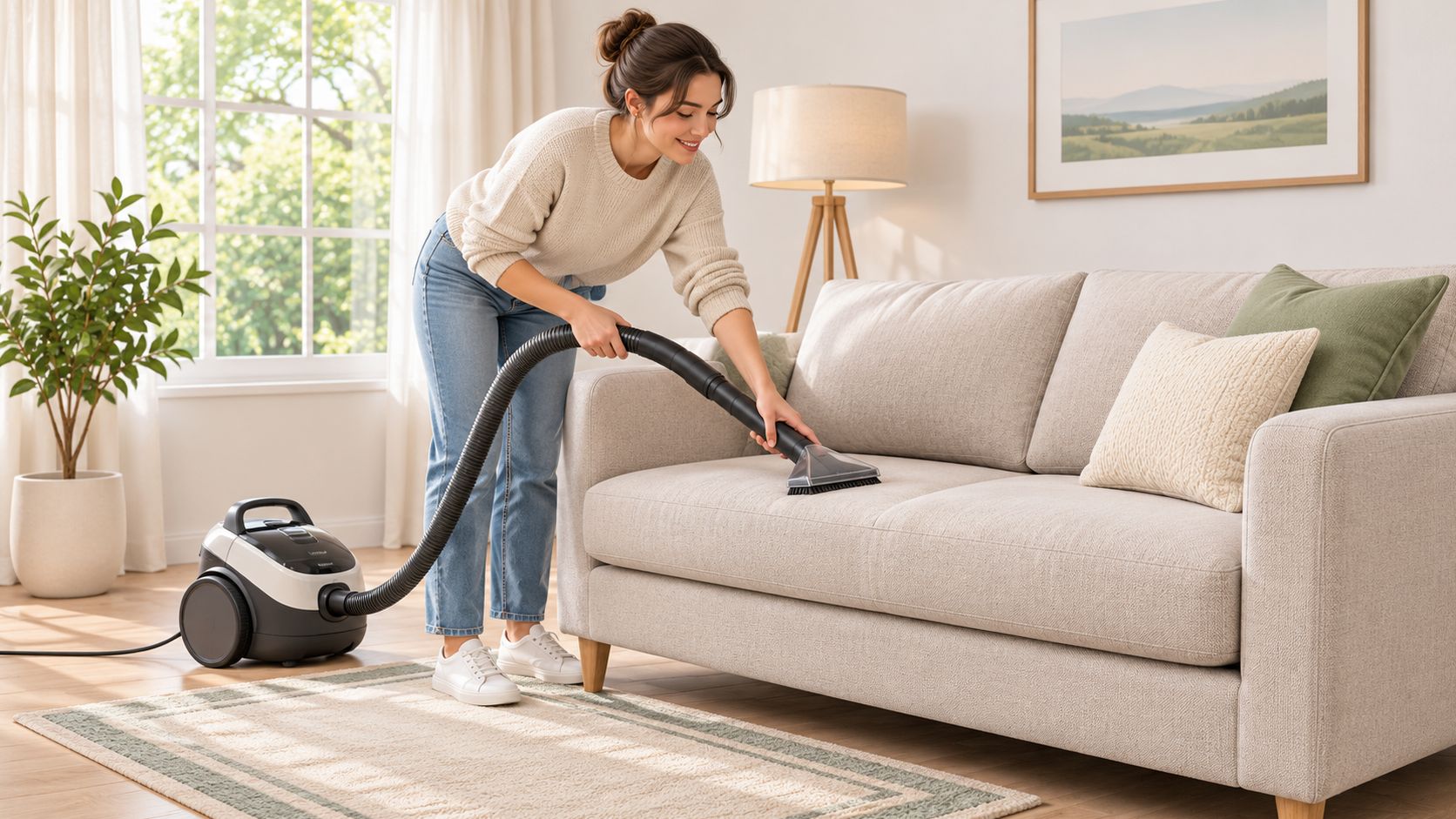
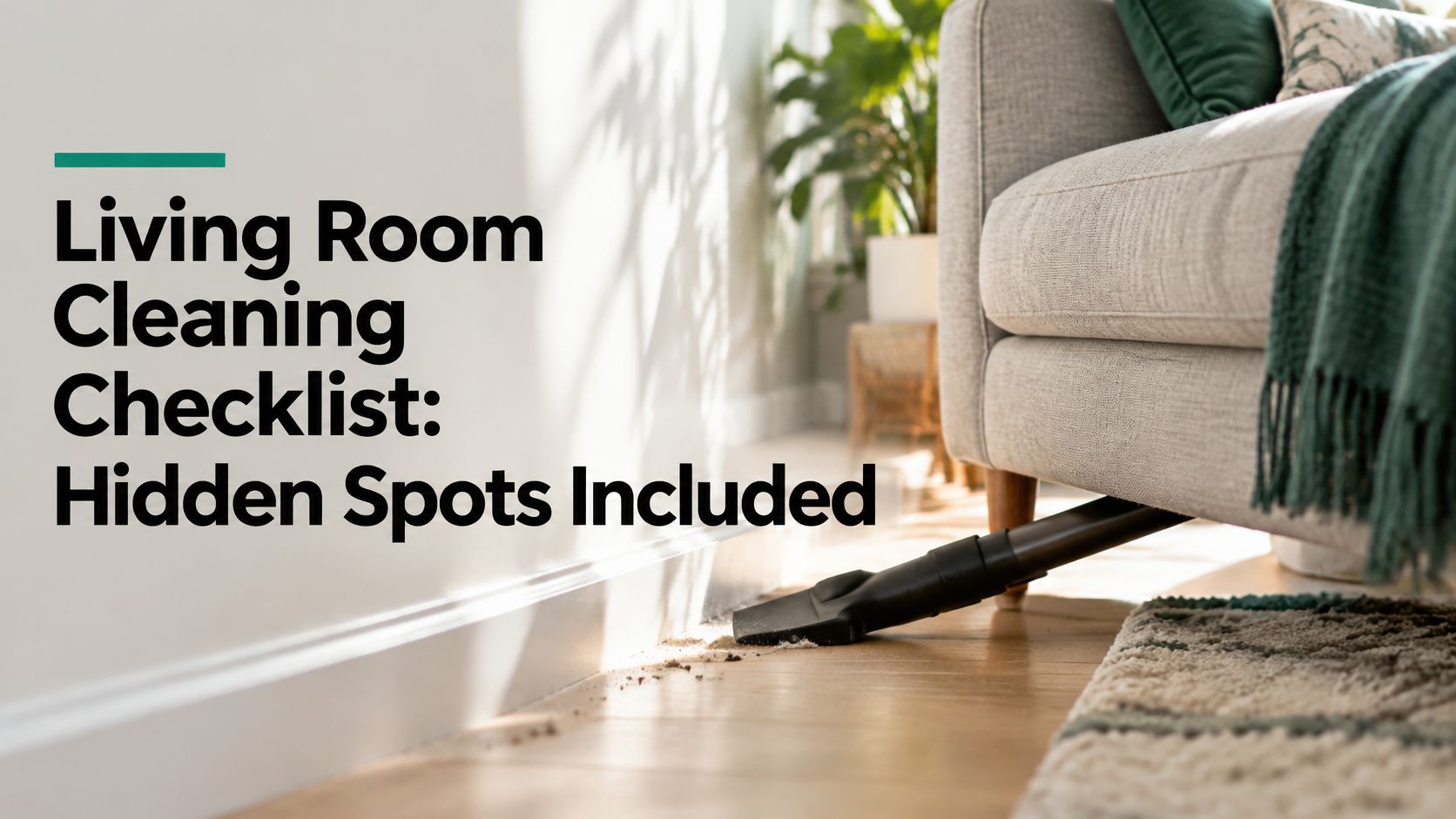
Give upholstery the same seriousness as the floor. Pull the cushions out, run a crevice tool along the deck seams and between the arms and back, then go over the fabric itself with the upholstery head.
The U.S. Environmental Protection Agency recommends vacuuming carpets and furniture every week, or more often, and identifies frequent cleaning as an effective way to reduce indoor dust and allergens, including dust mites and animal dander. That schedule is the baseline for a living room, which usually holds more fabric than any other room in the house.
Why the Filter Changes the Result
A standard vacuum can blow fine particles back into the room as fast as it lifts them. Use a high-efficiency or HEPA-filter machine where you have one, and empty the bag or rinse the filter before suction starts to drop. The EPA also notes that vacuuming stirs settled particles into the air temporarily, so open a window or run the fan, and keep a sensitive occupant out of the room during a heavy pass. Routine cleaning reduces dust mites, pollen, and dander but doesn't eliminate them, so a good vacuuming isn't an allergy cure.
- Two directions per surface: front to back, then side to side. One pass always leaves a striped result.
- Cushions both ways: vacuum the top, flip, and do the underside where crumbs collect.
- Delicate rugs: check the care label first, then test suction on a corner before you commit.
Say a cat sleeps on the same cushion every afternoon. That one spot needs the crevice tool and a slower pass, not a quick swipe, because the hair has felted into the weave. For heavier coats, this method for removing pet hair from fabric covers the tools that pull it out instead of pushing it deeper.
3. Disinfecting High-Touch Surfaces
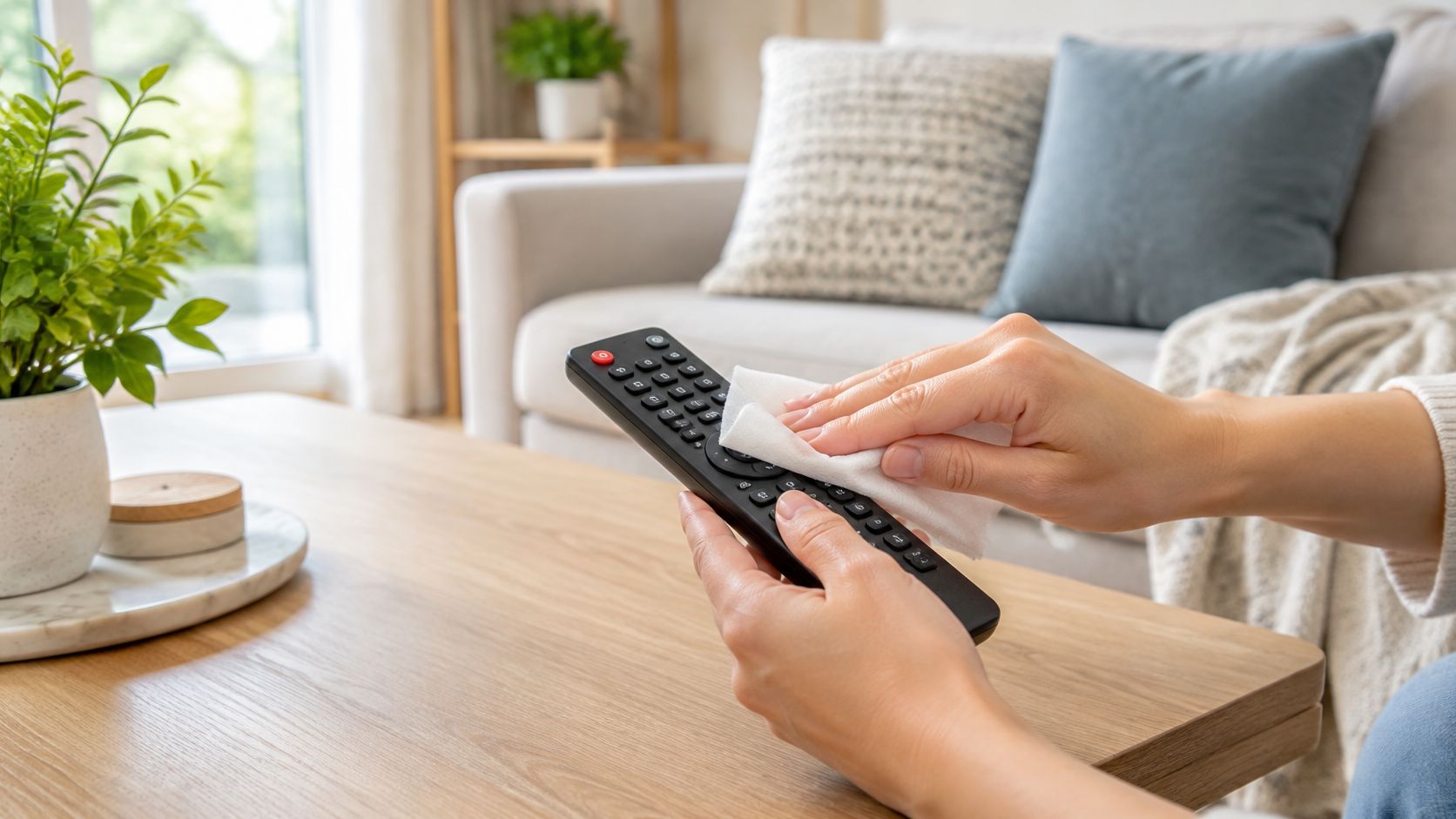
A remote control gets touched hundreds of times a week and disinfected almost never. The high-touch list in a living room is short and almost always skipped: switch plates, door handles, remote controls, the tablet on the coffee table, armrests, and the front edge of the side table. These are also the spots a top-to-bottom pass reaches last, right before the floors, so they fit the route naturally. Clean first to remove soil, then apply disinfectant and leave it visibly wet for the contact time printed on the label. Ten seconds and a dry swipe does nothing useful.
The Air Quality Trade-off
Products do their own work on the room's air. A 2025 peer-reviewed study that monitored two occupied homes over 21 weeks found that professional cleaning raised concentrations of about 60% of the measured volatile organic compounds and 80% of the measured semivolatile organic compounds. Most increases fell back within a few hours, though some lasted more than five.
That shapes the choices, not just the schedule. Pick fragrance-free or lower-emission products where the label allows, skip aerosols, ventilate during and after, and never mix chemicals. Bleach with ammonia or bleach with vinegar produces something you don't want in a living room, and a bowl of water with a splash of this and that is not a cleaner.
A room can smell like citrus and still carry more airborne chemistry than it did before you started.
- Electronics: an alcohol wipe on a remote or a slightly damp microfiber cloth on a screen. Never spray liquid directly onto a device.
- Contact time: set a timer on the first surface. If the label says four minutes, it means four minutes wet.
- Sensitive households: anyone with asthma, chemical sensitivities, small children, or pets can step out during the disinfecting pass.
Work the list in one direction around the room so nothing gets missed. Start at the entry switch plate and finish at the coffee table. A wipe that dries in the caddy between surfaces is fine; a wipe that has dried on the surface before contact time runs out is wasted product.
Keeping this up is less about deep effort than rhythm. This guide to maintaining a clean home lays out the small habits that keep a room from sliding back between bigger cleans.
4. Cleaning Interior Windows and Glass Surfaces
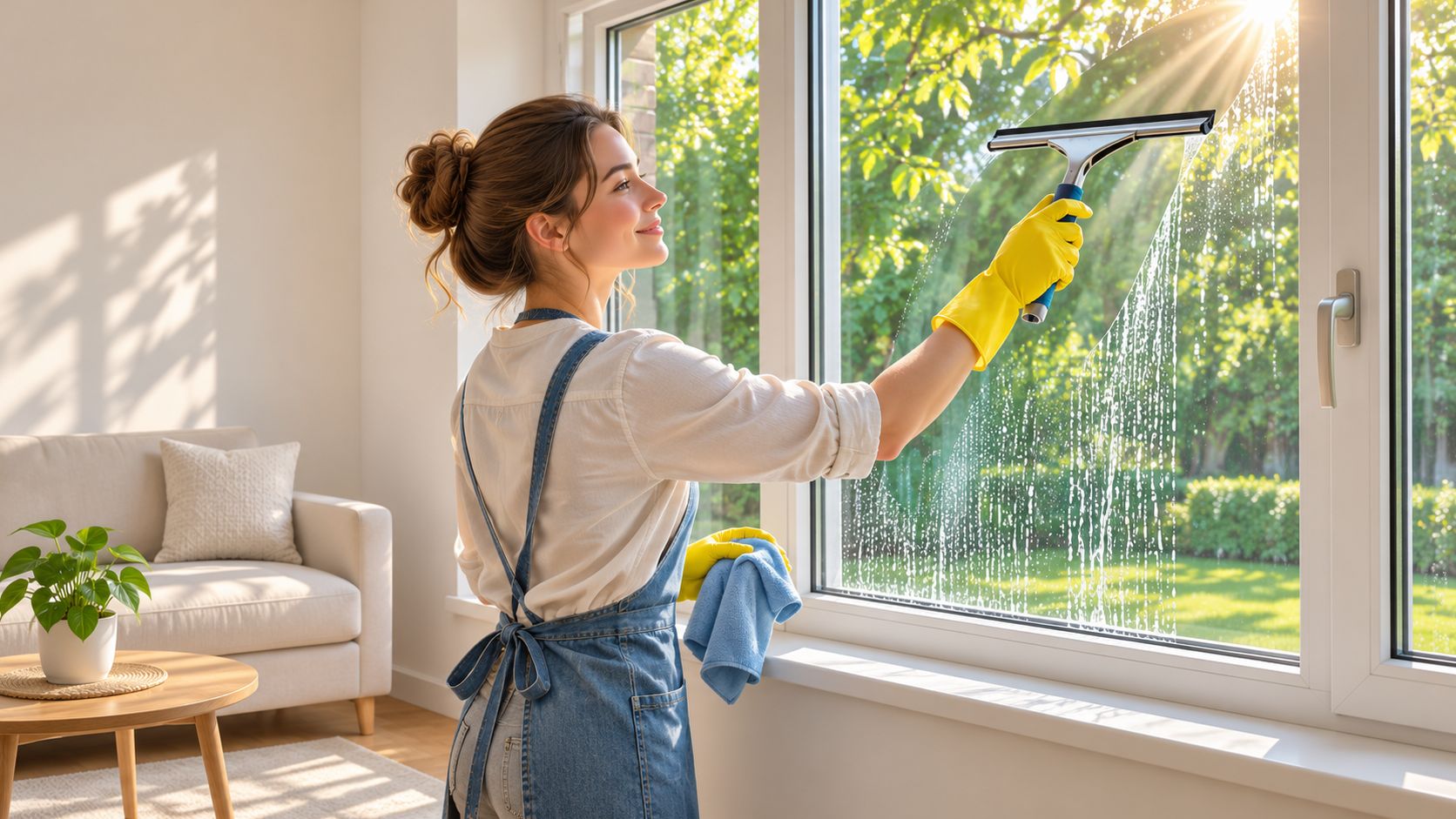
Do the tracks and sills before the glass, and the glass top before bottom. Damp-wipe the sill, dig the track out with a cloth over a flathead screwdriver, then wet the pane and run a squeegee in overlapping passes, wiping the blade dry after every stroke.
Where Interior Glass Actually Gets Dirty
Fingerprints cluster at hand height near the sofa. Condensation film builds on the pane above a radiator or vent, and it looks like haze rather than dirt. A window next to a door that opens all summer picks up a fine outdoor film that a dry cloth just smears around.
Work with a spray bottle and a wet scrubber rather than a rag and a bottle of glass cleaner. The scrubber lifts the film, the squeegee takes it off in one piece, and a dry microfiber cloth finishes the edges and the bottom corners where water pools.
- Squeegee angle: tilt the blade slightly and pull in a straight line. Angling too far just chatters across the glass.
- Protect the floor: a towel at the base of the window saves the wood or the rug from a wet run.
- Mirrors: the same order applies. Top down, squeegee, dry the frame last.
Interior window cleaning is a task worth planning for rather than fitting in. Curtains have to move, sills have to be cleared, and the floor needs protection, which is why many services treat interior glass as an add-on rather than part of a standard visit. If it's been more than a year, do the whole room's glass in one sitting instead of spreading it out. The result reads as a brighter room, not a cleaner one, and that's the point.
5. Baseboard Detailing and Wall Spot Cleaning
Baseboards collect everything the vacuum pushes toward the wall, plus whatever the room's air settles out over a month. Vacuum them first with a brush attachment on the lowest suction that still works, then wipe with a damp microfiber cloth. Skipping the vacuum step means you're dragging wet dust along the paint.
Walls Take Damage Where Hands Land
The spots that show are predictable. Around light switch plates, beside door frames, along the edge where a sofa back touches the wall, and at the height where a chair gets pulled in and out. Test any cleaner on a hidden patch of the same paint first, especially on matte finishes that mark easily. A melamine sponge works on scuffs but it's mildly abrasive, so rub gently and stop as soon as the mark lifts, or you'll leave a dull patch that catches the light.
The work is skipped far more often than it should be. In the 2018 American Cleaning Institute National Cleaning Survey, conducted by Wakefield Research among 1,000 nationally representative U.S. adults, only 10% of respondents named the living room as the room they deep-clean most often, against 46% for bathrooms and 36% for kitchens. Baseboards are exactly the kind of task that lives in the gap between the two.
A baseboard pass takes about ten minutes in a normal-sized room and changes how the whole space reads. It's the cheapest upgrade on this list.
Say you're handing back a rental, or prepping a room before a move-in inspection. Run a damp cloth along every baseboard, wipe the switch plates, and check the wall behind the sofa for rubbing marks. That's the difference between a room that passes a walkthrough and one that gets flagged.
6. Spot Cleaning and Caring for Upholstery Fabric
Upholstery isn't one material, and that's where most damage happens. The tag under the cushion carries a cleaning code, usually a letter: W means water-based cleaners are fine, S means solvent-based only, WS means either, and X means vacuum only. Follow the code, not the bottle.
Blot rather than rub. Work from the outside edge of the stain toward its center so you don't widen the ring, and press with a clean white cloth so you can see what's coming out. Test any product on the back of the sofa skirt or under a cushion and let it dry fully before judging, because some fabrics look fine wet and ring badly the next day.
What Cleaning Can and Cannot Fix
Allergen control is the harder question, and it's worth being honest about it. Indoor allergens commonly include dust mites, cats, dogs, rodents, and cockroaches, and a 2025 review found that studies on specific environmental-control measures have produced mixed results for reducing allergen levels and improving allergy outcomes. Routine cleaning manages visible dirt and reduces some of the load. It doesn't guarantee a symptom-free room, and no honest checklist should promise that.
What moves the needle is targeting the fabric people sit on and the sources that keep feeding it. HEPA-filtered vacuuming on the sofa, washing removable covers according to their care labels, and addressing a damp patch or a rodent problem rather than repeatedly cleaning the marks.
For anything that has soaked through the cover, this method for cleaning vomit from a rug handles the layer below the fabric, which is where the odor lives. Pet accidents follow the same logic: blot up what you can, then use an enzyme treatment that breaks down the protein instead of a fragrance that masks it, and give it the full dwell time before you judge the result.
7. Mopping and Caring for Hard Floors
The floor is last because everything above it has been dropping on it for the past hour. Dry-mop or vacuum first to take up loose dust, then mop with a damp microfiber pad, not a wet one. Wring the mop until it stops dripping, because water is what dulls a finish and finds its way into seams.
Match the Method to the Material
Hardwood and laminate want the least water you can manage and a pH-neutral cleaner. Tile and vinyl tolerate more, but grout lines still want a brush rather than a mop. Stone such as marble or travertine is acid-sensitive, so a vinegar solution etches the surface over time. Steam mops can also void the warranty on some laminate and engineered wood floors, so check the manufacturer's guidance before you plug one in.
- Flat microfiber mops: fresh or freshly laundered pads, one per area, working from the far corner toward the exit so you're not walking on wet floor.
- Two passes on a dirty floor: the first lifts residue, the second evens the finish. A single pass on a greasy patch just spreads it.
- Dry at the end: a dry pad or a clean towel over the hardwood takes up the last of the moisture.
Say you notice a dull patch in front of the sofa where a plant got watered for months. That's often a mineral film, not worn finish, and a damp cloth with a drop of neutral cleaner usually lifts it. If the surface is scratched, no amount of mopping fixes it, and polishing a small area can leave a visible sheen difference. Better to leave it than to make it obvious.
8. Cleaning Blinds, Curtains, and Window Treatments
Window treatments are the last fabric in the room and the one almost nobody touches between seasons. Dust them before the floor pass if you can, or at least dust them before you mop, since every slat you move drops something.
Blinds go slat by slat. A microfiber glove worn on the hand lets you run each slat from the center outward in both directions, top side then underside, and it's faster than a duster and cleaner than a rag. Vertical blinds collect dust on the leading edge and along the top rail. Wood blinds shouldn't be soaked, so a barely damp cloth and a quick dry pass is the limit.
Curtains need the vacuum before the wash. Run a soft brush attachment on the lowest suction down each panel to lift surface dust, holding the fabric taut with your free hand. Check the care label before anything wet touches them: lined drapes, velvet, and anything with a fixed pleat usually go to a dry cleaner, while cotton and polyester panels often machine-wash cold and rehang slightly damp so their own weight pulls the wrinkles out.
Say an apartment sits above a busy road. Exhaust residue builds on slats until a white cloth turns gray after one pass, and those blinds want cleaning more often than the ones in a quiet back room. Greasy kitchen film travels too if the living room is open plan, and a drop of dish soap in a bowl of warm water cuts it where plain water just smears.
How the eight living room cleaning tasks compare
Laying the tasks side by side shows why the order works the way it does. Every task either drops dust downward or lifts it off surfaces, so the pass runs high to low and ends with the floor. Read the order column as a single route through the room: fixtures first, mop last, and everything else slotted so nothing gets re-dusted by the step after it.
| Task | Main Tools | Best Order | Key Caution |
|---|---|---|---|
| Dusting Hard Surfaces, Ceiling Fans, and Light Fixtures | Microfiber cloths or dusters, step stool | First; work from high surfaces down | Turn off fixtures and let them cool; handle tall fixtures carefully |
| Vacuuming Upholstery, Rugs, and Carpet with a HEPA Filter | HEPA vacuum, upholstery attachment, floor head | After dusting and before floor cleaning | Check delicate rug care labels and use a gentle beater-bar setting |
| Disinfecting High-Touch Surfaces | EPA-registered disinfectant, alcohol wipes, microfiber cloth | After general cleaning | Follow label contact time; avoid damaging surfaces or mixing products |
| Cleaning Interior Windows and Glass Surfaces | Glass cleaner, squeegee, lint-free cloth | After dusting; before final floor cleaning | Avoid direct sunlight to reduce streaking |
| Baseboard Detailing and Wall Spot Cleaning | Brush attachment, mild cleaner, microfiber cloth | After dusting; before floor cleaning | Test cleaners first and scrub painted surfaces gently |
| Spot Cleaning and Caring for Upholstery Fabric | Fabric-safe cleaner, clean cloths, specialized foam | As soon as spills occur; before upholstery vacuuming | Check the fabric code and avoid over-wetting |
| Mopping and Caring for Hard Floors | Microfiber mop, pH-neutral or recommended floor cleaner | Last, after dry cleaning tasks | Use minimal water and follow flooring guidance |
| Cleaning Blinds, Curtains, and Window Treatments | Microfiber cloth or glove, vacuum with soft brush | Before vacuuming floors | Check fabric care labels before washing |
Two patterns stand out. First, fabric and care labels drive most of the cautions, on rugs, curtains, and upholstery alike, because a wrong cleaner or too much water costs more than the dirt did. Second, the tools repeat: microfiber cloths, a HEPA vacuum with attachments, and mild cleaners cover nearly every row, so the checklist needs a small kit rather than a closet full of specialty products.
Turn the Checklist Into a Routine You Can Keep
Run the eight tasks in order and the room gets clean in about an hour for a normal-sized space. The order is what makes it fast: nothing you clean gets re-dusted by the step after it.
Not every task belongs in every week, though. Dusting, upholstery vacuuming, switch plates, and floors carry the routine, and they're the ones to repeat weekly or every other week. The heavier items rotate: window treatments once a month or once a season, upholstery spot cleaning as needed plus a full fabric refresh each quarter, and interior glass a couple of times a year unless someone in the house has allergies or a window faces a dusty street.
Clear the clutter before the cleaning starts. Clothing, toys, and paperwork you don't want a stranger reading cost more time than any task on this list.
That's a real trade-off, and it's why the pickup pass matters more than people expect. A sofa covered in laundry takes twice as long to vacuum, and a table buried in mail never gets wiped. Ten minutes of sorting saves twenty minutes of cleaning. Keep a basket for the things that belong in other rooms and empty it at the end rather than walking each item back by hand.
If the schedule is the problem rather than the method, recurring living-area service is what Carmen Family Cleaning is built around, with weekly, biweekly, and four-week options, and any area that doesn't meet the checklist gets re-cleaned at no extra charge. Homes that haven't had a professional clean in more than 30 days usually need the deep version first, since routine upkeep assumes the buildup is already gone.
---
Carmen Family Cleaning serves Milwaukee and the surrounding suburbs, including Wauwatosa, Shorewood, Franklin, and Waukesha, with one-time basic and deep cleans plus weekly, biweekly, and four-week schedules. Living areas get baseboards, ceiling fans, and ledges dusted, carpets vacuumed with HEPA equipment, hard floors mopped, and furniture, surfaces, and light switches wiped, in the top-to-bottom order above. Visit Carmen Family Cleaning to compare the service options and request a flat-rate quote online.