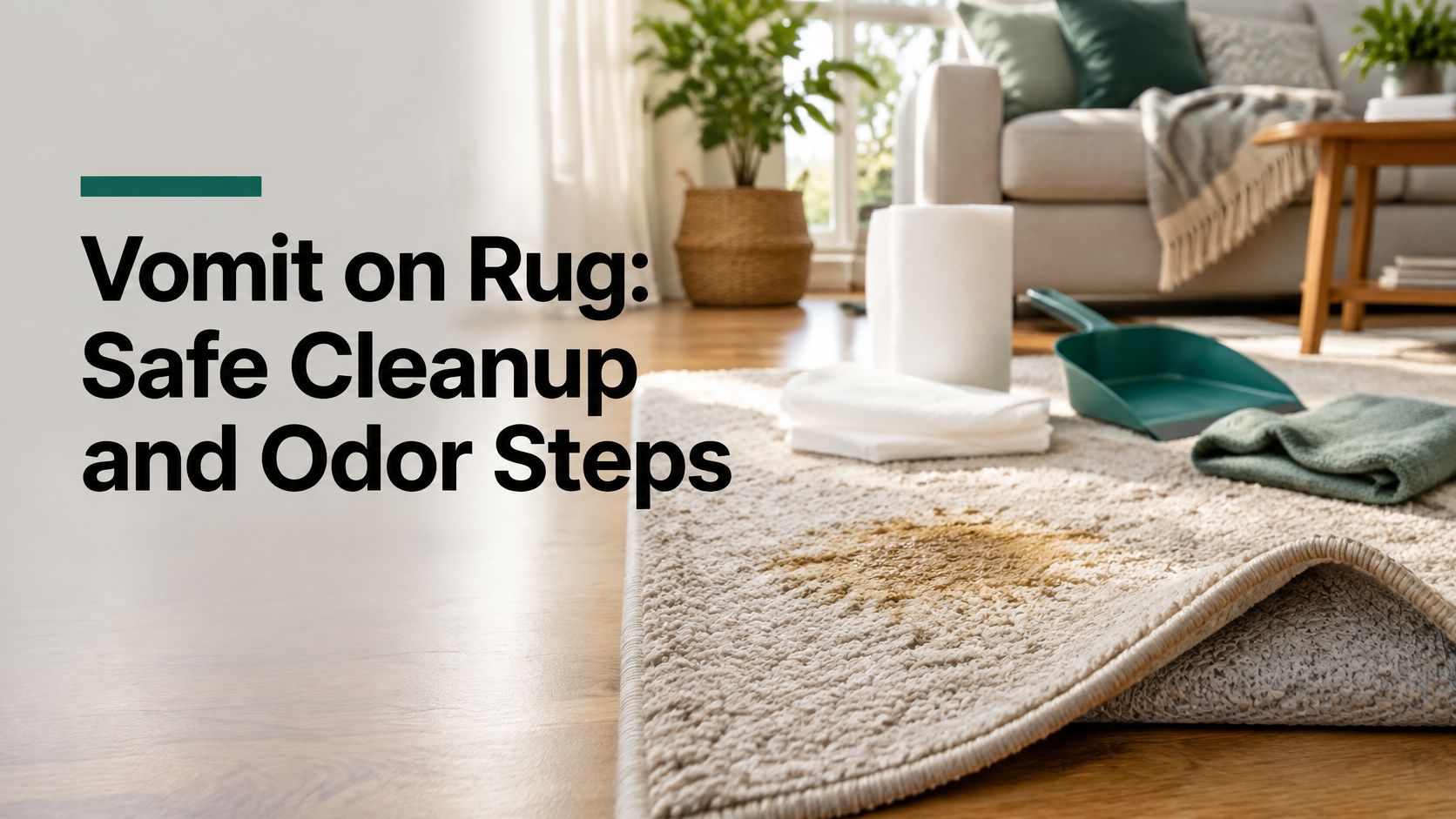
The puddle is smaller than you expected, and that's the trap. A child gets sick on the living-room rug at 2 a.m., you grab a roll of paper towels, and the mess looks contained to an area the size of a dinner plate.
Meanwhile, the dog has walked through it, a toy bin sits two feet away, and the sofa skirt carries a fine spatter you won't notice until morning. By the time you're choosing between vinegar and a carpet spray, the work has already spread past the stain. This is the point where most cleanup goes wrong, and it isn't a scrubbing problem.
What follows is the order a floor-care professional would use. Define the contamination zone first, lift the material without launching it into the air, then treat the smell at the layer where it lives. Jump to the wrong step and you'll push residue into the backing, where no amount of blotting reaches it.
Map the Splash Zone and Check the Rug
Vomit on a rug is a contamination event with a stain attached, and the two need different tools. The stain lives in the fibers. The contamination lives on every surface the droplets reached, a much larger footprint than the wet patch you're staring at. Treat only what you can see and the job fails.
An evidence review commissioned by the U.S. Agency for Healthcare Research and Quality put numbers on that footprint. Simulated vomitus spread across an average two-dimensional area of 44.8 square meters, with an average reach of 3.6 meters in width and 7.7 meters in length from the source, according to the AHRQ review of carpet contamination and disinfection. That is splash and aerosolized droplets landing on flooring, furniture edges and nearby objects, not only the rug fibers directly beneath the event.
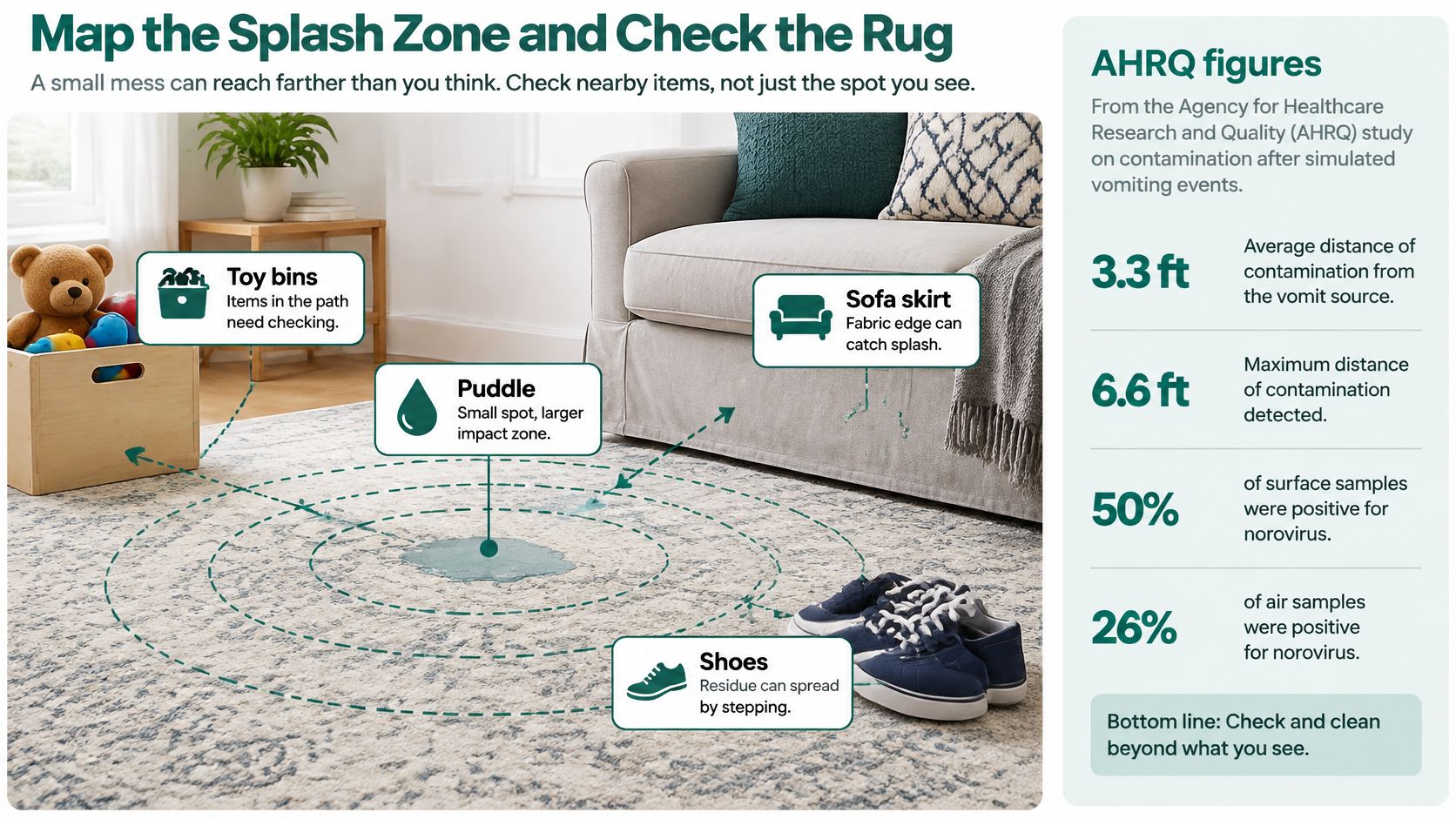
The zone is wider than the puddle
Norovirus is the reason that distinction matters. As few as 18 norovirus particles may be enough to infect another person, and the droplets produced during vomiting can settle on nearby surfaces or reach someone's mouth, as the CDC norovirus review explains. Anything within droplet range, from the remote control to the faucet handle, belongs on the wipe-down list until proven clean.
Not every vomiting episode is norovirus. A child who ate too fast, a migraine, a reaction to a new medication: none of those carry an infection risk. But in the first hour you rarely know the cause, and the safe cleanup covers both possibilities. The visible spot is the center of the job, not the whole job.
Working rule: when the cause is unknown, clean the room, not the spot. Ten extra minutes of wiping costs far less than a second sick person in the house two days later.
Before you kneel down, walk a perimeter and note what sits within droplet range:
- Shoes and slippers pick up residue on the soles and carry it down the hall.
- Floor cushions, throw blankets and pet beds sit at splash height and get handled by the people you're protecting.
- Curtain hems and low furniture edges catch droplets that stay invisible against a busy pattern.
- Door handles and light switches are the hand-off points everyone forgets.
- The bathroom faucet matters if the person rinsed their mouth there.
Read the rug before any liquid touches it
Turn up a corner and check three things: the fiber content on the label, the backing, and whether the rug sits on its own pad or directly on wall-to-wall carpet. Those answers decide how much moisture the rug can take and whether steam belongs anywhere near it.
Washable low-pile synthetics such as nylon, polyester or polypropylene are the forgiving case. They take a light detergent blot, dry reasonably fast, and tolerate steam once the right contact time is met. Wool and silk take cool water and a wool-safe detergent only, because heat and alkaline cleaners can dull or felt the fiber. Rubber-backed and glued rugs get powder and a damp cloth, never a soak, since water trapped against the backing softens adhesive and starts delamination. A rug over wall-to-wall carpet has two layers to treat, and the underlayer is the one that stays wet longest. Antique and hand-knotted pieces get a hidden-spot test and no household disinfectant at all.
More liquid is the usual way a cleanup goes wrong here. Every extra cup of water pushes residue toward the pad, where it dries into a smell that no surface blotting reaches. If the same rug collects animal hair between cleanings, the pet hair removal routine for rugs and upholstery is worth reading before you add liquid to a pile that's already matted. Fiber type drives the tool, and that logic holds no matter where the mess came from.
Pick one row and stay in it
Use this as a decision table, not a menu. Find the row that matches your rug, follow only that method, and respect the stop signal in the last column. Mixing two rows, for example a wool rug plus a liquid disinfectant, is how dye loss and delamination happen.
| Rug | Moisture limit | Disinfect path | Stop if |
|---|---|---|---|
| Washable low-pile synthetic | Light detergent blot, then full dry | Steam about 158°F for 5 minutes or 212°F for 1 minute if illness is suspected | Backing stays wet after a day |
| Wool, silk, or other natural fiber | Cool water and a wool-safe detergent only | No bleach; steam only if the maker allows it | Color bleeds on a white-cloth test |
| Rubber-backed or glued rug | Powder and a damp cloth, no soaking | Skip liquid disinfectants that must dwell wet | Backing peels, cracks, or smells of adhesive |
| Rug over wall-to-wall carpet | Treat both layers; lift the rug | Steam the carpet only if its fiber allows it | Underlay or pad is damp or sour |
| Antique, hand-knotted, or unstable dye | Hidden-spot test, minimal water | No household bleach or unverified disinfectant | Dye transfers or the knot structure softens |
Steam is a fiber decision, not a default
The AHRQ review also tested disinfection on carpet and found steam vapor the most effective approach tested against norovirus and Clostridioides difficile endospores, with results that depended on carpet construction, backing and contact time. The same review reports steam working against feline calicivirus and Tulane virus on carpet with a 15-second contact time, while C. difficile endospore control on one nylon carpet required 120 seconds.
Those are laboratory conditions on specific carpet samples, not a promise about the rug in your hallway. In practice, steam earns its place on a synthetic rug after a suspected stomach bug. It's the wrong tool on a glued back, on wool whose maker forbids it, or on a dye that transfers to a white cloth. Contact time is the part people skip. Waving a steam mop over a spot for three seconds feels productive and meets none of the exposure the testing describes.
How to Lift Vomit Without Spreading It
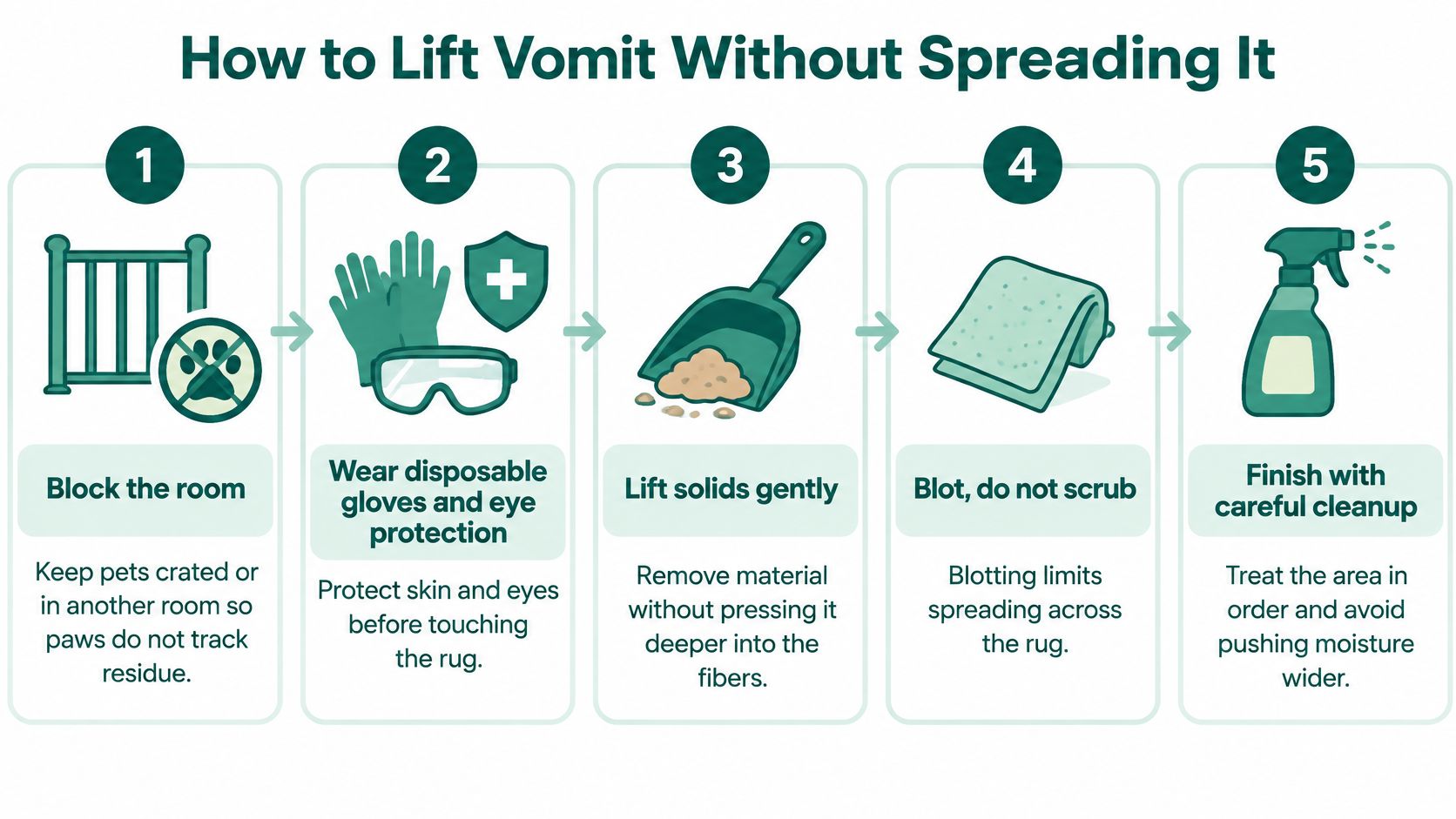
The removal stage has one goal: get the material out of the room without launching it into the air or pressing it deeper. Public-health vomit cleanup procedures from the Oklahoma State Department of Health follow the same low-aerosol sequence: isolate the area, wear disposable gloves and eye protection, skip the vacuum and the aggressive scraping, absorb the liquid, then bag everything.
Build the kit before you start. Paper towels, baking soda or unscented clay cat litter, a dustpan, a sealable plastic bag, mild dish detergent, a white cloth for the hidden-spot test, and a box fan. Two minutes of gathering beats a trail of wet footprints to the kitchen halfway through the job.
1. Block the room. Close the door and crate the dog or shut the cat in another room. Paws and socks track residue onto upholstery and down the hall. Blocking only the puddle is the mistake; close the whole room.
2. Put on disposable gloves and eye protection. Add a simple mask if the person was actively ill during the incident. You'll be leaning directly over the source, and vomiting generates droplets.
3. Cover the wet mass with baking soda or unscented clay litter. Wait until the liquid is visibly absorbed. Pouring is the action; stirring is the mistake, because pressing spreads the material sideways into the pile.
4. Scoop the solids and powder with a dustpan or paper towels into a bag, then seal it. No vacuum at this stage, since agitation aerosolizes particles and redistributes them across the room you just closed off.
5. Blot, don't rub, with dry towels until the towel comes away nearly clean. Rubbing grinds residue into the fiber and drives it toward the backing, which is exactly where you can't reach it later.
6. Mix a small amount of mild dish detergent in cool water. Test a hidden corner first, then work from the outside of the spot inward with a barely damp cloth. Soap applied straight to the center wicks liquid outward and leaves a ring.
7. Blot again with clean water on the cloth, then dry with towels and airflow from a fan. Lift the rug off a soaked pad if you can, because a rug drying flat against wet foam stays damp for days.
8. Disinfect only by a route the rug allows. For a suspected stomach bug, that means steam where the rug's fiber, backing, and care label permit it, or a chemical disinfectant EPA-registered for the pathogen you're targeting and used exactly as its label directs. Chlorine bleach can permanently discolor a rug, so keep it off colored or delicate fibers unless the manufacturer approves it.
9. Wash surrounding hard floors and high-touch points within a few feet, bag the gloves with the waste, and wash your hands with soap and running water for at least 20 seconds.
A visual pass through the same low-agitation approach:
If the vomit has already dried, don't scrub it into the fiber. Dampen the spot with cool water on a cloth, give it a few minutes to soften, then lift the solids with a dustpan or paper towel and rejoin the sequence at the blotting stage. Stay with cool water throughout, because heat sets protein-based residue into the pile.
The four mistakes that undo the work: vacuuming before the solids are gone, over-wetting the backing, reaching for an unverified household disinfectant, and mixing bleach with an acid or with ammonia.
Done looks like this: no loose solids on the pile, no dark wet patch creeping past the original edge, and the room still closed to foot traffic until the surface is dry to the touch. Carry the sealed bag out as soon as it's full instead of parking it by the door. The splash zone should end the job exactly the size it started, with every trace of the spot inside the bag or under the cloth you already threw out.
Stop Odor From Living in the Pad
Another bottle of vinegar is not a plan. Odor that survives a full dry is the exhaust from a source the surface cleaner never reached, and adding more liquid usually makes it worse.
Floor-care guidance from the IICRC carpet care reference explains why. Vomit can contain stomach acid, food and medication dyes that may permanently stain fibers, and because the liquid penetrates well below the surface, the carpet pad or upholstery cushion may need subsurface treatment or even disposal. Blotting works on the pile. It doesn't work on a pad an inch below it.
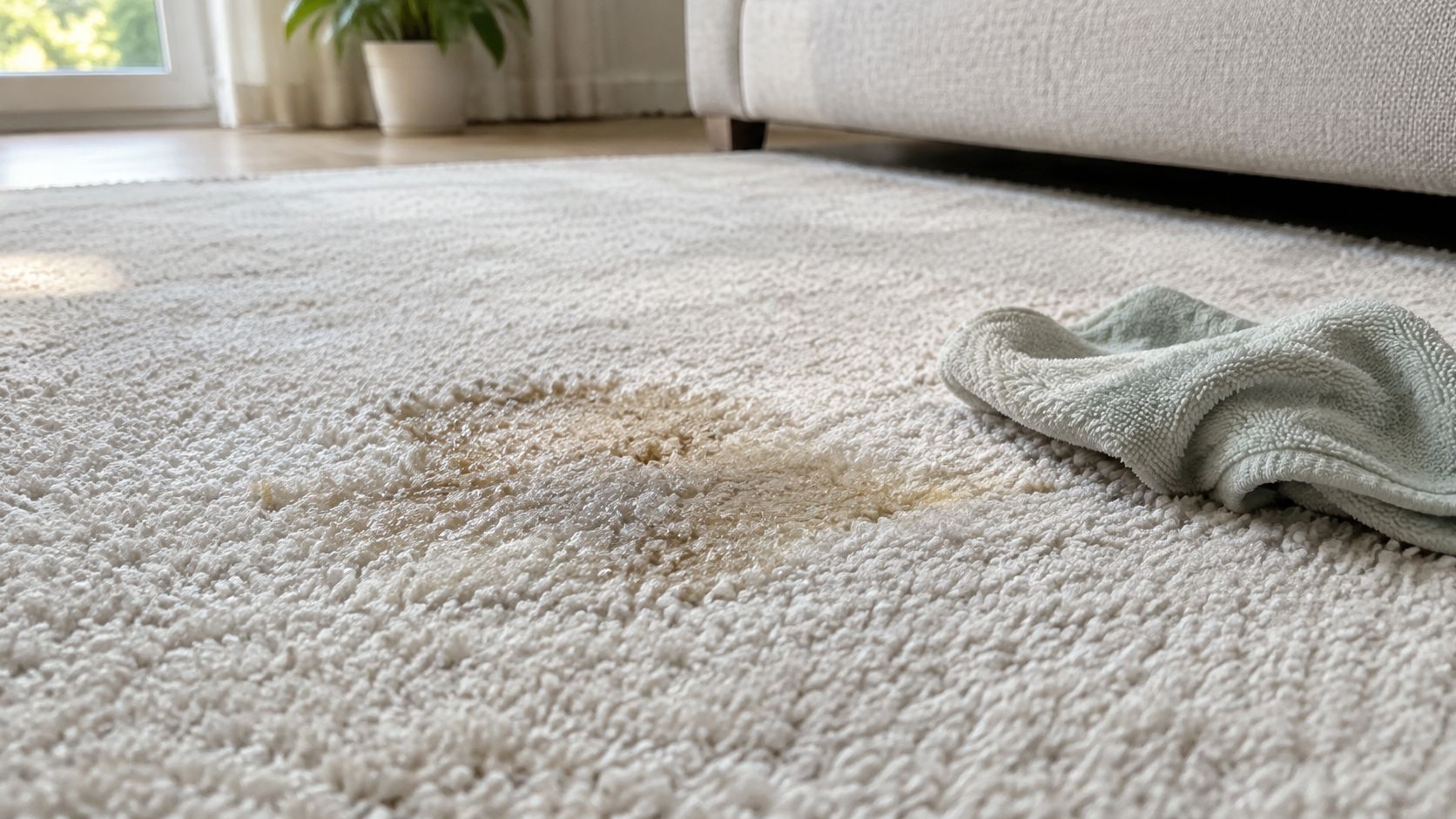
Dry it completely before you judge it. A wet nose can't separate residue from moisture, and the smell of damp fiber reads exactly like the smell of leftover vomit. Run a fan for a full day, prop a loose rug so both faces get air, and only then decide whether there's a problem left to solve.
Once the rug is dry, name what you're smelling.
- Sour and food-like: residue is still in the pile or has soaked into the backing, and the fix is flushing that layer, not masking the surface.
- Musty, like a basement: moisture never left, and microbial growth is now part of the problem. More cleaner adds to it.
- Chemical and sharp: two products are reacting, usually bleach meeting an acid or ammonia. Stop, ventilate, and rinse with plain water.
What I would not do is pour another round of solution on top. Extra water pushes residue deeper into the pad and feeds musty growth in a layer that has no airflow. A light baking-soda dusting on a fully dry synthetic face, vacuumed the next day, can take the edge off a faint smell, but only after the solids and the first powder are long gone. Wool and glued backs never get a vinegar soak.
Odor that returns after the rug has dried completely is a message about the layer under the pile, not about the last product you tried.
The stop point is specific: persistent odor after a complete dry, discoloration that keeps spreading, a backing that delaminates, or a pad that stays damp. At that stage, subsurface extraction or replacement is the rational spend, and another bottle from the pantry is money thrown at the wrong layer.
Fixes When the Stain or Smell Returns
The vacuum is the tool people reach for first and the one that causes the most trouble. Public-health guidance for vomit and diarrheal cleanup from the McLean County Health Department recommends disposable protective clothing, removing solids with paper towels, absorbing the remainder with kitty litter or baking soda, and avoiding vacuuming the contaminated material because it can spread particles. The same guidance calls for washing affected surfaces with soapy water, rinsing, drying, then disinfecting or steam cleaning carpet and upholstery, and it specifies steam cleaning at about 170°F for five minutes.
That guidance also carries a warning worth taping to the machine: visible stain removal doesn't prove pathogen removal, and germs can remain after cleaning. A rug that photographs well isn't necessarily a rug that's safe for a crawling toddler.
Read the row below that matches what you're seeing, then take only that action.
| Symptom | Usual cause | Next action |
|---|---|---|
| Smell while the pile is still damp | Moisture, not only residue | Fans and towels; do not add cleaner yet |
| Sour smell after the face is fully dry | Backing, cushion, or pad | Stop liquids; extract or replace the underlayer |
| Brown ring wider than the spot | Wicking as it dries | Blot the ring edges; keep water minimal |
| Color loss or a new dye mark | Acid, medicine dye, or bleach | Stop chemicals; the fiber may be permanently marked |
| Backing peeling or adhesive smell | Over-wet glued or rubber back | Dry flat and do not steam |
| Someone else gets sick | Possible spread beyond the rug | Gloves, no early vacuuming, clean surfaces within a few feet |
If a second person in the house gets sick, the rug may not be the remaining source at all. Repeat attention on cushions, curtain hems, faucets, light switches and handles within a few feet of where the incident happened, instead of scrubbing the same patch of pile harder. Soft items go in the wash, hard items get wiped, and hands get washed after each pass.
Same-day fixes are unglamorous: more blotting, more airflow, and waste bagged and carried out. The signals to stop are color loss, a peeling back, or illness in a home with an infant, an older adult or an immunocompromised person. Vacuuming waits until the area is fully dry and only loose powder remains, because a vacuum can blow particles around while solids or damp residue are still present.
Decide If the Rug Can Stay
Keep the DIY route only if four things are true. Solids are gone from the pile. A white-cloth test on a hidden corner showed no dye transfer. The backing is intact and not lifting at an edge. And the rug, plus whatever sits under it, is dry with no sour smell.
Fail any one of those and the next call is a rug specialist, not another product. Vomit can penetrate past what blotting reaches, so a pad that stayed wet or a smell that survived a full dry points to subsurface extraction or a new underlayer. For a cheap foam-backed mat that absorbed the spill straight through, replacement is the honest answer, and it usually costs less than the chemicals you'd buy trying to save it.
Then let the room go back to normal. Once the contaminated rug, the pad and the bagged waste are handled, ordinary cleaning can resume for the rest of the home. Our crews bring commercial-grade vacuums, fresh microfiber mop heads and safe sanitizing supplies, so you don't need to buy equipment for the aftermath, and our deep cleaning service is built for the rooms outside the splash zone. One boundary matters here: we don't clean human or animal bodily fluids, feces, needles, active mold infestations, or severe rodent or pest infestations, so the spill itself stays with you or with a specialist.
Finish or stop the rug today, while the decision is still cheap. Then book the routine work only for the rooms the spill never touched.
---
A Milwaukee-area home with a sick-day spill still needs the rest of it kept up, and that's the part Carmen Family Cleaning handles. The team brings its own HEPA vacuums, microfiber cloths and family-safe cleaners, quotes a flat rate before booking, and offers one-time basic cleaning, deep cleaning, and weekly, biweekly or four-week schedules across Milwaukee and the surrounding suburbs. Visit Carmen Family Cleaning to see what each service includes and to pick an available date.