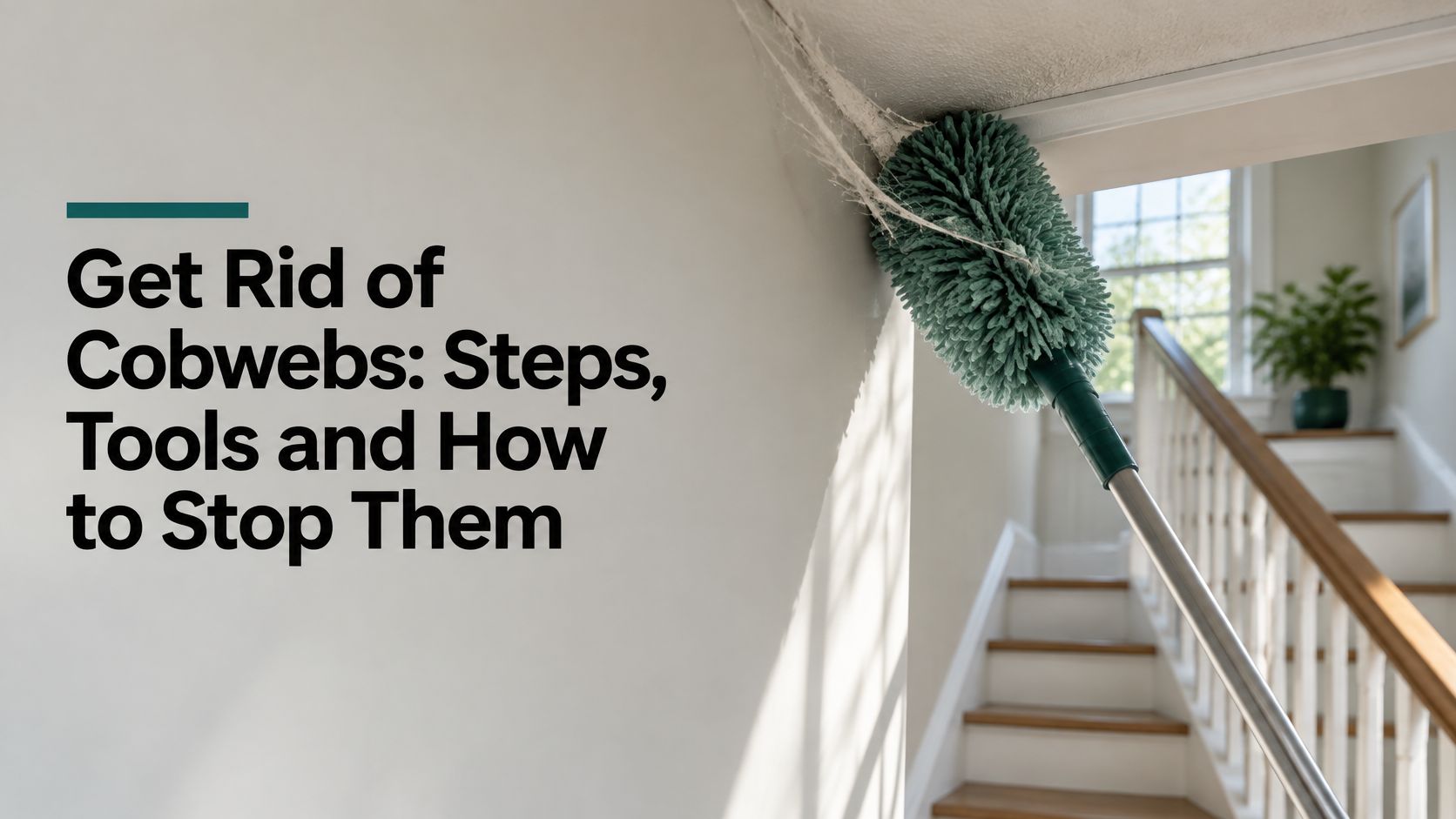
The corner above the stairwell has gone grey again. You knocked the strands down in spring, and now there's a fresh, dust-loaded triangle hanging off the ceiling line, with a second one starting over the window frame. Nothing in the room changed except the calendar.
That pattern is common enough to show up in national surveys. In 2025, 47% of surveyed British consumers said dust, dirt and cobwebs most quickly ruin a cozy atmosphere at home, a figure Samsung published from a Censuswide survey of 10,000 respondents across 10 European countries.
Getting rid of cobwebs in a house with high stairwells is rarely one job. There's the physical work of reaching and capturing what's hanging there, and there's a separate question of why the spot keeps attracting silk in the first place. Treat the first as maintenance and the second as diagnosis, and the webs stop being a monthly surprise.
Tools to Use for Each Cobweb Spot
Walk up your stairs on a Saturday and look at the top corner where wall meets ceiling. Your instinct is to grab the broom from the closet. Don't. A broom pushed into that corner drags half the web down the paint and leaves the rest stuck as a grey smear you then have to scrub.
Part of the confusion is the word. In household use, a cobweb is an old, abandoned web that has collected dust. Biologically, a cobweb is the irregular, three-dimensional structure built by spiders in the family Theridiidae, a group with more than 2,200 species worldwide, as Britannica's overview of spiderwebs explains. The same entry traces the word to the Old English cob, meaning spider.
That distinction decides your tool. A dusty abandoned web is a dust problem sitting above eye level. An active web is silk anchored under tension, often with a spider resting at one edge, and it needs to come away in one piece rather than shred onto the wall.
Cobweb tools by reach and surface
| Tool | Reach | Best surface | Watch out for |
|---|---|---|---|
| Vacuum with crevice tool | Floor level to arm's reach, longer with wand extensions | Corners, baseboards, behind furniture | Works best on dry webs; empty the canister outside |
| Vacuum with soft brush | Floor to shoulder height | Wall edges, vents, window frames | Use low suction on painted or delicate finishes |
| Telescoping microfiber duster | Floor to ceiling with the extension pole | Ceilings, stairwells, top of fixtures | Work from high to low so falling dust is caught |
| Damp microfiber cloth | Hand reach | Ledges, trim, light switches | Dampen the cloth; a dry cloth lifts settled dust |
| Broom or dust mop | Floor level | Not recommended for webs | Leaves webbing and egg sacs behind |
Brooms, feather dusters and dust mops fail in the same way. They knock webbing loose without capturing it, so strands fall across ledges and onto floor you already cleaned, while the egg sacs tucked into the seam stay exactly where they were.
The reach rule: if you'd have to move a step stool to get to it, you're holding the wrong tool.
Pick the tool that reaches the spot from the floor. Climb only when no extension gets there, and when you do climb, take a vacuum wand with you rather than a cloth.
How to Remove Cobwebs Step by Step
A normal room with a handful of webs takes ten to fifteen minutes. The order of work matters more than the effort, because dust you knock loose at the wrong moment lands on a surface you've already finished.
Here's the sequence at a glance before the detail.
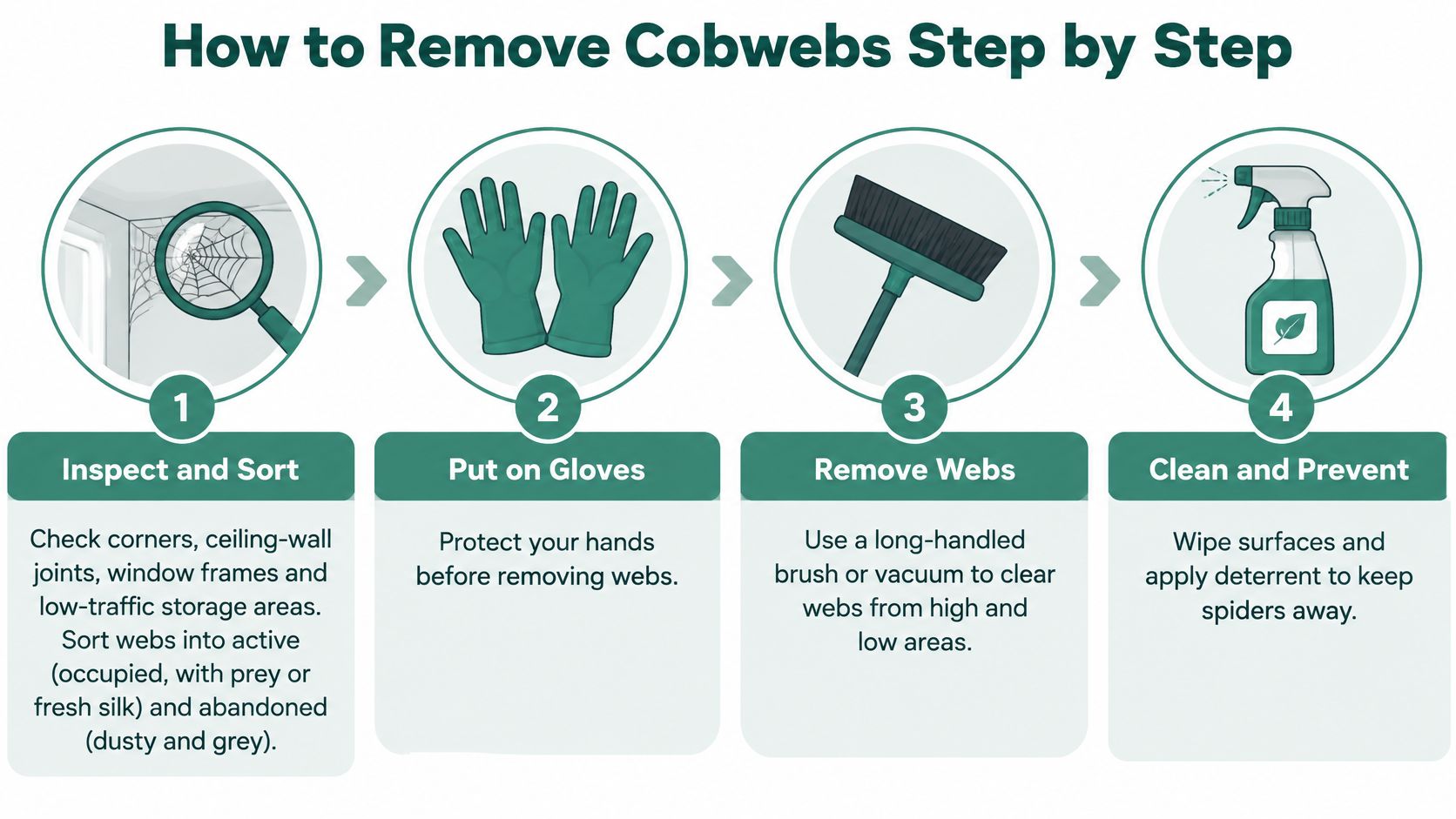
1. Inspect and sort. Check corners, ceiling-wall joints, window frames and low-traffic storage areas. Sort what you find into active webs, which have fresh silk and often prey wrapped nearby, and abandoned webs, which are grey and heavy with dust.
2. Gloves on, eyes first. Look into dark corners with a torch before your hand follows. Spiders and egg sacs cluster in seams and behind stored boxes, and a blind reach is how people get bitten or startled into dropping something.
3. Vacuum from the top down. A crevice tool on the wand pulls the web, the spider and any egg sacs into the canister in one pass. The University of Maryland Extension guide to spiders recommends vacuuming webbing for exactly this reason, because cloth dusting, dust mops and brooms often leave biological material attached to the surface.
4. Switch to the telescoping duster for ceilings. Sweep the head in one direction rather than scrubbing back and forth. One-direction passes wrap the strands around the microfiber instead of flicking them into the air, which matters on stairwell walls you can't wipe afterward.
5. Damp-wipe everything adjacent. Ledges, trim, light switches and window sills hold the dust film the web sat in. Rinse the microfiber cloth after each area so you're lifting dust rather than redistributing it, and keep the cloth damp, since a dry one puts settled particles back into the air.
6. Finish the floor and the baseboards. Vacuum the drop zone under the work area, then empty the canister outside the house. Egg sacs and live spiders in an indoor bin relocate the problem to the room where you store the bin.
7. Ventilate and skip the spray. Open a window for ten minutes. Removing webs is a mechanical task, and no aerosol improves on a crevice tool.
Where the work usually goes wrong
Working bottom-up is the most common slip, because you spread dust across sections you've already cleaned and have to repeat them. Reaching blind into a storage box is the second, and it's the one that ends with a spider on your wrist.
Ladder safety: use a stable step stool with a rated weight limit, never a dining chair or a bucket. Keep one hand on the frame and move the stool rather than overreaching. If a ceiling needs a full ladder and a second person to steady it, that's a job for a crew.
The result to aim for is unglamorous: a corner with no visible strands, no dust film on the trim beneath it, and no egg sacs left in the seam. If you're rebuilding a whole routine rather than chasing one corner, work from a house cleaning checklist so the high spots stop being the ones you skip.
Why Cobwebs Keep Coming Back
Here's the finding that should change how you plan this work: one-time sweeping or vacuuming has only marginal effects on spider numbers, while repeated removal combined with broader pest management looks more promising. A single pass improves how a room looks. It rarely changes how many spiders live there.
The reason is that webs are a symptom. North Carolina State University Extension reads numerous indoor spiders as a sign of ample food supply and points to sanitation, moisture reduction, exclusion and vacuuming of corners, baseboards and the gaps behind furniture.
Cleaning changes how the corner looks. It rarely changes how many spiders are using it.
Recurring cobweb spots, causes and fixes
| Recurring spot | Likely cause | Fix |
|---|---|---|
| Near windows and doors | Gaps in seals, insects drawn to lights | Seal gaps with caulk or weatherstripping; use warm-toned outdoor bulbs |
| Basement or crawlspace | Humidity, clutter, stored boxes | Run a dehumidifier, lift boxes off the floor, clear clutter |
| Garage or eaves | Outdoor insect activity, debris | Clear leaves and debris, sweep eaves, check outdoor lighting |
| Ceiling corners in kitchens and bathrooms | Steam, dust and food residue | Ventilate after cooking and showers, dust corners monthly |
Read the pattern before you reach for the duster. Webs that return beside a window or a door frame point to a gap in the seal and to insects gathering at the light outside it. Webs in a basement or crawlspace point to damp air and cardboard boxes stacked against a wall. Webs in a garage or under the eaves usually reflect outdoor insect activity rather than a dirty interior, and no amount of indoor cleaning will settle those.
The decision rule
Cleaning alone is enough when webs are old, dusty and scattered across different rooms. That's normal turnover, not an infestation.
Sealing or moisture control comes next when a web rebuilds in the same spot within a week or two. Something is feeding or sheltering there, whether that's a gap under a sill, a leaking downspout or a stack of boxes holding damp.
Call a pest professional when webs turn up with egg sacs attached, or when you're seeing a steady stream of insects alongside them. Indoor residual sprays are a poor default here, since they may not deliver long-term spider control and they leave residue on surfaces your household touches. Fix the access and the food, not just the silk. If routine upkeep is where this keeps falling apart, the habits in this guide to maintaining a clean home close more of the gaps than a bigger cleaning day does.
Safe Methods When Allergies, Pets or Egg Sacs Are Present
Say the house has a toddler in it and an adult with a dust allergy, and one corner of the living room needs clearing before guests arrive. The web itself is not the problem. What comes off it, and where that material lands, is the problem.
Cleaning for allergy-sensitive rooms
Webs are sticky, and they hold whatever drifts past them: dust, dander, pollen and the fine particles floating through a room all week. A web is a record of what your air was carrying, which is why you remove it carefully instead of swatting it loose and letting that material resettle on the furniture below.
- Use filtration: fit a HEPA-filter vacuum and run it on the crevice tool rather than a brush, so fine material goes into the machine instead of back into the room.
- Clear the room first: keep the allergy sufferer, young children and pets out while you work, and let the vacuum settle before anyone returns.
- Ventilate afterward: even a good filter can leave a brief rise in airborne dust, so give the room ten minutes with a window open.
- Wipe, don't flick: a damp microfiber cloth on the ledge under the web catches the fall-through that vacuuming misses.
Egg sacs, pets and live spiders
Don't crush an egg sac against the wall. Vacuum it, then empty the canister into an outdoor bin, because a sac smeared into paint leaves staining and silk fragments behind. The National Pesticide Information Center recommends vacuuming webs and egg cases, checking dark corners before you put a hand in, and sealing the gaps around doors and windows; the same guidance cites USDA research showing that cobweb, cellar and funnel spiders prey on brown marmorated stink bugs indoors and out.
That last point explains why egg sacs matter more than the web does. A web you can clear in seconds, but a sac means the spider found enough food and shelter to breed, which points back to moisture, clutter or an entry gap feeding the spot. Removing the sac ends the current cycle. Closing the gap and drying the corner is what stops the next one.
For pet owners, the practical rule is no sprays in the corner at all. Residue settles onto floors and ledges at exactly the height a crawling child or a cat investigates.
Relocation deserves a mention. A single harmless cobweb spider in an open room is easier to catch in a cup and slide onto a card than to chase with a vacuum, and it's doing some pest control for you.
Rule of thumb: remove the web and the egg sacs, keep the room clean, and stop there unless the activity keeps growing.
Room-by-Room Schedule to Keep Webs Away
Webs come back fastest where spiders find food, moisture and shelter, so a working schedule concentrates on high corners, quiet storage and anything that faces the outdoors. Floors get the attention because the dust on them is visible; an Ecovacs survey of 1,000 U.S. consumers found Americans spend under an hour a week on vacuuming, mopping and sweeping, and that floor time is where the whole cleaning budget tends to go. The corners overhead rarely make the list.
Cobweb cleaning schedule by area
| Area | How often | Task | Why it webs first |
|---|---|---|---|
| Living room and bedroom corners | Every 2 weeks | Vacuum corners, ceiling edges and behind furniture | Still air and undisturbed shadows behind furniture |
| Bathroom ceiling and fixtures | Monthly | Dust fan blades and light fixtures, wipe edges | Humidity draws small insects, and spiders follow |
| Kitchen corners and cabinet tops | Monthly | Dust tops and corners, wipe with a damp cloth | Warmth and cooking odors attract flying prey |
| Basement and storage areas | Monthly | Vacuum corners and joists, lift boxes off the floor | Stacked boxes give spiders anchor points and cover |
| Garage and porch | Monthly | Sweep eaves and corners, check outdoor lights | Direct line in from outside through the house's largest gaps |
| Stairwells and high ceilings | Quarterly | Telescoping duster from the floor, vacuum edges | Out of reach, so webs build undisturbed |
| Outdoor entry lights and door frames | Every 4 weeks | Wipe frames, remove webs from fixtures | Night lights pull insects straight to the doorway |
The ten-minute pass
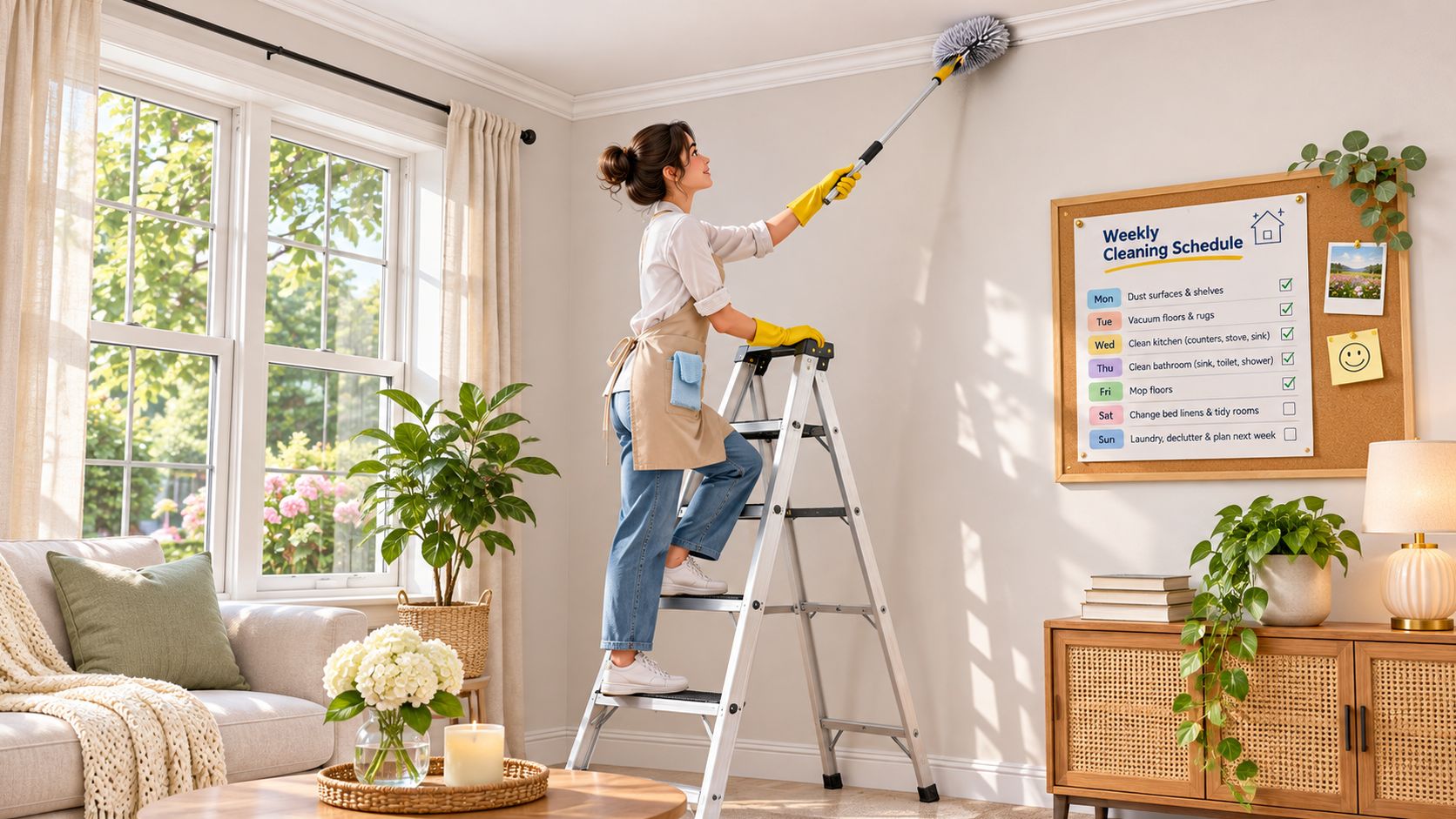
Keep a small kit staged by the door: a telescoping duster, a crevice vacuum attachment and a couple of microfiber cloths. The monthly pass then runs about ten minutes per room, because nothing has to be fetched or assembled before you start. Stairwells and high ceilings get worked from the floor with the extension pole, which is faster and safer than hauling a ladder up the steps.
The sign the schedule is working is not a web-free house. It is thin, pale strands instead of dense grey ones, and no egg sacs appearing between passes. Dense grey silk means a web has been maintained for weeks, while pale strands mean a spider moved in recently and your interval is still beating it.
Here's a short walkthrough of the high-corner technique if you want to see the motion:
Frequency beats intensity here. A weekly cleaning list covers the two-week and four-week rows automatically, and the quarterly stairwell pass slots in on top of it. That routine does more than a seasonal deep clean, which just lets six months of silk accumulate before anyone looks up.
Confirm Your Routine or Call a Cleaning Crew
Two weeks is the test. If the same corner is webbed again inside that window, the cause hasn't changed and cleaning it a third time won't either. Go back to the cause table, check the seal, the humidity and the clutter, and fix that before the next pass.
Then decide whether the job fits your tools and your reach. A single corner or a low ceiling is straightforward with a telescoping duster and a crevice tool. A multi-room sweep with stairwells, cathedral ceilings or years of buildup is a different job, and it's the point where a step stool stops being enough.
If you hire, ask one question first: does the crew bring its own vacuums, microfiber and supplies, or are you expected to provide them?
Carmen Family Cleaning brings commercial-grade vacuums, fresh microfiber mop heads and safe sanitizing supplies, so there's nothing to buy or stage before an appointment. Homes with heavy buildup, extensive pet hair or undisclosed biohazards may need additional labor time and an adjusted flat rate, always authorized with you beforehand. You don't need to be home during a recurring weekly cleaning, which matters for stairwells and high corners that are easier to clear in an empty house.
When you book, describe the ceiling heights and point out the corners with heavy buildup. A deep clean at $355 is priced for the labor the work takes, and an accurate description keeps the quote honest. If the buildup goes beyond routine webs, this explanation of what a deep clean includes will tell you which service fits.
---
High corners, stairwells and the tops of cabinets are the spots that get skipped for months, and they're exactly where a recurring cleaning schedule earns its keep. Carmen Family Cleaning handles the reach, the filtration and the detail work on a weekly, biweekly or monthly plan across Milwaukee and the surrounding suburbs, so the webs don't get a head start between visits. Visit Carmen Family Cleaning to price a one-time clean or set up a recurring appointment.