If a home looks tidy but dust sits along the carpet edges and soap scum coats the shower, does it need more frequent cleaning or a different kind of cleaning? That's the gap in most discussions of deep cleaning vs regular cleaning: effort alone doesn't tell you whether the work matches the problem.
A useful cleaning plan accounts for buildup, household exposure and timing. It also separates removing soil from disinfecting surfaces, without assuming that stronger products or a longer appointment automatically make a home healthier.
Deep Cleaning vs Regular Cleaning at a Glance
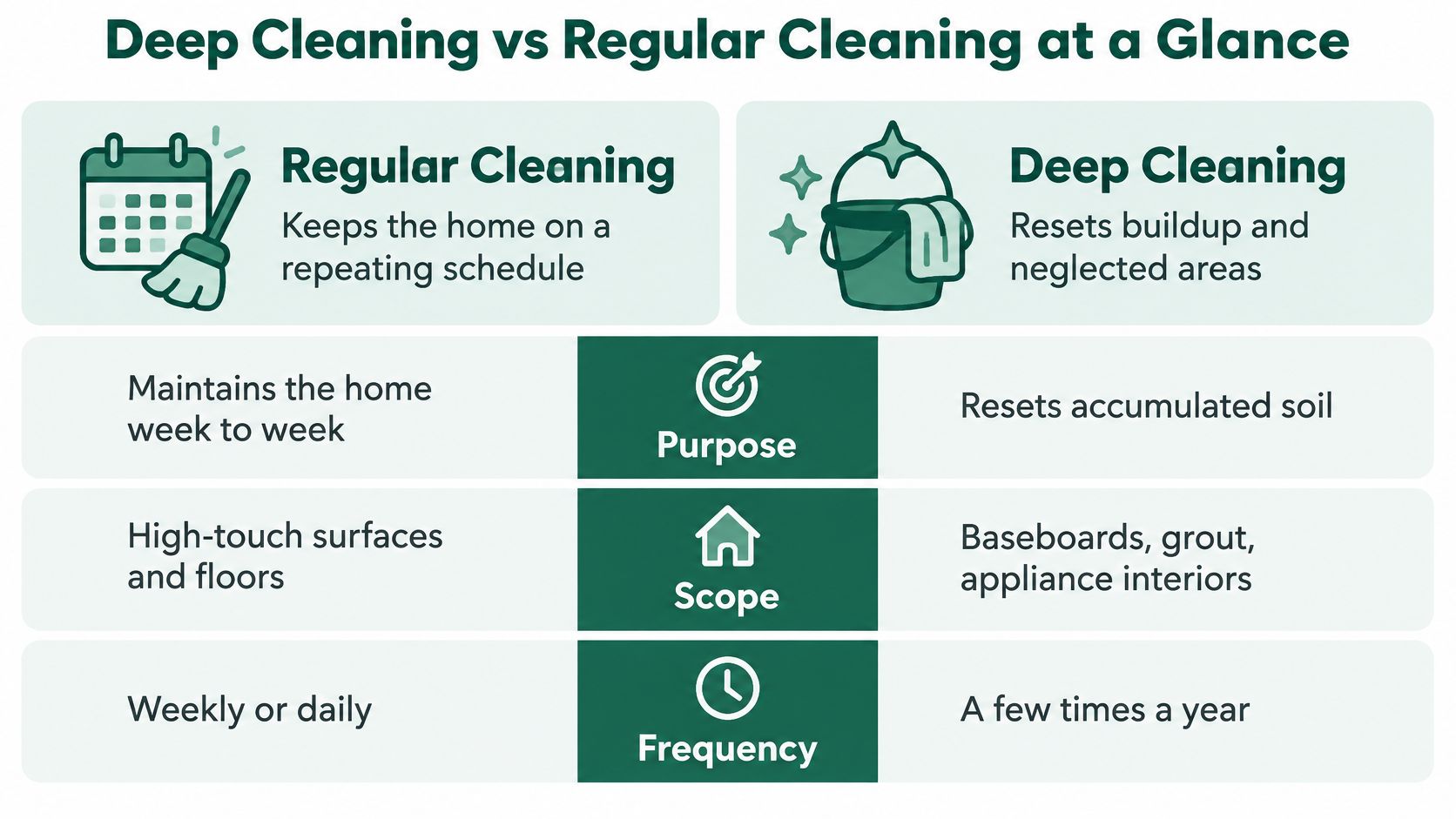
Regular cleaning maintains a home on a repeating schedule, while deep cleaning resets accumulated buildup and neglected areas. Neither service is universally better. The right choice starts with what needs removing, not how impressive the service name sounds.
Regular cleaning and deep cleaning compared
| Factor | Regular Cleaning | Deep Cleaning |
|---|---|---|
| Main purpose | Keeps high-touch and visibly soiled areas under control | Resets accumulated buildup and neglected detail |
| Scope | Living areas, kitchen and bathrooms on a repeating rhythm | Adds detailed work on baseboards, ceiling fans, appliance interiors, grout, fixtures and low-traffic surfaces |
| Typical frequency | Weekly, biweekly or every four weeks | Once at the start, after a long gap, or after a major change |
| Time required | Shorter, predictable visit | Longer, multi-area visit; hours depend on home size and condition |
| Price pattern | Flat rate per visit | Higher flat rate reflecting the additional scope |
| Disinfection | Not automatic; separate step when illness is present | Not automatic; separate step using the product label contact time |
The distinction is easier to understand when you compare the purpose and coverage side by side.
The work changes, not just the appointment length
A maintenance visit might remove fresh cooking splashes from a stovetop. A reset may require loosening hardened grease around its edges, cleaning removable components and treating adjacent buildup. Those jobs require different preparation and more deliberate mechanical work.
The same distinction applies to a bathroom. Wiping an already-maintained vanity isn't comparable to removing deposits around faucet bases or scrubbing accumulated film from shower tile. Giving a cleaner more rooms to cover doesn't automatically make the appointment a deep clean.
Service boundaries also matter. Appliance interiors, interior windows and intensive baseboard detailing may be selected separately rather than included automatically. A room name on a checklist doesn't tell you whether the cleaner will wipe an accessible surface or restore a heavily soiled one.
At Carmen Family Cleaning, routine services can include dusting baseboards and ceiling fans, along with bathroom grout work. Those surfaces aren't exclusive to deep cleaning. The condition of the surface and the intensity of the work distinguish maintenance from a reset.
Choose the service that addresses the home's current condition, not the one with the longest checklist.
What Regular Cleaning Covers and Why It Matters
Regular cleaning is ongoing contamination control, not an abbreviated attempt to detail the entire house. It keeps the surfaces people repeatedly touch, use and walk across from being neglected between larger projects.
The CDC's household cleaning guidance recommends regularly cleaning frequently touched surfaces, including doorknobs, tables, handles, light switches, countertops, toilets, faucets, sinks and electronics, including after visitors. Other surfaces should be cleaned when visibly dirty or as needed.
What a practical maintenance visit includes
An effective visit follows a repeatable route rather than jumping between unrelated tasks:
- Living and sleeping areas: Dust accessible furniture and ledges, then wipe frequently handled surfaces and switches. Apply cleaner to the cloth rather than spraying electrical fittings directly.
- Floors: Vacuum carpets and rugs, including accessible edges, and mop hard floors with a product suited to the finish.
- Kitchen and bathrooms: Wipe counters and sink basins, appliance exteriors, the stovetop and backsplash. Clean toilets, mirrors and other agreed bathroom surfaces with separate cloths.
- Waste and finishing checks: Empty wastebaskets and inspect handles, faucet bases and other easily missed touch points.
Our weekly cleaning list helps turn that scope into a manageable household routine. Between appointments, deal with spills and obvious soil rather than leaving everything for the next scheduled visit.
A standard appointment shouldn't be overloaded with oven restoration, neglected fan blades or extensive deposit removal. Light dusting and routine grout care can fit maintenance; entrenched buildup needs its own allocation of work.
Cleaning isn't the same as disinfection
Cleaning removes dirt and some germs. Disinfection uses a product intended to kill remaining germs. The distinction matters when someone is sick or an infected person has recently visited, rather than treating every surface as though it always needs disinfectant.
Keep cleaning cloths separated by task, and don't use a toilet cloth on a vanity or kitchen counter. For electronics, use a method compatible with the manufacturer's instructions instead of saturating the surface.
Our standard cleanings are intended for routine upkeep once deep buildup has been removed. They preserve a manageable starting condition; they aren't designed to recover every neglected area within a maintenance appointment.
What Deep Cleaning Resets and When It Is Due
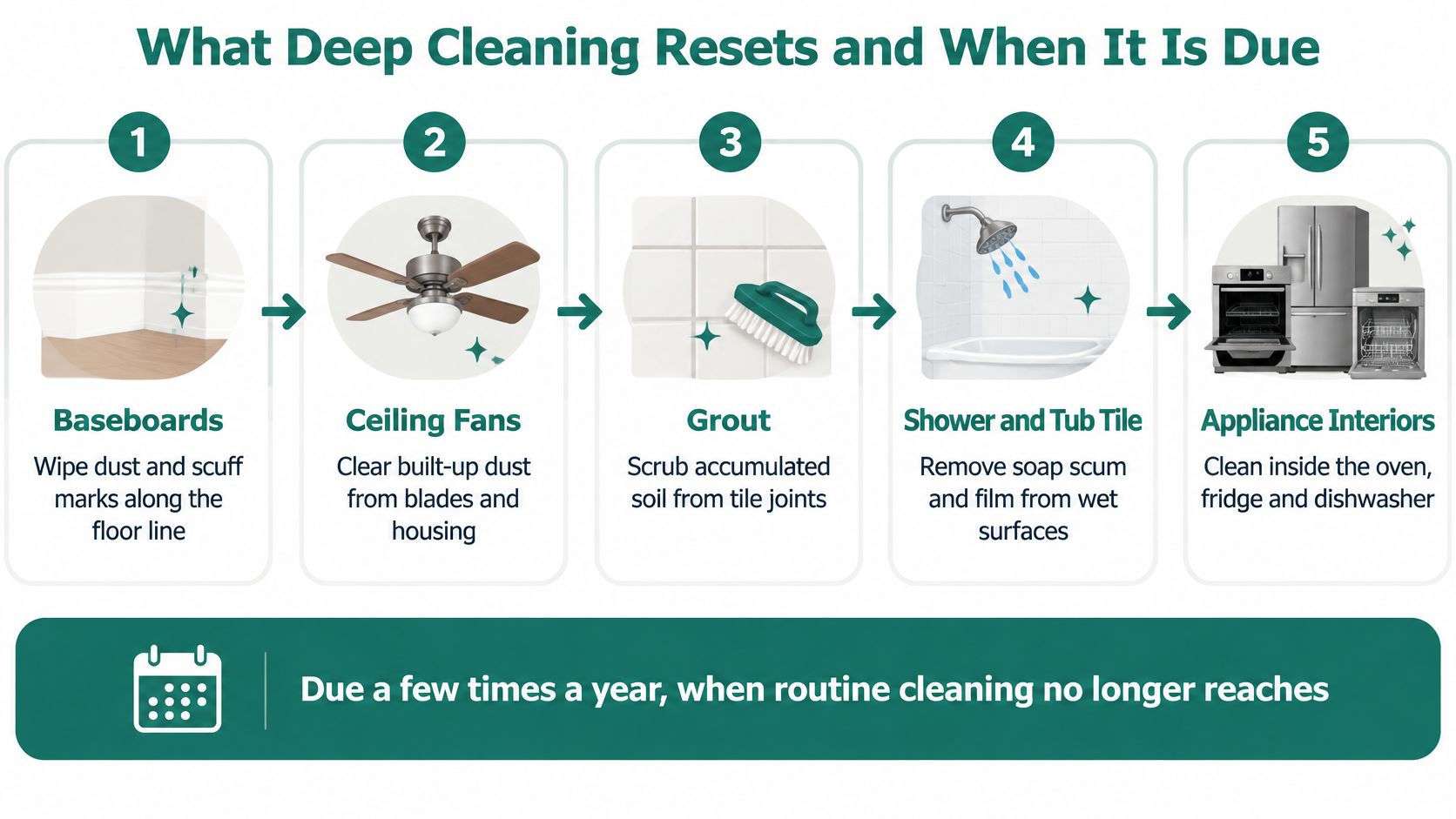
Book a deep clean when accumulated soil requires more than routine wiping, or when the home is entering a different phase of use. We recommend it for first-time visits or homes not professionally cleaned in over 30 days. That's our service recommendation, not a medical threshold.
Moves, renovation, prolonged cleaning gaps and heavy occupancy can all justify a more extensive reset. After a moisture event, cleaning must also be paired with attention to the underlying water problem. Cosmetic work won't resolve an active leak.
These detail areas are useful starting points for inspecting a home before booking.
Use a deliberate working order
1. Remove visible soil first. Use soap or detergent appropriate to the material before considering disinfection. The CDC's cleaning and disinfecting guidance explains that dirt can interfere with disinfectant effectiveness and that products must remain on surfaces for their specified contact time.
2. Work from high surfaces toward floors. Clear fan blades, ledges and reachable vent covers before finishing lower surfaces. Capture dust with a cloth or vacuum attachment rather than brushing it into the room.
3. Detail the buildup zones. Address baseboard profiles, grout joints, shower film, accessible fabric and floor edges. The EPA identifies HEPA vacuums as capable of capturing tiny dust particles that can pass through regular vacuum filters, making filtration worth considering where fine dust matters.
4. Disinfect selectively. Where illness risk justifies it, apply an EPA-registered product compatible with the surface. Keep it wet for the label-specified time rather than immediately wiping it dry.
5. Record unfinished or specialist work. Note inaccessible areas, damaged finishes and deposits requiring another treatment. Don't compensate for a stubborn stain by scrubbing until the surface is damaged.
Inspect beyond the obvious surfaces
Neglected areas aren't unusual: in Frontdoor's December 2024 survey of 984 U.S. homeowners, 41% said they failed to deep clean their carpets annually, while 38% neglected annual baseboard cleaning. Those findings support inspecting overlooked areas, not automatically selling every household the same package.
Our deep-cleaning specialists bring professional-grade products, microfiber cloths, HEPA vacuums and specialized tools. Customers don't need to be home during the appointment, but access instructions and selected appliance-interior tasks should be settled beforehand.
For another view of hands-on cleaning methods, watch the demonstration below.
What Each Clean Costs in Time and Money
Deep cleaning generally costs more because the cleaner must cover more detail and spend longer removing buildup. In 2025, deep cleaning services were reported to cost approximately 30% to 40% more than regular house cleaning, according to Angi pricing information cited by Burrini Cleaning.
That reported pattern isn't a formula for our prices. Compare the actual service scope and quote rather than applying a general percentage to a discounted recurring rate.
Starting prices for regular and deep cleaning services
| Service | Starting Price | Best Fit |
|---|---|---|
| Weekly recurring | $117 per visit | Homes needing constant upkeep |
| Biweekly recurring | $168 per visit | Households with steady maintenance needs |
| Every four weeks | $191 per visit | Light upkeep between deeper resets |
| Basic one-time | $205 | One standard visit without a recurring plan |
| Deep one-time | $355 | First visit or home not professionally cleaned in over 30 days |
| Move-in or move-out | $380 | Relocation cleaning |
| Post-construction | $430 | Dust and debris after renovation |
| Commercial | $455 | Offices and businesses |
What changes the flat rate
Our exact deep-cleaning rate accounts for square footage, bedroom and bathroom count, and optional add-ons selected before booking. Oven interiors, refrigerator deep cleaning, interior windows and baseboard detailing should be chosen explicitly so the appointment includes the work you expect.
Time also depends on access and condition. An empty counter is straightforward to clean; a crowded counter requires moving items before the surface is reachable. Hardened grease and heavy shower deposits require more attention than fresh splashes.
Our deep-cleaning cost guide provides additional context for planning the booking. The important comparison is the quoted scope, not just the cheapest listed visit.
Compare annual plans without overbuying
For a hypothetical household using our starting rates, 26 biweekly visits at $168 plus a deep clean at $355 total $4,723. A weekly plan using 52 visits at $117 totals $6,084, before any separately booked starter service or optional tasks.
Those calculations compare spending, not equivalent coverage. The weekly household receives more frequent maintenance, while the biweekly household must handle more work between visits.
Budget rule: Buy the frequency you'll use, and reserve extra detailing for an identified need.
A shorter recurring appointment can be good value when the home stays controlled between visits. Paying less per year isn't a saving if the chosen schedule leaves the household unable to keep up.
Whether More Cleaning Is Always Healthier
More scrubbing and a stronger fragrance can feel reassuring. Neither is a reliable measure of a healthier home, and unnecessary product use deserves as much attention as neglected dirt.
A 2026 study published in Environmental Science and Pollution Research found that people in the heaviest cleaning-product-use group had higher odds of current asthma than those in the minimal-use group, with an odds ratio of 3.24 and a 95% confidence interval of 1.19 to 8.77; weekly bleach use was also associated with higher odds, with an odds ratio of 2.48 and a 95% confidence interval of 1.10 to 5.63.
These are associations, not proof that professional deep cleaning causes asthma. They also don't mean households should stop removing dirt or avoid necessary disinfection.
Remove the soil without overusing products
The practical response is to choose a product for the task, use the intended dilution and avoid adding chemicals merely to make the room smell freshly cleaned. A neutral floor cleaner, for example, shouldn't be replaced with a stronger degreaser unless the soil and flooring warrant it.
The application method matters alongside the product choice.

- Choose unscented options when practical: Fragrance isn't necessary to remove soil. Tell us about asthma, chemical sensitivities and preferred specialty products before service.
- Avoid product mixing: Never combine bleach with ammonia or acidic cleaners. Keep products in their labeled containers rather than improvising mixtures.
- Ventilate the workspace: Use suitable exhaust ventilation and open windows when weather and outdoor conditions permit.
- Control application: Where the label allows, apply cleaner to a cloth instead of broadcasting mist around the room. Don't spray near faces, food or pet bowls.
- Match the chemistry to the surface: Use a compatible cleaner and a non-scratch tool before escalating to a stronger product.
Judge the result by removal, not scent
For a household with children, pets or chemical sensitivities, discuss the rooms used during cleaning and allow treated surfaces to dry as directed. Natural or botanical wording shouldn't replace checking suitability and instructions.
A detailed clean can involve patient wiping, careful vacuuming and targeted scrubbing without coating every surface in disinfectant. The goal is effective removal with appropriate exposure control, not the largest possible collection of products.
Which Clean Fits Your Home Right Now
A busy household with children or pets usually needs help controlling the mess generated between appointments, not just an occasional intensive visit. Choose a maintenance rhythm that keeps floors and frequently handled surfaces manageable, then inspect less-used areas for separate detail work.
The following are practical starting points, not medical prescriptions.
Matching household situations to a cleaning rhythm
| Household Situation | Regular Rhythm | Deep Clean Trigger |
|---|---|---|
| Busy household with children or pets | Weekly or biweekly | Over 30 days without professional service or visible seasonal buildup |
| Allergy-prone home | Weekly floor and dust control | Visible dust in vent covers, baseboards or carpet edges |
| Low-occupancy home or rental | Every four weeks | Before new occupants arrive |
| After a move | Standard visit once settled | Deep clean on arrival or before move-out |
| After renovation | Resume maintenance once construction dust sources are controlled | Post-construction clean before occupancy |
| After a confirmed illness in the home | Routine touch-point cleaning | Targeted disinfection of high-touch surfaces rather than an automatic whole-home deep clean |
Match the rhythm to exposure
For allergy-prone homes, consistency deserves priority. A national U.S. housing survey published in Environmental Health Perspectives found that living rooms cleaned less often than weekly had significantly higher indoor Alternaria mold-antigen concentrations. That association supports regular floor and dust control rather than relying entirely on occasional detailing.
It doesn't establish that booking a particular cleaning service will improve symptoms. Visible dust, moisture conditions and the household's ability to maintain floors are more useful booking inputs than a promise of medical benefits.
Our recurring options are Weekly, Biweekly and Monthly, scheduled every week, every two weeks and every four weeks. Monthly means a four-week interval, so plan around that recurring rhythm rather than assuming a fixed calendar date.
Allow different rooms to have different needs
A low-occupancy home may need modest general upkeep while its kitchen still requires targeted grease removal. A family with pets may need frequent floor attention without needing appliance interiors cleaned at every visit.
Relocation and renovation also deserve their own scope. An apparently empty property can still need cabinet-interior work, while construction dust calls for a dedicated post-construction appointment rather than an ordinary maintenance booking.
For daily habits between appointments, our guide to maintaining a clean home can help distribute the workload. Focus household effort on fresh spills, food residue and frequently used areas instead of repeatedly polishing low-use rooms.
Keep a recurring rhythm for everyday exposure, then add targeted detail work when inspection reveals a specific problem.
Book the Clean Your Home Needs Next
For a home that's new to our service or beyond our recommended professional-cleaning interval, start with the deep one-time visit. For a home that's already reset, choose the recurring frequency that matches how quickly the household creates work.
A basic one-time appointment suits a maintained home that needs a standard visit without an ongoing plan. It isn't a lower-priced substitute for removing extensive buildup, and booking it for that purpose can leave the main problem outside the selected scope.
Move-in, move-out and post-construction work should be booked under their dedicated services. Those appointments involve different access, dust and debris considerations from ordinary occupied-home maintenance.
Prepare the quote inputs
Before requesting a price, gather the details that define the appointment:
1. Confirm the last professional clean. Give the date if you know it, and describe current conditions clearly. Mention heavy shower film, accumulated kitchen grease or inaccessible rooms.
2. Choose the intended recurring rhythm. Select weekly, biweekly or every four weeks if you want ongoing maintenance. Choose based on the work you can realistically handle between appointments.
3. List the selected extras. Identify oven interiors, refrigerator cleaning, interior windows and baseboard detailing before booking. Include specialty surfaces or preferred products that need discussion.
We quote the flat rate online or by phone before booking, without requiring an in-home estimate. Our technicians bring their equipment and supplies, so you don't need to assemble a separate cleaning kit.
Set expectations before the appointment
Use our questions to ask a house cleaner to organize any remaining concerns about scope, access and preparation. Confirm which appliance interiors are selected and arrange access to the rooms that need attention.
Move personal belongings off the surfaces you want cleaned where practical, but don't spend the evening doing the booked cleaning yourself. The useful preparation is making work areas reachable and identifying anything delicate, damaged or requiring special handling.
Book for the home you have now, then schedule maintenance around the condition you want to preserve. That avoids paying for unnecessary intensity while also avoiding a routine appointment that can't reasonably address the buildup present.
---
Carmen Family Cleaning offers one-time deep cleaning and recurring maintenance for Milwaukee-area homes, with dedicated services for moves and post-construction cleanup. Visit Carmen Family Cleaning to request an upfront quote for your home's current condition, select the detail work you need and arrange a recurring schedule that fits your household.