You're comparing cleaning quotes between work calls, looking at the kitchen you haven't had time to tackle, and hoping someone can take the job off your hands. Then the booking form asks about entry instructions. Suddenly, you're deciding who gets your alarm code, access to your belongings, and permission to use cleaning products throughout your home.
Hiring a house cleaner is a trust decision, not just a purchasing decision. A polished website and an appealing quote don't tell you who will arrive, what they'll clean, or who takes responsibility if something goes wrong.
The most useful questions to ask a house cleaner turn broad promises into specific commitments. You need more than reassurance that the team is reliable or the supplies are safe. You need answers you can check and instructions both sides can follow.
Use these questions during a phone call or email exchange before booking. For each answer, listen for a clear process, a practical limitation, and someone who accepts responsibility. A professional doesn't have to promise everything you request, but they should explain what they can deliver without dodging the details.
1. Are all of your cleaners background-checked, and what does the check include?

Background-checked isn't a complete answer. You need to know whether screening applies to everyone who might enter your home, including substitute technicians and subcontractors.
We background-check all our cleaning technicians. When comparing screening practices, request a written explanation of what the check includes rather than assuming every company uses the same process. You're asking for the screening policy, not someone's confidential personnel file.
What a useful answer includes
- Scope: Does screening include identity verification and relevant criminal-record searches? Is driving history reviewed for employees who drive for work?
- Coverage: Does every technician complete screening before entering customers' homes?
- Updates: Is screening repeated, and what happens when the company learns about a new concern?
- Substitutions: Will you know when someone unfamiliar joins the assigned team?
Say you travel regularly and won't be home during appointments. Written confirmation that replacement cleaners meet the same screening requirements matters more than being told the usual cleaner is trustworthy.
Walk away if the answer relies entirely on friendship, family connections, or a claim that the owner can judge character. Personal familiarity isn't a substitute for a defined screening process. Also remember that screening is a precaution, not a guarantee against misconduct.
2. Are you fully bonded and insured, and can you provide proof?
A broken vase, a missing bracelet, and an injured cleaner involve different risks. Insurance and bonding aren't interchangeable, and neither phrase means every possible loss is automatically covered.
The National Cleaning Authority's safety and security guidance distinguishes general liability protection, bonding associated with theft-related losses, and workers' compensation for employee injuries. The practical question is which protections apply to the actual people working in your home.
We're fully bonded and insured. For any provider, request current documentation and clarification of coverage rather than accepting a badge on a website.
- Verify the business: Check that the certificate names the company you're hiring and shows active policy dates.
- Verify the workers: Ask whether employees and subcontractors fall under the stated coverage.
- Verify the process: Find out who receives incident reports, what documentation is needed, and whether exclusions affect fragile items.
Practical rule: A certificate documents coverage. It doesn't promise that an insurer will approve every claim or make you an additional insured.
Suppose a cleaner damages a glass shower door. You should know whom to contact and how the company starts its damage review, not discover the process while trying to arrange repairs.
If you're comparing providers across locations, apply the same documentation standard when reviewing house cleaning in Plano. Walk away if a provider refuses proof or insists that being careful makes insurance unnecessary.
3. What cleaning supplies and equipment do you bring, and are they non-toxic?
A pleasant citrus smell isn't proof that a cleaner suits your household. Non-toxic, natural, and green are starting points for a conversation, not substitutes for product names.
The EPA's Safer Choice guidance describes ingredient evaluation against human-health and environmental criteria, including restrictions on volatile organic compounds. That gives you something more meaningful to investigate than a broad promise about safety.
Match the product to the household
Ask for product names, fragrance-free options, and any safety data sheets relevant to your concerns. Explain whether someone has asthma, fragrance sensitivity, or an allergy before the appointment, not after a scented product has been applied.
We bring professional-grade products, microfiber cloths, HEPA vacuums, and specialized tools. You can also tell us about preferred specialty cleaners for delicate surfaces.
- For stone: Identify the stone and finish, then specify manufacturer-approved products.
- For wood: Discuss the finish and moisture limits rather than requesting an indiscriminate wet mop.
- For shared equipment: Ask how cloths, mop heads, and vacuum attachments are cleaned between homes and tasks.
For example, a household with a fragrance-sensitive child should agree on an actual product list and ventilation plan. A promise to use something mild leaves too much open to interpretation.
Use this video alongside your product discussion.
Walk away if the cleaner won't identify products or claims that every natural ingredient is harmless on every surface.
4. What is included in the price, and what costs extra?
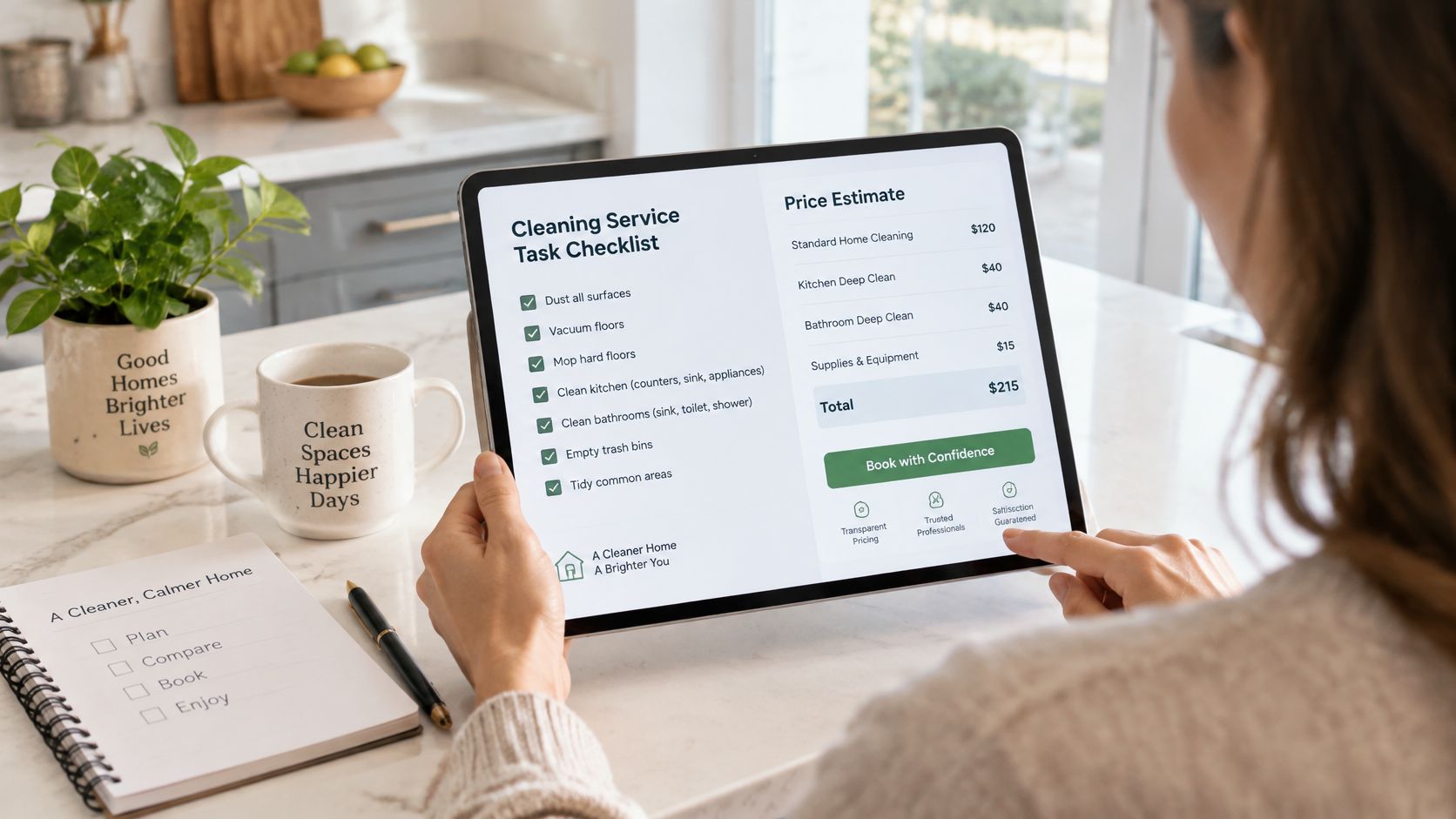
Two quotes can describe the same house and still cover very different work. One might include wiping appliance exteriors, while the other includes cleaning inside them. Compare tasks, not service labels.
Request the checklist attached to your specific quote. Pay particular attention to baseboard dusting versus detailed washing, accessible interior glass versus every window, and surface wiping versus removing accumulated buildup.
Put your priorities into the quote
A useful answer identifies included rooms, tasks, exclusions, and optional work. It also explains whether dishes, laundry, clutter pickup, furniture moving, and high or inaccessible areas fall outside the appointment.
Say you're moving out and expect the refrigerator to be ready for the next resident. If its interior isn't listed, don't assume an empty-house appointment includes it. A move-in cleaning cost guide can help you identify scope questions before comparing relocation quotes.
Our quotes account for the home details and optional tasks selected before booking. If undisclosed heavy buildup, extensive pet hair, or biohazards require additional labor and an adjusted flat rate, we require prior customer authorization.
Walk away if the provider promises to clean everything but won't supply a task list. That answer sounds generous until you disagree about whether everything included the oven, cabinet interiors, or a room that wasn't mentioned.
5. How do you structure pricing, and are there any hidden fees?
Hourly pricing buys labor time. Flat-rate pricing buys an agreed scope. Neither model is automatically better, but you need to understand which uncertainty you're accepting.
An hourly arrangement can accommodate shifting priorities, although the final total may depend on how much work is necessary. A flat rate makes budgeting easier, provided the quote accurately describes the property and the work.
In a Harris Williams survey of U.S. consumers in 2023, 49% of respondents said they were spending more on home-service providers than two or three years earlier. That makes a clear explanation of ongoing charges more useful than an attractive introductory price.
- Billing basis: If hourly, does the rate apply to each cleaner or the whole crew?
- Additional charges: Are parking, travel, supplies, or payment-processing charges separate?
- Booking terms: Is a deposit required, and when is the remaining payment collected?
- Ongoing costs: How are recurring price changes communicated, and is tipping optional?
For a busy household, compare the total expected visit cost rather than multiplying an hourly figure by your best guess. This explanation of house cleaning rates per hour helps frame that comparison.
We quote before booking rather than billing hourly, without requiring an in-home estimate. Walk away if the provider can't explain when a quote may change or reserves the right to add work without your approval.
6. Will I have the same cleaners on every visit?
A familiar cleaner can remember that the guest room is rarely used, the office door stays closed, and the dog shouldn't enter the hallway during mopping. But continuity needs a backup plan, not a promise that nobody ever gets sick or takes leave.
We provide recurring clients with consistent cleaners and dedicated scheduling windows. Consistency should still come with an explanation of how substitutions and updated instructions are handled.
Ask about the exception, not just the routine
Find out whether you can request a particular cleaner, whether that request is guaranteed, and who contacts you if the assignment changes. Ask how a substitute receives room-specific instructions without relying on your regular technician's memory.
For example, a household arranging weekly cleaning might keep a short preference sheet covering excluded rooms, approved products, pet arrangements, and priority tasks. That document helps preserve continuity even when someone unfamiliar attends.
A familiar face is valuable. A reliable handover process is what protects consistency when that person is unavailable.
There's a trade-off here. A small operation may offer closer personal continuity but fewer replacement options; a larger team may offer more scheduling resilience but require stronger communication.
Walk away if substitutions happen without notice or the provider can't explain how new technicians receive your instructions. You shouldn't have to start the entire conversation again whenever the schedule changes.
7. What is your satisfaction guarantee, and how do you handle a problem?
The useful test of a guarantee is a missed task, not a glowing review. Suppose you return home and find soap residue still on the shower wall despite bathroom cleaning being included.
A strong answer explains what you should do next, who reviews the concern, and what remedy is available. It should also distinguish incomplete cleaning from permanent staining, worn finishes, or work that wasn't included.
We re-clean the specific unsatisfactory areas at no additional charge when the cleaning doesn't meet the standard checklist. That's a defined remedy tied to the agreed work, rather than an open-ended promise that every surface will look new.
Get the reporting procedure before you need it
- Contact: Identify the person or office responsible for resolving concerns.
- Evidence: Ask whether clear photographs and the original task list are sufficient to start a review.
- Timing: Confirm the reporting deadline and how a return visit is arranged.
- Escalation: Clarify what happens when a re-clean isn't practical or doesn't resolve the issue.
Document a missed area promptly, before ordinary household use makes its condition difficult to assess. Keep the message factual: identify the task, attach a clear image, and state the remedy you're requesting.
Walk away if the guarantee has no accessible terms, or the provider treats every complaint as unreasonable. Conversely, don't expect a cleaning guarantee to cover damage claims automatically. Those need their own reporting and resolution process.
8. How are your cleaners trained, and do they hold any certifications?
Ask a practical training question: how would the technician approach your natural-stone shower, finished wood floor, or food-preparation counter? The explanation should describe a method, not just confidence.
We train our cleaning technicians. Useful follow-up questions concern supervised work, equipment instruction, chemical handling, surface identification, and how staff demonstrate that they're ready to work independently.
The CDC's household cleaning guidance distinguishes cleaning, which removes dirt and many germs, from sanitizing and disinfecting, and says cleaning should happen before sanitizing or disinfecting. For disinfecting, it also specifies following label directions, including the required contact time and ventilation.
Listen for a workable method
A trained cleaner should be able to explain how they select a compatible product, avoid transferring bathroom soil to kitchen surfaces, and use the right amount of moisture. If disinfection is requested, wiping a product away immediately isn't an adequate answer when its label requires the surface to remain wet.
Ask about certifications if the provider advertises them, including who issued the credential and which staff hold it. A logo doesn't establish that the person assigned to your home completed the training.
For example, a homeowner with a specialty-coated floor should provide the manufacturer's care instructions before the visit. Walk away if the response is that the team uses the same chemical and technique everywhere, or that a stronger concentration always cleans better.
9. How do you handle keys, access, and security in my home?
Your entry instructions deserve the same attention as your cleaning priorities. A team can do excellent cleaning and still create an unacceptable risk by sharing a permanent alarm code too widely.
A strong answer names who can access your credentials, how physical keys are identified and stored, and what happens if a key is lost. It should explain how access is withdrawn when an employee leaves or your service ends.
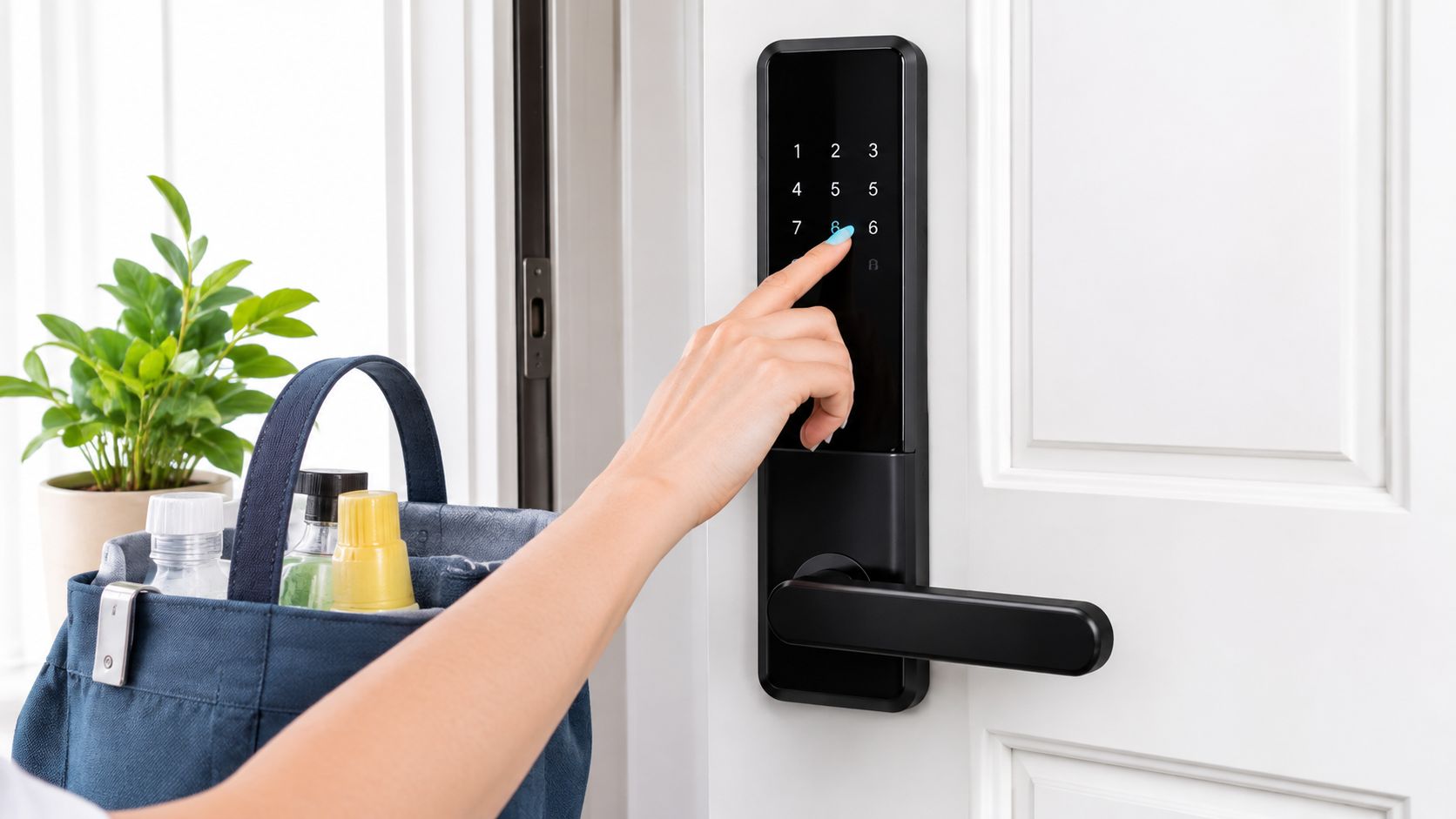
- Smart locks: Where supported, use a distinct code for the provider and restrict it to the appointment window.
- Physical keys: Avoid labels that pair a key with your full address.
- Arrival and departure: Agree on notifications and who checks that doors and accessible windows are secured.
- Privacy: Discuss cameras, room photographs, sensitive paperwork, and areas that remain off-limits.
For a household that travels, a temporary smart-lock code can avoid handing over a permanent household code. Confirm how a replacement technician receives authorized access and what happens if the lock fails.
Before sharing access: Decide what the cleaner may enter, photograph, move, and secure. Don't leave those decisions to assumptions.
Also settle pet arrangements. A cleaner shouldn't discover at the doorway that an anxious dog must be contained before entry.
Walk away if the provider proposes hiding a key in an obvious outdoor location or can't explain who receives your alarm information. Convenience doesn't justify uncontrolled access.
10. What is your cancellation, rescheduling, and arrival-time policy?
An appointment date isn't necessarily a precise arrival time. Cleaners may work within an arrival window because earlier jobs, traffic, and unexpected conditions affect the route.
You need the policy for changes on both sides. Ask what notice you must provide, what charge may apply, and what happens if the company cancels or arrives outside the agreed window.
Confirm the practical details
For a move-out appointment, explain any handover deadline before booking. If you must return keys that afternoon, an uncertain arrival window could make the appointment unsuitable even when the cleaning itself would be excellent.
Clarify these details in writing:
- Changes: How do you cancel or reschedule, and when does the request count as received?
- Delays: Who contacts you if the crew is running late?
- Failed entry: What happens if a lockbox fails or nobody answers?
- Readiness: Which utilities and household preparations are required?
For our visits, running hot water, functional electricity, and climate-controlled indoor temperatures are mandatory. General surface clutter, including clothing, toys, and sensitive paperwork, should be picked up beforehand.
Walk away if fees aren't disclosed before booking or you're expected to remain available indefinitely without updates. A workable schedule respects the cleaner's reserved time and your ability to plan around it.
The 10 Questions at a Glance
| Question Focus | Main Risk Addressed | What to Expect in a Good Answer | Key Red Flag |
|---|---|---|---|
| Background checks | Theft, misconduct, or harm from unvetted staff | Screening scope, coverage of all staff, and re-screening policy | Refusal to confirm screening or undisclosed unvetted subcontractors |
| Bonding and insurance | Property damage, theft, or liability for an injured worker | Current, verifiable proof of liability coverage, workers' compensation, and bonding | Won't provide proof or coverage excludes workers or property damage |
| Supplies and equipment | Exposure to unsuitable products or damage to surfaces | Product and equipment list, safety details, and options for sensitive homes | Vague product claims or no discussion of supplies |
| Included services and extras | Unexpected charges or mismatched service expectations | Written task checklist separating included work from add-ons | Quote does not specify included tasks |
| Pricing structure and fees | Unpredictable costs and undisclosed fees | Clear pricing model, final quote, and policies for fees, cancellations, and changes | “Starting at” pricing with no final quote or unexplained charges |
| Consistency of cleaners | Unfamiliar staff, inconsistent results, or changing access | Assignment process, substitution notice, and ways to share preferences | Frequent unannounced staff changes |
| Satisfaction guarantee and problem resolution | Unresolved quality issues or unclear remedies | Written reporting window and process for a re-clean, credit, or refund | No clear guarantee or refusal to address complaints |
| Cleaner training and certifications | Poor-quality work, surface damage, or unsafe chemical handling | Details on onboarding, supervision, safety training, and quality checks | No supervised training or written safety procedures |
| Keys, access, and home security | Lost keys, unauthorized entry, or privacy breaches | Clear key and code handling, access tracking, and arrival notifications | No written access policy or retaining access after service ends |
| Cancellation, rescheduling, and arrival times | Surprise fees, missed visits, or scheduling disruption | Notice requirements, fees, arrival windows, and delay notifications | Undisclosed cancellation fees or no defined arrival policy |
Ask First, Book Second. Your Next Steps
You don't need to become an insurance specialist or memorize cleaning chemistry before hiring help. You need clear answers about who enters your home, what they'll do, what you'll pay, and how problems are resolved.
Send these questions in an email or use them during a phone call. Then request a written summary of the scope, price, access instructions, and relevant policies before confirming the appointment. Friendly conversation is useful, but written details give both sides something dependable to follow.
Compare answers, not promises
Put the responses beside each other and look for meaningful differences. A lower quote may exclude the work you care about most, while a higher quote may include tasks you don't need. A provider who acknowledges a limitation can be a better choice than one who agrees to everything without explaining how.
Use these decision points:
- Clear enough to verify: Screening, insurance, products, and assigned responsibilities are explained specifically.
- Clear enough to perform: The cleaner has your priorities, surface instructions, and access arrangements.
- Clear enough to resolve: You know whom to contact about missed work, damage, delays, or changes.
We're a locally owned Milwaukee cleaning company, and our technicians are background-checked and trained. We're fully bonded and insured, and we welcome practical conversations about delicate surfaces, household sensitivities, entry arrangements, and expectations. Our approach is to establish the work and its terms before the appointment, not leave you guessing afterward.
Before the visit, put away sensitive documents and small valuables, clear ordinary surface clutter, and share anything that changes the job. Extensive pet hair, heavy buildup, restricted rooms, and unusual finishes are useful booking details, not inconveniences to hide.
The best cleaner for your home is someone whose answers you understand and whose commitments fit your needs. Ask directly, compare carefully, and don't hand over access until you're comfortable with both the cleaning plan and the people responsible for it.
---
We offer residential and commercial cleaning in Milwaukee and surrounding communities, with one-time appointments and recurring schedules. Visit Carmen Family Cleaning to request an online flat-rate quote, share your household's priorities, and confirm the scope and arrangements before you book.