
Post-construction cleaning in the United States commonly costs $274 to $707, with an average of about $477; large or complex projects can reach about $1,300. Your actual quote depends on what the crew must remove and detail, not just how much floor space you have.
A floor plan tells an estimator how far cleaners will travel through the house. It doesn't show adhesive on the glass, drywall dust inside drawers, or whether a contractor will return after the cleaning. Those details determine whether a modest-looking quote covers the finished result you expect.
Post-Construction Cleaning Rates at a Glance
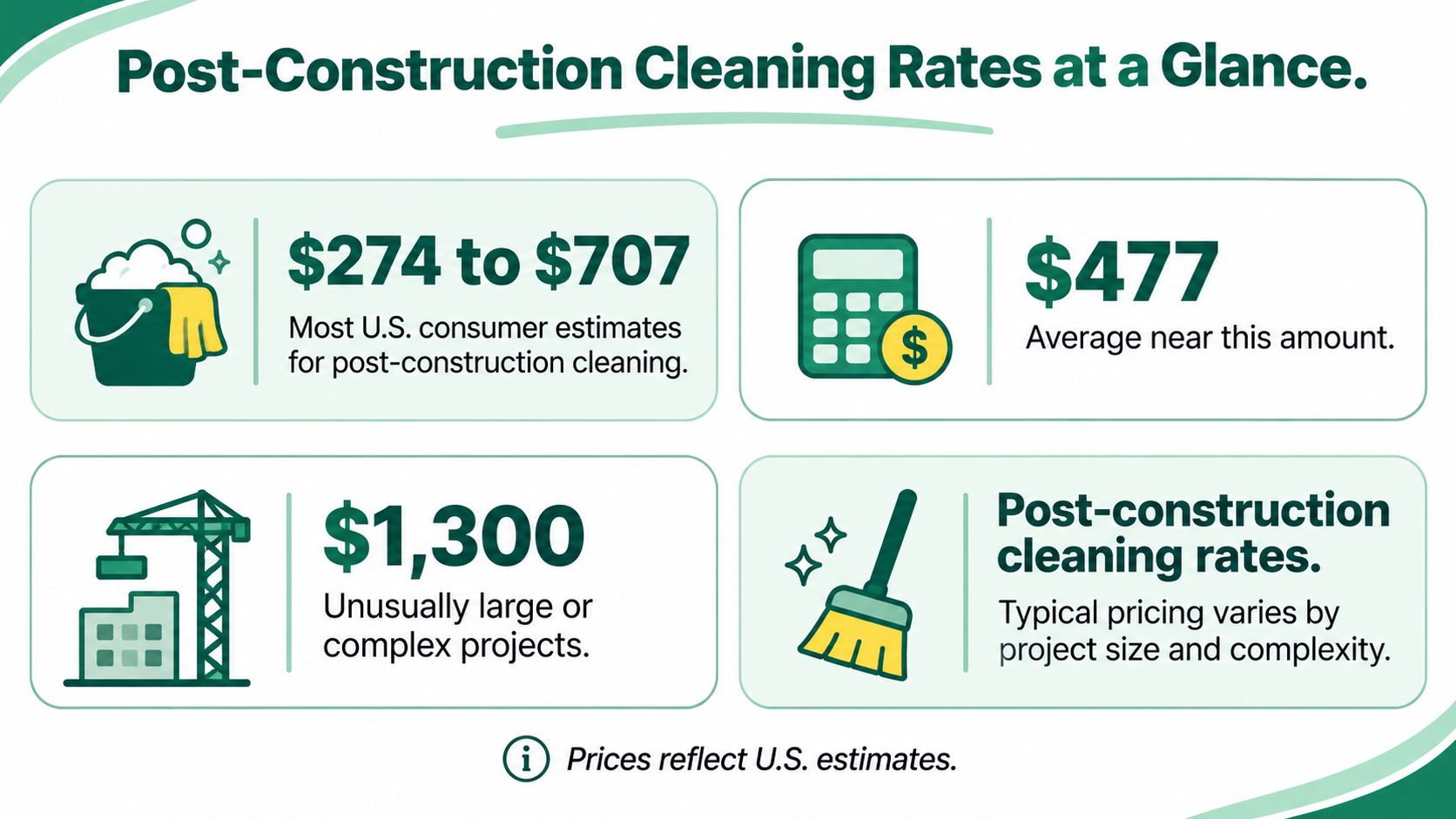
National cost guides report post-construction cleaning as both a total project price and a per-square-foot benchmark. Those figures describe different things: a total estimates the whole job, while a square-foot rate is a starting point for pricing a defined area.
How to Read the Benchmarks
Post-construction cleaning cost benchmarks
| Benchmark | Figure | Context |
|---|---|---|
| Typical national range | $274 to $707 | Consumer estimates, HomeAdvisor |
| Average national cost | About $477 | Consumer estimates, HomeAdvisor |
| Large or complex projects | About $1,300 | Consumer estimates, HomeAdvisor |
| Planning benchmark | About $0.25 per sq ft | Newly built home |
| Labor share of the bill | About 90% | Consumer estimates, HomeAdvisor |
The national totals and labor estimate come from HomeAdvisor's construction-site cleaning cost guide. The square-foot figure is a planning benchmark for a newly built home, not a guaranteed rate for every project.
Labor can account for much of the bill because cleaners need time to reach and detail surfaces, including drawers, tracks, trim, and glass. The amount of residue and the tasks included in the scope matter more than floor area alone. A low per-square-foot quote may leave out a second pass, disposal, or residue removal, which can raise the final cost.
Choose the Right Starting Point
Use a whole-project estimate to judge whether a quote is broadly plausible. Use a square-foot benchmark to sketch a preliminary budget when you know which areas need cleaning. Neither figure confirms that cabinet interiors, window tracks, or construction waste are included.
If you're familiar with house-cleaning rates per hour, keep in mind that routine housekeeping and post-construction cleaning involve different starting conditions and task lists.
Budgeting rule: Treat a benchmark as a starting allowance, then compare the listed tasks before deciding whether the price is reasonable.
A flat rate gives you an agreed price before work begins. Its value depends on a clearly defined scope.
Site Release, Dust and Safety Rules That Add to the Bill
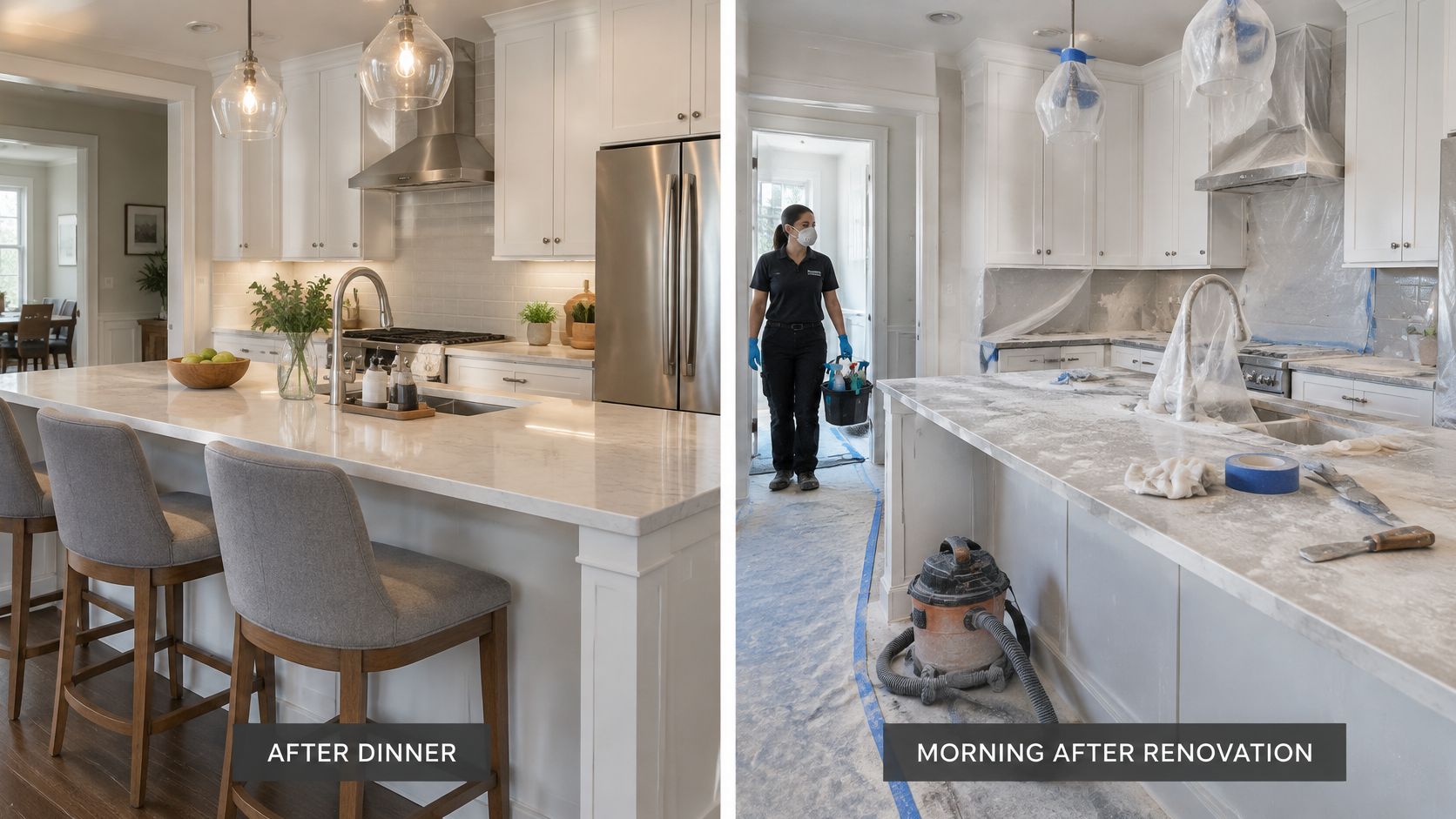
Regular housekeeping is tidying a kitchen after dinner. Post-construction cleaning is cleaning that kitchen after a renovation crew leaves, with drywall dust inside light fixtures, adhesive flecks on tile, and dried paint splatters on trim.
Before an estimator prices that work, the starting condition needs to be clear. A defensible final-clean quote assumes the site has been released for cleaning, utilities are available, bulk construction debris has been removed, and hazardous materials are excluded unless separately assessed.
The difference is easier to recognize when the spaces are viewed side by side.
A Cleaning Appointment Isn't a Site-Clearance Service
Think of the work as separate responsibilities: removing construction debris, collecting fine dust and residue, and preparing finished surfaces for occupancy. A company may offer more than one of these services, but you shouldn't assume a final-clean price includes them all.
OSHA's construction housekeeping rule requires work areas, passageways, and stairs to remain clear of debris, including scrap lumber with protruding nails, and requires combustible scrap to be removed at regular intervals. It also addresses containers for separating refuse and hazardous waste.
That distinction matters when you look at what's left on the property. A bag of clean packaging isn't the same handling problem as nail-bearing lumber, solvent containers, paint residue, or oily rags.
- Sorting and loading: Mixed waste takes additional handling, especially when sharp objects or chemical containers are present.
- Protective equipment: The material being handled determines what protection workers need, rather than the homeowner's preferred cleaning package.
- Disposal: Some materials can't go into an ordinary household trash container.
- Equipment cleanup: Tools used around problematic dust or residues may need controlled cleaning before they leave the site.
If a quote excludes these tasks, that isn't automatically a weakness. It may correctly separate a residential cleaning service from work the contractor or a specialist must complete.
Dust Can Change the Method
Dust isn't always just a cosmetic issue. The Purity Services guide to post-construction cleaning rates describes OSHA's respirable crystalline silica exposure limit of 50 micrograms per cubic meter over an eight-hour workday, along with restrictions on dry sweeping or compressed-air cleaning when those practices increase exposure.
This is especially relevant when concrete, masonry, tile, or stone has been cut or ground. You can't judge the exposure risk by looking at how dusty a room appears, and an ordinary final clean shouldn't be presented as regulated remediation.
Appropriate controls may involve wet methods, HEPA-equipped vacuums, containment planning, and task-specific protective equipment. These affect setup, filtration, waste handling, and production speed, not merely the number of surfaces a cleaner wipes.
A higher quote may reflect a safer cleaning method, not a slower or less capable crew.
For ordinary, nonhazardous finish dust, cleaners can work from high surfaces down toward floors, collecting loose material before damp wiping. They should avoid dragging gritty dust across new finishes, and residue treatment should begin with a discreet compatibility test rather than an aggressive scraper.
Put Responsibility in Writing
Before booking, identify who is responsible for hazardous-material assessment and removal. The general contractor should arrange removal of bulk debris, hazardous materials, and contaminated waste before a standard final-clean crew takes over.
Keep that agreement separate from cosmetic expectations. Wiping an accessible vent cover isn't duct cleaning, and cleaning visible surface dust isn't certification that the property is free of hazardous contamination.
Local wages, travel, insurance, equipment, and scheduling also affect the customer's price. A worker's wage isn't the same as the company's billable rate, because the latter must cover the resources needed to deliver the agreed service.
The Pricing Factors That Move a Quote
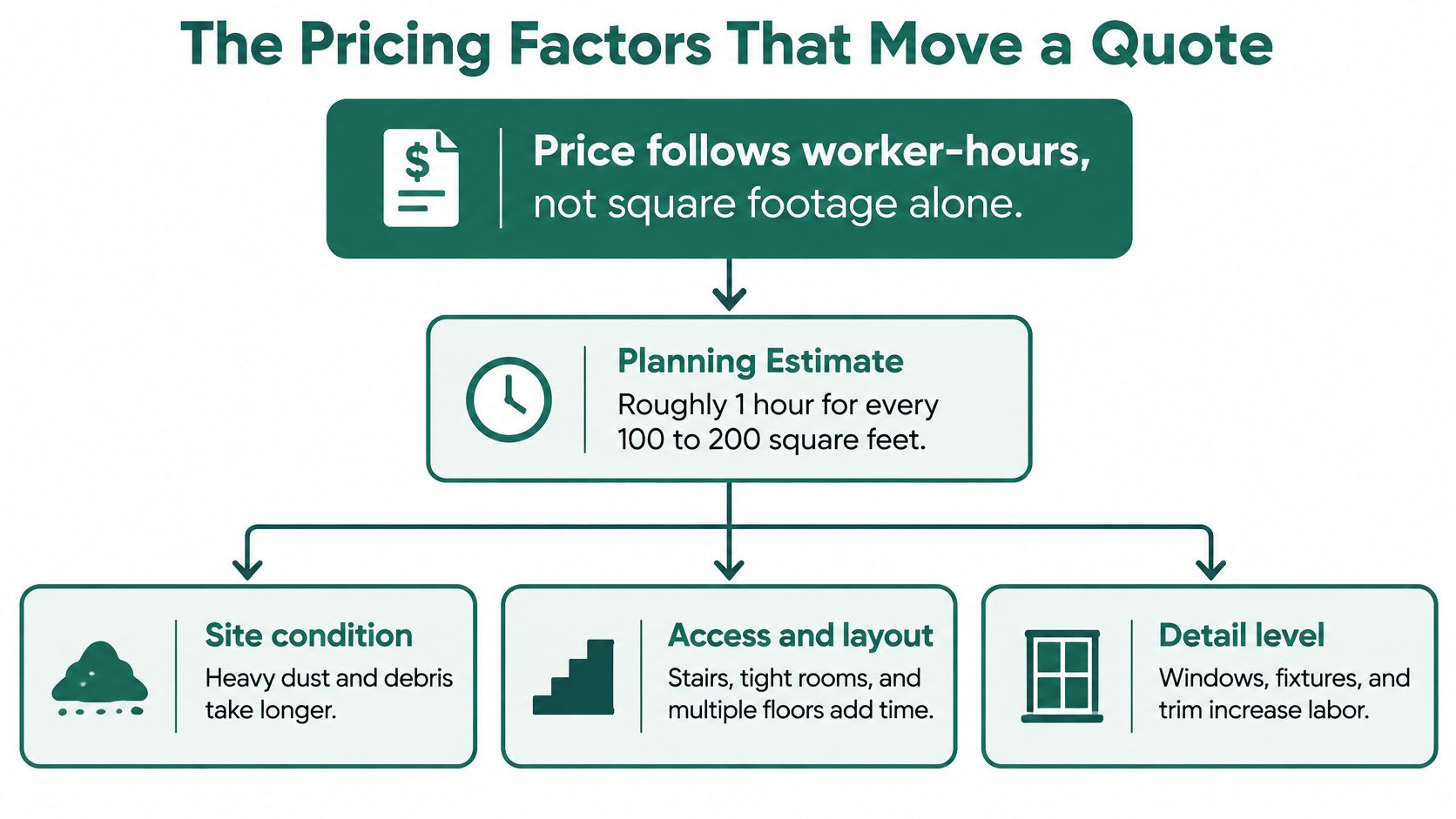
Price follows worker-hours, not square footage alone. In Cinderblock's construction labor-estimating guidance, cleanup is treated as a distinct labor allowance, a useful principle for separating final-detail cleaning from setup, transport, debris handling, and disposal.
An estimator starts with the area, then adds work according to the conditions inside it. A large empty room with accessible surfaces can be simpler than a smaller kitchen filled with drawers, hardware, and textured tile.
This hierarchy shows how site conditions build on the basic area allowance.
Build the Estimate From the Floor Plan Up
- Area and room count: More cleanable space adds work, but divided rooms also create doorways, corners, closets, and trim to detail.
- Fixtures and fittings: Sinks, tubs, toilets, vents, light fittings, and cabinet hardware require individual attention. A bathroom isn't just another patch of flooring.
- Windows and frames: Glass is only part of the task. Tracks, sills, frames, labels, and protective film can require separate methods.
- Dust load: Heavy deposits call for collection before finish wiping. Loading a cloth with loose grit and rubbing harder isn't an appropriate shortcut.
- Bonded residue: Adhesive, grout haze, and paint overspray need surface-specific treatment. A method suitable for ceramic tile may damage coated glass or finished wood.
- Debris handling: Sorting, carrying, loading, and haul-away should be distinguishable from surface cleaning.
- Access and height: Stairs, remote parking, restricted entry, and high-set fixtures change how workers and equipment reach the task.
- Deadline pressure: A compressed handover or trades still working in the home can complicate staffing and sequencing.
Define the Finished Condition
A broom-clean handover leaves a markedly different result from a move-in-ready clean. The latter can require repeated vacuuming, damp wiping, trim detailing, and inspection-based corrections, rather than merely clearing walkways and visible piles.
A deep-cleaning cost comparison can help distinguish household buildup from construction residue. They may occur in the same property, but they aren't interchangeable estimating categories.
Before requesting a quote, record the cleanable area, room count, bathrooms, windows, and surfaces with visible residue. Photos of tracks, cabinet interiors, and flooring edges often communicate the condition better than a wide shot of an otherwise empty room.
For a visual look at cleaning work, the following video provides additional context.
Why Two Homes of the Same Size Get Different Quotes
For a 2,000-square-foot home, the interior estimate of $0.15 to $0.60 per square foot produces a planning spread of roughly $300 to $1,200, using the 2026 estimates described by ThePricer's post-construction cleanup guide. The floor area hasn't changed, but the required work can be dramatically different.
Say one home has already had construction waste removed and needs accessible surfaces finished. Another has dusty cabinet interiors, film on windows, adhesive on flooring, and a contractor scheduled to return. Matching floor plans don't make those equivalent assignments.
Compare Stages Before Comparing Prices
Post-construction cleaning stages and what each one covers
| Stage | What It Removes or Covers | When It Is Needed |
|---|---|---|
| Rough clean | Bulk debris, sawdust piles, packaging, and leftover materials | After heavy trade work, before finishing |
| Final clean | Fine dust on fixtures, vents, floors, window tracks, and cabinets | Once all trades have finished |
| Touch-up | Settled dust, paint marks, and spots identified on the walkthrough, within the agreed scope | Following inspection or later dust settlement |
| Residue removal | Adhesive, paint specks, protective film, and grout haze | When surfaces need material-specific treatment |
| Window detailing | Interior glass, frames, and sills | Often an add-on, quoted separately |
These are scope categories, not a universal package. A rough-clean contractor may handle bulk waste, while a residential final-clean provider may require it to be gone before arrival.
Likewise, accessible vent cleaning doesn't automatically include work inside the HVAC system. Put those tasks on separate lines so they can't be confused.
The Cheapest-Quote Trap
A low square-foot price may cover floors and exposed surfaces but exclude window detailing, disposal, and stubborn residue. If you need those tasks to occupy the home comfortably, the advertised rate isn't the relevant total.
Compare the price of the finished result you need, not the cheapest description of an incomplete job.
A move-out cleaning cost guide addresses another empty-home service, but vacancy alone doesn't define construction-cleaning needs. An unoccupied property can still contain substantial finishing residue.
Have each estimate identify the stage, included surfaces, optional tasks, and conditions that trigger an additional visit. A higher initial quote can be the less expensive choice when it includes the work the lower quote leaves out.
Worked Examples for Three Home Sizes
Say you're a Milwaukee homeowner finishing a kitchen and basement remodel. Your house's total size isn't automatically the correct billing area: you first need to identify the renovated rooms and any adjoining spaces where dust traveled.
For a hypothetical 2,000-square-foot cleanable area, you can use the square-foot assumptions in the benchmark tables to build a preliminary allowance. These calculations are illustrations, not local quotes or promises that the same rate fits every property.
Turn Area Into a Planning Allowance
Start by measuring the floors that need service. Include an adjoining hallway or living room if construction dust reached it, but don't add untouched rooms merely because they appear on the property listing.
Next, multiply that area by the planning rates. The table below applies the guide's stated assumptions consistently, without assigning a separate surcharge to any particular renovation type.
Estimated cost ranges for three home sizes
| Project | Floor Area | Range at $0.15 to $0.60 per sq ft | Planning Figure at $0.25 per sq ft |
|---|---|---|---|
| Hypothetical condo renovation | 1,200 sq ft | $180 to $720 | $300 |
| Hypothetical new build | 2,000 sq ft | $300 to $1,200 | $500 |
| Hypothetical full renovation | 3,500 sq ft | $525 to $2,100 | $875 |
The planning column is a reference calculation, not the mathematical midpoint of the range. It also applies a newly built-home benchmark to renovation scenarios for comparison; the estimator still needs to account for their actual conditions.
For the middle example, don't stop at the calculated total. Determine whether the allowance is meant to cover cabinet interiors, glass, residue treatment, and waste handling, or only general final cleaning.
Keep Labor-Hours Separate From Visit Length
Time estimates need an equally careful reading. Worker-hours describe combined labor, while elapsed hours describe how long the crew is on site.
For illustration, a hypothetical task requiring twelve worker-hours could occupy a three-person crew for approximately four elapsed hours if everyone can work productively in parallel. That's arithmetic, not a production guarantee: narrow rooms, sequential tasks, and access constraints can prevent an even division.
Don't combine a crew-visit estimate with an individual productivity allowance unless the estimator confirms they use the same definition. Otherwise, you can accidentally multiply labor twice or assume a crew will finish far sooner than the scope permits.
Use the calculated allowance to decide what questions to bring to the quote, rather than treating it as a price ceiling. The useful outcome is a budget tied to identifiable work, not a deceptively precise total based only on area.
Confirm Your Scope Before You Book
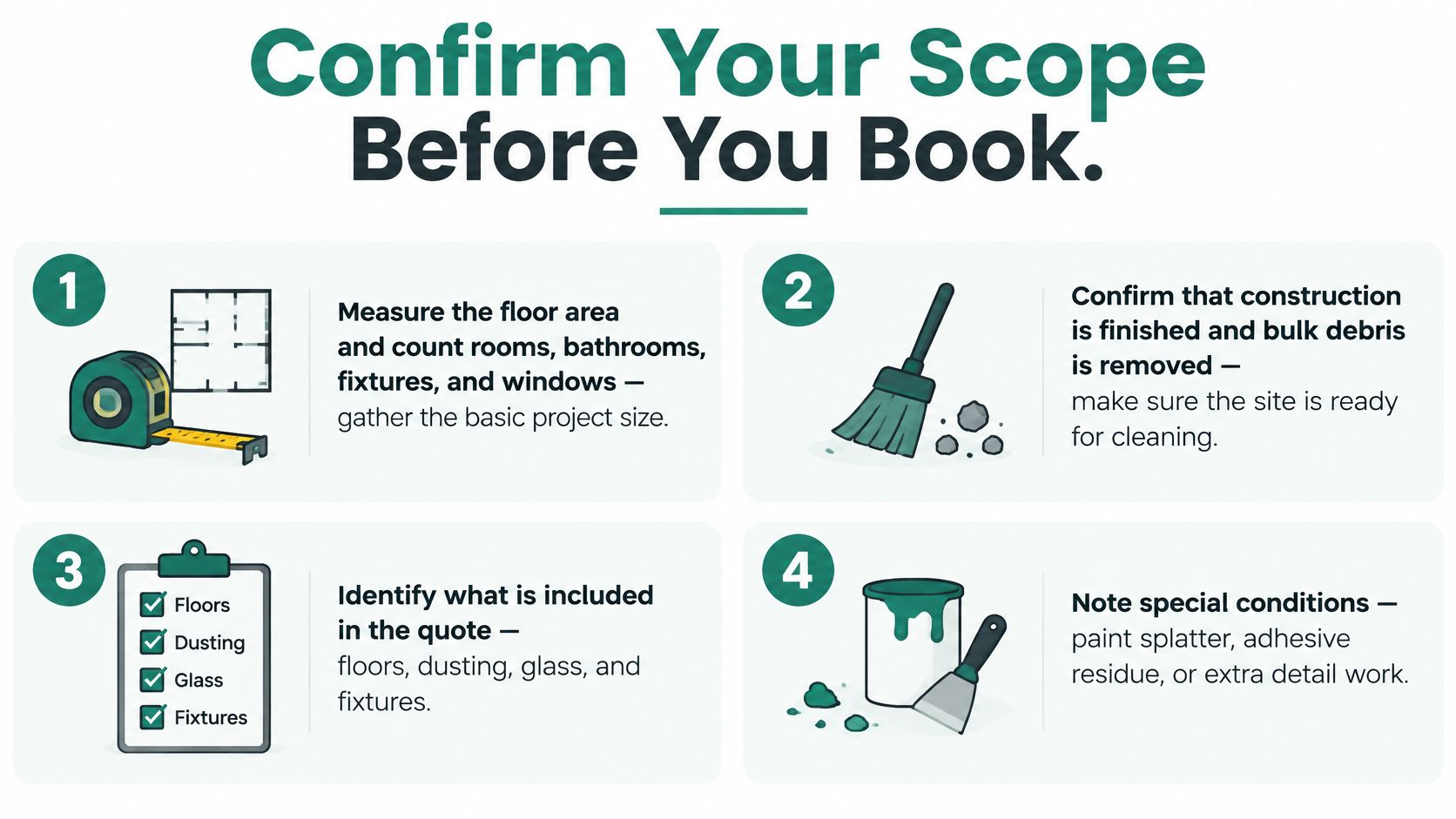
A useful quote lets you explain what you're buying without guessing. Before accepting it, organize the property details and turn broad terms such as “full clean” into an agreed checklist.
Use this visual as a preparation aid, then work through the booking checks below.
Run These Checks Before Accepting the Total
1. Measure and count. Record the cleanable floor area, rooms, bathrooms, fixtures, and windows. This gives the estimator a concrete starting point instead of a description such as “an average house.”
2. Confirm readiness. Establish that construction is finished, utilities are available, and bulk debris has been removed. Tell us about any planned trade visits so the appointment can be discussed against the actual site condition.
3. Name the cleaning stage. Identify whether you need a rough clean, final clean, or inspection touch-up. An agreed stage makes the expected handover easier to evaluate.
4. Write down exclusions. Address hazardous materials, haul-away, residue removal, and window detailing explicitly. Don't interpret silence as inclusion.
5. Clarify return-work conditions. Distinguish an incomplete checklist item from new dust created when trades return. Those are different situations and shouldn't be covered by an assumed blanket promise.
6. Compare the complete total. Include the optional tasks you need before choosing between estimates. A starting price isn't a substitute for the agreed project price.
Know What Our Quote and Checklist Mean
At Carmen Family Cleaning, Post Construction Cleaning starts at $430 as a one-time clean. Our online quoting uses the selected service and home details, including size, bathrooms, and additional tasks, to calculate the flat rate.
If a cleaning doesn't meet our standard checklist, we re-clean the specific unsatisfactory areas at no additional charge. That policy addresses the agreed cleaning standard; it shouldn't be interpreted as an unlimited allowance for new construction activity.
Heavy buildup, extensive pet hair, or undisclosed biohazards may require additional labor and an adjusted flat rate with prior customer authorization. Giving us accurate details before booking helps keep the quote aligned with the condition of the home.
Use our questions to ask a house cleaner to prepare any remaining scope questions. Gather photos, the cleanable area, the construction completion status, and your required tasks, then confirm the inclusions and exclusions in writing.
---
Carmen Family Cleaning offers one-time post-construction cleaning for homeowners preparing a renovated or newly built space for use. Visit Carmen Family Cleaning to request a quote with your home details, cleaning stage, and residue concerns, so you can review the full scope before booking.