
Care.com's cleaning-rate comparison reports 2025 house cleaning rates per hour from $19.09 to $24.55 in posted starting rates across major U.S. cities, alongside a national starting average of $20.74 and an average maximum of $29.09. A posted starting rate works like the "from" price on a menu board: it marks the floor, and three different numbers can hide inside it.
It can mean the cleaner's wage, the marketplace's advertised rate, or the effective rate left once crew size and scope settle the final bill. A Milwaukee household weighing options in 2026 gets further by asking what work, staffing, supplies, and price protections an hour covers, and when a defined flat quote protects the budget better than an open clock.
House Cleaning Rates per Hour Across US Cities
A city can post a tidy hourly figure while the actual appointment still has several unknowns. Care.com's cleaning-rate comparison reported city starting rates from $19.09 per hour in Houston to $24.55 in Los Angeles as of September 11, 2025, alongside an August 2025 U.S. average starting rate of $20.74 and an average maximum rate of $29.09.
Posted house cleaning starting rates by market
These figures are customer-facing marketplace references for starting scope. Employee wages and finished company invoices belong to different categories.
| Market | Posted starting rate | What the number is | As of |
|---|---|---|---|
| Houston | $19.09 per hour | Posted starting rate | September 11, 2025 |
| Indianapolis | $19.39 per hour | Posted starting rate | September 11, 2025 |
| Philadelphia | $20.36 per hour | Posted starting rate | September 11, 2025 |
| Washington, D.C. | $21.24 per hour | Posted starting rate | September 11, 2025 |
| Chicago | $21.64 per hour | Posted starting rate | September 11, 2025 |
| Brooklyn, New York | $21.96 per hour | Posted starting rate | September 11, 2025 |
| Denver | $23.36 per hour | Posted starting rate | September 11, 2025 |
| San Diego | $23.56 per hour | Posted starting rate | September 11, 2025 |
| Los Angeles | $24.55 per hour | Posted starting rate | September 11, 2025 |
| United States | $20.74 per hour | Average posted starting rate | August 2025 |
| United States maximum | $29.09 per hour | Average maximum posted rate | August 2025 |
What a starting rate actually tells you
A starting rate works like the sticker on an entry-level appliance: it places the item in a price neighborhood before features, condition, and service terms enter the decision. The advertised amount may describe routine cleaning under favorable conditions. It leaves open whether appliance interiors, accumulated bathroom buildup, equipment, or transportation belong inside that first figure.
The national maximum row needs care. It describes an average maximum posted rate, so a higher-end job can land elsewhere once scope expands. A detailed move-out clean and a maintained apartment are different purchases, even when both are discussed in hours.
Geography explains part of the spread, yet the table gives Milwaukee no local rate. Chicago offers a regional reference point, and your address still needs its own scope definition. Historical marketplace figures also should stay labeled as marketplace figures rather than being treated as a current company menu.
Use the table without mistaking it for an estimate
Before comparing an advertisement with a company quote, identify the billing unit. Is the advertisement for an individual cleaner, a crew, or a service package? Does the stated price apply throughout the appointment, or only to a limited starting scope?
A flat-rate provider may never publish an hourly number. Its price can still be transparent if the company defines the rooms, tasks, exclusions, and total charge before booking. You can calculate an hourly equivalent afterward, though that calculation needs staffing information as well as elapsed time.
Practical rule: Use posted house cleaning rates per hour as a sanity check, then budget from a defined scope.
An unusually low advertisement deserves questions rather than an automatic rejection. An apparently higher quote deserves the same scrutiny. The fair comparison sits between equivalent services, staffing assumptions, and included tasks, where the dollar sign finally has context.
Cleaner Wages Versus the Price You Pay
Three different numbers all get called "the hourly rate," and mixing them up is how a reasonable comparison turns into a misleading one. The first is the cleaner's paycheck. The second is a posted starting rate in an ad. The third is the effective rate you can only calculate after the visit, once you know the bill and how many people worked.
Start with the paycheck.
Published wage figures for cleaning occupations describe what an employee earns per hour. That figure is only one part of the full service price, so it works as a labor-cost baseline for judging whether the labor portion of a quote is plausible. Even the highest wages on the pay scale describe what a worker takes home. They say little about what a delivered appointment should charge.
The visual separates the paycheck from the customer's bill.
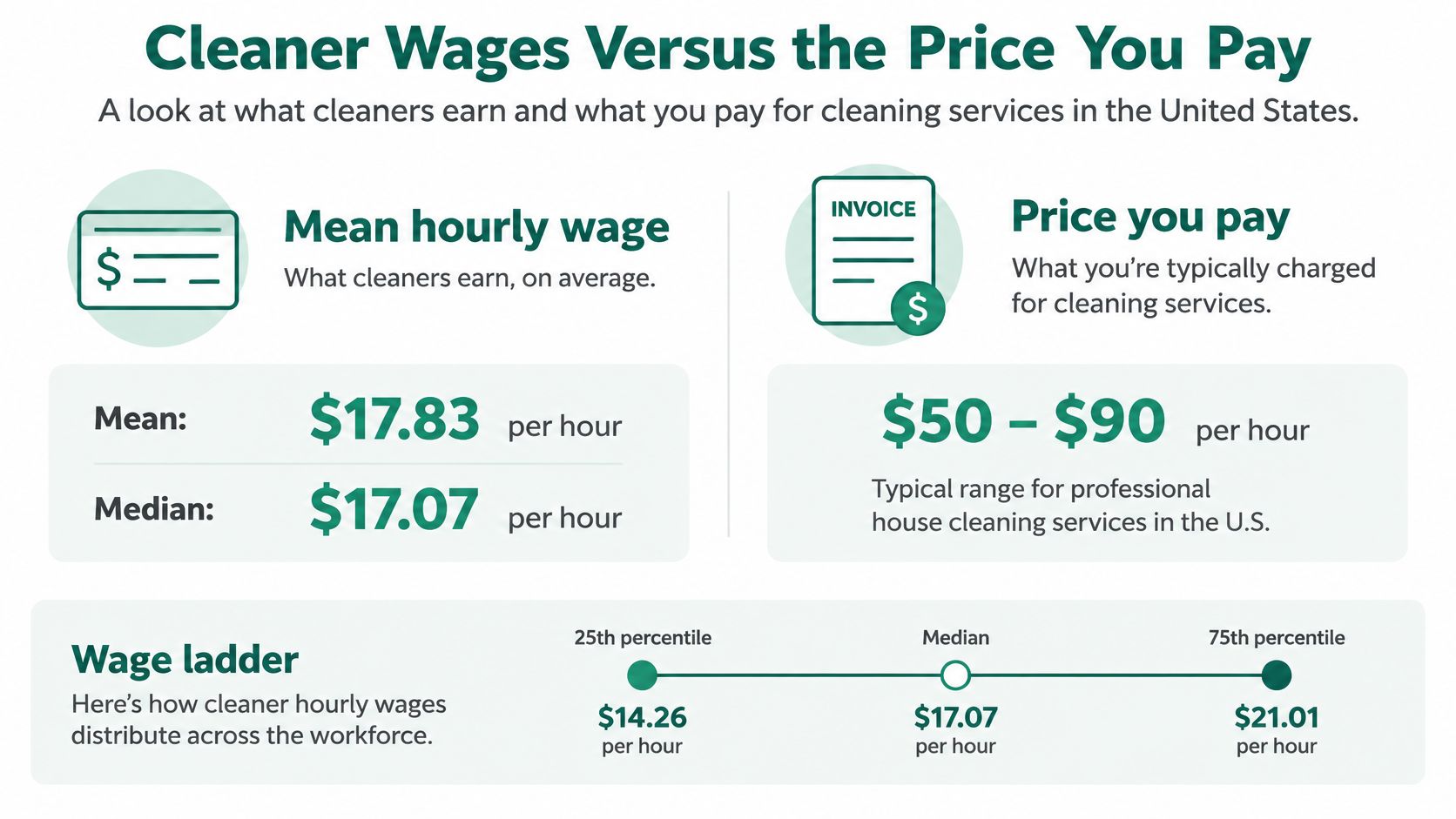
Why the invoice is larger than the paycheck
A cleaner's wage works like an ingredient cost in a restaurant meal. A restaurant cannot price dinner using only what it paid for vegetables, and a cleaning company cannot price a delivered appointment using only the cleaner's wage.
The business also needs to cover:
- Employment costs: Payroll taxes, workers' compensation, and paid work that doesn't happen inside a customer's home.
- Protection and oversight: Liability insurance, bonding where applicable, training, supervision, and quality checks.
- Tools and materials: Vacuums, replacement filters, fresh mop heads, microfiber cloths, and cleaning products.
- Running the appointment: Transportation, scheduling, customer communication, administrative work, and profit.
Those costs don't mean every higher quote is good value. They explain why subtracting an employee's wage from a customer's bill doesn't reveal the company's profit. Much of the difference can pay for delivering and supporting the visit.
Compare the service behind the price
The second number, the posted ad rate, describes what a seller charges. Whether that charge is fair depends on what it includes. For a Milwaukee booking, local travel, the home's layout, bathroom workload, and specialty tasks shape the service more than any national pay figure. A household hiring an individual directly may also take on coordination responsibilities that a company handles inside its price.
The third number appears only after the appointment. Divide the total bill by the combined time of everyone who worked, and you get the effective hourly rate you paid. A two-person crew that finishes quickly produces a different effective rate than a solo cleaner who takes twice as long, even at identical invoice totals. An open clock can be fair when the scope is predictable. When a home's condition is hard to judge in advance, a defined flat quote shifts the time risk away from the household.
Don't assume a low advertisement excludes protections, and don't assume a company includes everything. Identify what the agreement covers. The useful question is: How much of the payment compensates the cleaner, and how much pays for a reliable, insured visit?
Scope Details That Set the Hourly Cost
A cleaner can quote an hourly amount before seeing your home, but that alone won't tell you the likely total. The task list and conditions determine how much work the appointment contains.
Start with labor-hours, meaning the combined time worked by everyone on the crew. A larger crew can finish sooner without doing less work. Keeping crew size separate from appointment length prevents misleading comparisons.
Describe the home in scheduling order
Size establishes the starting workload. More accessible floor area means more vacuuming and mopping, while additional furnished rooms add dusting surfaces. Bedrooms alone won't describe an open-plan living area, finished basement, or heavily furnished office.
Bathrooms deserve separate attention. Toilets, shower walls, tubs, fixtures, and soap film require different work from an equivalent area of bedroom floor. Describe the fixtures and condition rather than treating every room as interchangeable.
Condition can outweigh size on an initial visit. Clutter blocks access to surfaces, pet hair collects around furniture, and dried kitchen residue takes more attention than fresh crumbs. Explain what needs cleaning and what needs picking up, because those aren't the same task.
Service type changes the job itself. Routine maintenance, a deep reset, and a relocation clean require different checklists. Our guide to move-in cleaning service costs helps distinguish move-related preparation from ordinary upkeep.
Supplies and travel belong in the comparison as well. We bring cleaning equipment and supplies, so customers don't need to assemble a separate kit. Preferred products for delicate surfaces should be discussed before the appointment.
Frequency affects the condition the crew returns to, but a recurring estimate should reflect a realistic maintenance workload. Establish the initial condition before assuming every future visit will resemble a short touch-up.
Gather these answers before comparing quotes
Use this checklist when describing the home. Photos of problem areas can clarify details that words such as moderately dirty leave open to interpretation.
1. Home size and bedrooms. Give the square footage, bedroom count, and any finished spaces you want included.
2. Bathroom count. Separate full bathrooms from half bathrooms, and identify showers or tubs with significant buildup.
3. Service type. Specify maintenance, deep cleaning, move-in, move-out, or post-construction work.
4. Last professional cleaning. Give the approximate timing and explain what upkeep has happened since.
5. Pets and clutter. Describe shedding, inaccessible floors, crowded counters, and anything that prevents normal access.
6. Desired detail. Distinguish wiping reachable surfaces from detailing baseboards, fixtures, or neglected edges.
7. Named add-ons. List oven interiors, refrigerator interiors, and interior glass separately rather than requesting everything.
8. Equipment and products. Confirm what's supplied and identify any surface-specific requirements.
9. Staffing and expected duration. Keep the number of cleaners separate from the estimated appointment length.
10. Changed-condition procedure. Establish how undisclosed conditions affect the agreed price.
At Carmen Family Cleaning, heavy buildup, extensive pet hair, or undisclosed biohazards may require additional labor and an adjusted flat rate with prior customer authorization. That approval matters more than a vague assurance that the crew will work something out.
Two quotes are comparable only when they describe the same home, access, condition, and finished result.
When Hourly Billing Costs More Than a Flat Quote
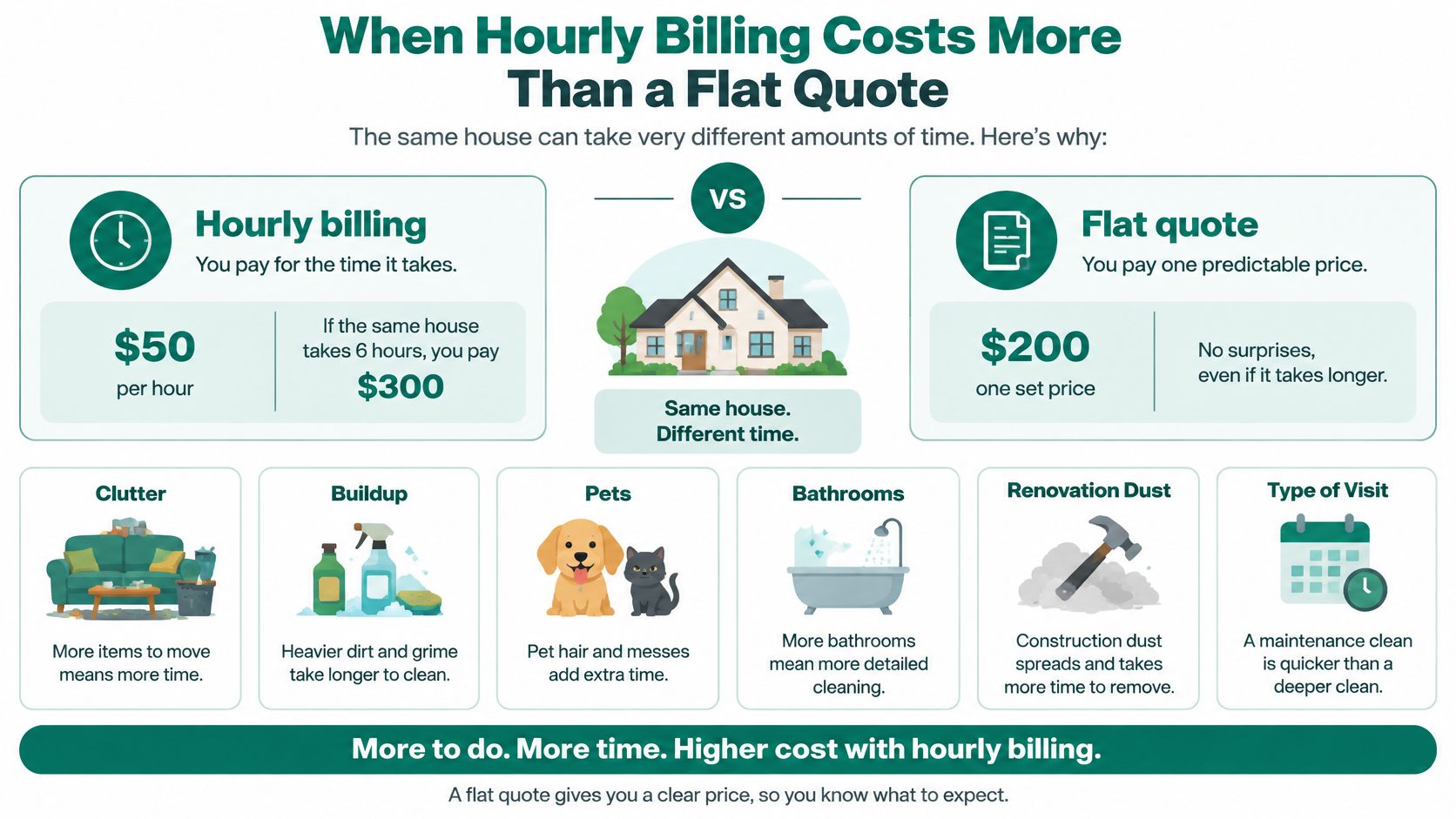
The same three-bedroom home can take a maintenance-length visit in June and a far longer one after a dusty remodel. Under hourly billing, that difference belongs to the customer. Under a flat quote, the company carries the estimation risk instead. Each model stays fair only with a clear boundary around the work.
Duration moves for ordinary reasons. Clutter, buildup, pets, bathrooms, renovation dust, and the difference between a maintenance visit and a reset all change how long a home takes, and on an hourly plan every extra hour raises the invoice. The advertised rate is also only one of three numbers. The cleaner's pay per labor-hour, covered in SimplyWise's discussion of how much house cleaners make, sits underneath it; the posted rate adds the company's costs on top; and your effective per-hour cost shifts again with crew size and time on site.
Hourly billing compared with a flat cleaning quote
| Model | Who holds time risk | Fits best when | How it goes wrong |
|---|---|---|---|
| Hourly rate | Customer | Scope is unknown and the customer can watch the work | Clutter, pets, or extra rooms extend the bill |
| Flat quote | Cleaning company | Size, bathrooms, service type, and add-ons are set before booking | Undisclosed buildup needs a revised price |
| Recurring flat visit | Shared, if the plan stays maintenance | The home stays on a weekly, biweekly, or four-week rhythm | A neglected reset is priced like a short maintenance visit |
When an open clock can be reasonable
Hourly billing suits an uncertain project where the customer actively chooses priorities. Clearing a crowded storage room is a good example: the cleaner works through accessible areas until an agreed stopping point, and the customer accepts that nobody could have priced the pile in advance.
That arrangement still needs two guardrails: a spending cap and a way to approve further work. Without them, an invoice alone cannot tell you whether the crew did more work or took longer.
The infographic below maps each model against the conditions that make a visit hard to predict.
When a defined flat quote is fairer
A flat quote is easiest to judge when both parties can name the deliverable: specified rooms, a defined cleaning level, and approved extras. You know the charge before anyone arrives, and the company takes responsibility for estimating the work it described.
Scope still has to be written down. The agreement should list exclusions and state what happens if the home's condition differs from what was described, so a surprise on site becomes a repricing conversation instead of a growing bill. The same scope-first logic holds outside Milwaukee; our house-cleaning guide for Plano shows a flat rate built from home size, bathrooms, and add-ons rather than hours on a clock.
Maintenance needs an honest definition as well. A recurring visit covers upkeep, a reset is booked and priced as a reset, and neither should secretly stand in for the other.
The fairness test: If you can't say what's included before the start time, you don't have a dependable rate. You have a guess.
Choose the model that makes the total and the approval process for changes understandable. Hourly can cost less on a small, well-defined job, while a defined flat quote protects you whenever the home's condition makes duration the unknown.
Sample Homes and Their Effective Hourly Cost
Consider these hypothetical homes, not timing promises or service estimates. For arithmetic only, use an assumed $22 per labor-hour. That invented planning assumption isn't a market finding, a cleaner's wage, or our company rate.
The image illustrates why staffing and elapsed appointment time are separate inputs.
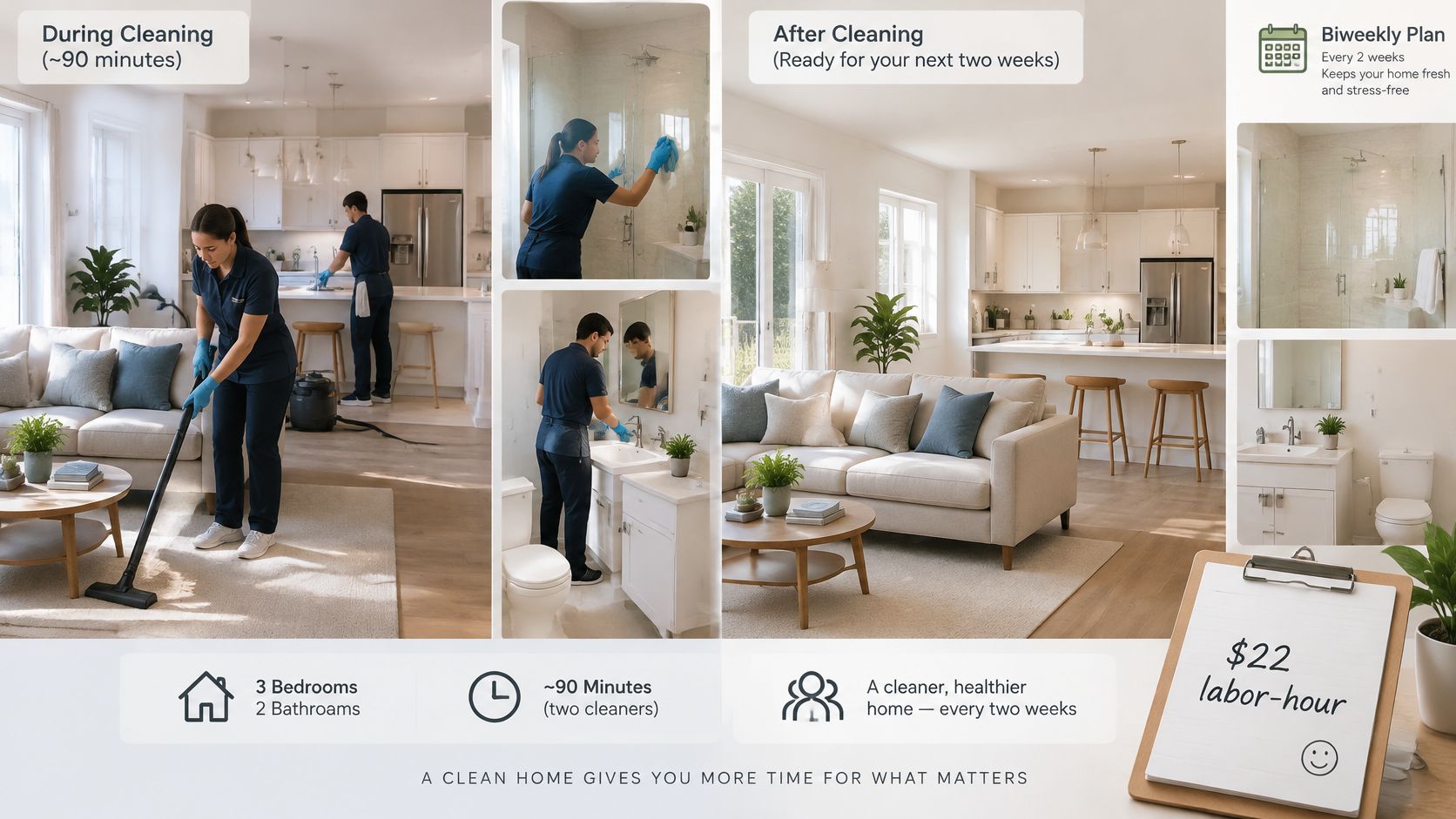
A maintained home and a neglected version
Say a maintained three-bedroom, two-bath home takes two cleaners about ninety minutes. That's three labor-hours, giving a hypothetical labor sketch of $66. It isn't an all-inclusive quote, because the arithmetic hasn't priced the full service.
Now suppose the same home needs a reset after months without professional cleaning. For illustration, allocate four to six labor-hours, equivalent to two cleaners spending two to three hours on site. The hypothetical labor sketch becomes $88 to $132, but those assumed durations must not be treated as predictions for an actual home.
Three sample homes at a $22 labor-hour sketch
| Home | Crew and time on site | Labor-hours | Effective rate formula |
|---|---|---|---|
| Maintained 3-bedroom, 2-bath home on a biweekly plan | Hypothetically, 2 people for about 90 minutes | 3 | Flat quote divided by 3 |
| Same home after months without a clean, reset | Hypothetically, 2 people for 2 to 3 hours | 4 to 6 | Flat quote divided by 4 to 6 |
| Move-out adding oven interior, refrigerator interior, and interior glass | Crew and duration estimated from the expanded task list | Cleaners multiplied by hours on site | Flat quote divided by labor-hours |
A move-out is a different assignment
The move-out adds appliance interiors and glass, so it needs its own estimate rather than a maintenance duration with a small adjustment. Empty rooms may make floor access easier, but they don't erase grease inside an oven or residue in refrigerator drawers.
The calculation is:
Labor-hours = cleaners × hours on site
Effective hourly cost = total flat quote ÷ labor-hours
For the maintained-home scenario, dividing the quote by ninety minutes instead of three labor-hours would produce a figure twice as large. That measures the crew's clock-hour cost, not the cost per worker-hour.
For additional visual context, the video appears below.
Use expected staffing and duration to understand a proposed visit, not to force every home into these examples. When considering weekly cleaning, distinguish the initial reset from the repeatable upkeep workload. Compare the resulting service estimate with the flat quote, not with an employee-pay benchmark.
Check a Flat Milwaukee Quote Before You Book
Check three things before choosing a price: whether the home's size, bathroom count, and task list are known; whether its current condition is described accurately; and whether the agreement identifies supplies and expected staffing. When those details are settled, a prequoted flat price is usually easier to budget than an unrestricted hourly meter.
At Carmen Family Cleaning, we don't bill by the hour. Basic Cleaning in Milwaukee starts at a $205 flat rate, and weekly recurring cleaning starts at $117 per visit. The exact quote depends on the selected service, home size, bedroom and bathroom count, and optional add-ons.
Confirm the agreement, not just the starting price
Starting prices aren't a personalized offer. Use the quote tool to confirm the applicable amount before booking, rather than assuming your home qualifies for the lowest listed price. Our Milwaukee cleaning-company guide offers local context for that decision.
For a home that hasn't been professionally cleaned recently, establish whether an initial deep reset is needed before selecting ongoing maintenance. A useful agreement makes these details visible:
- Included work: The rooms, cleaning level, and separately selected tasks.
- Service protections: Insurance, bonding, and technician screening. We're bonded and insured, and our technicians are trained and background-checked.
- Approval boundaries: Any revised flat rate for undisclosed conditions requires your authorization.
An effective hourly calculation can help explain staffing, but it can't establish value by itself. Check the finished task list, the agreed total, and the rule for changes before choosing an appointment.
---
Carmen Family Cleaning offers upfront flat-rate cleaning for Milwaukee-area homes, with the quote based on your home and selected tasks rather than an open hourly clock. Visit Carmen Family Cleaning to enter your home details, compare the quoted scope with your needs, and book once the included work and price are clear.