What gets cleaned when a fridge cleaning service opens your refrigerator door, and what happens to the food while it's out?
A typical image is a rag, a spray bottle and twenty minutes of wiping. That picture is wrong in a way that matters, because the inside of a fridge is a food-contact surface, not a shelf in a cupboard. What goes on there touches what you eat. The job is closer to a small food-safety protocol than to a quick polish: things come out, surfaces get washed, rinsed, sanitized and dried, the temperature gets checked, and only then does food go back in.
This is a plain walk through that process: what a visit covers, what it costs, why the food-safety rules drive the order of steps, how to protect your groceries while the door stands open, and how to get a quote you can compare.
What a Fridge Cleaning Service Covers
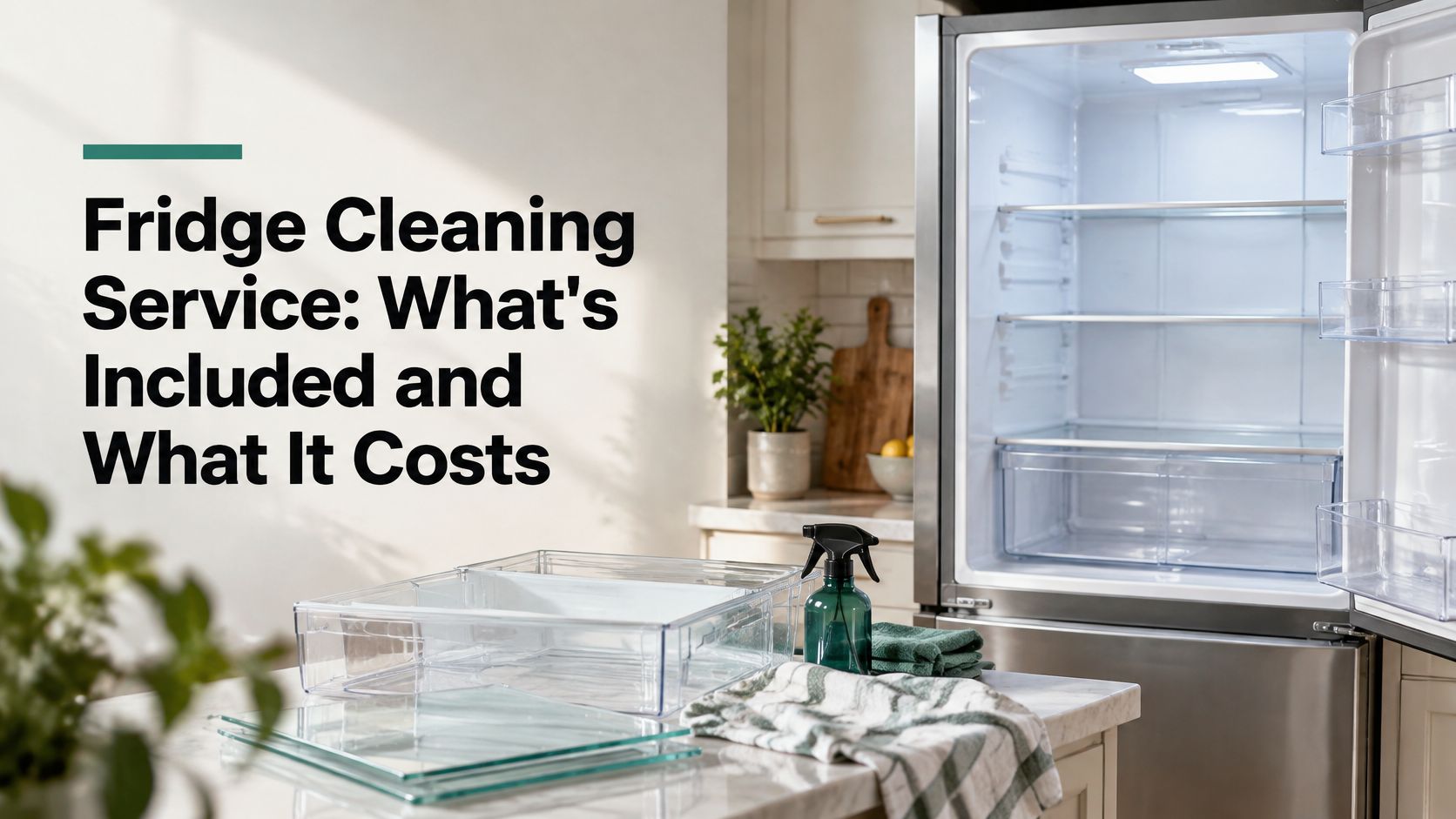
A fridge cleaning service empties the unit, pulls the shelves, drawers and bins, washes each removable part, cleans the door gasket and every spill channel, wipes the interior walls and exterior, and hands the fridge back dry, cold and ready to reload. That's the whole job in one sentence. Everything else is detail.
The detail is where a real visit separates itself from a wipe-down. Residue hides in the rubber folds of the door seal, in the channel under the crisper, in the lip where the back wall meets the floor of the compartment. Those are the spots nobody cleans on a Tuesday night, and they're the reason a fridge smells faintly wrong even when it looks clean.
Typical fridge cleaning tasks by area
| Area | What Gets Cleaned | Why It Matters |
|---|---|---|
| Shelves and drawers | Remove, wash in hot water with mild detergent, rinse and dry | Spills on lower shelves can reach food below |
| Door gasket and seals | Clean the folds and spill channels | Odor and residue collect in the folds |
| Interior walls | Wash with hot water and mild dish detergent, then rinse | Drips and spills spread to other foods |
| Crispers and ice trays | Wash, rinse and sanitize | Often the source of persistent odors |
| Drip tray and drain | Clear debris and clean the tray | Standing water grows odor and mold |
| Exterior and handles | Wipe with a suitable product | Fingerprints and grease build up |
| Condenser coils (where accessible) | Remove dust | Dust reduces cooling efficiency |
Two rows deserve a second look. The door gasket is a folded rubber seal that traps crumbs, drips and moisture, and it's the single most skipped part of a refrigerator. The condenser coils, usually behind or beneath the unit, collect dust that makes the compressor work harder. Coil cleaning isn't a repair, but it's honest maintenance.
You don't need to buy anything for the visit. Our cleaning specialists arrive with professional-grade cleaning products, microfiber cloths, HEPA vacuums and the specialized tools a job like this needs, the same kit we bring to biweekly recurring cleaning. Fresh microfiber matters more than people expect in a fridge: a cloth that already wiped a countertop carries residue straight onto a surface where food will sit.
What a visit is not: a fridge clean is not a repair. It won't fix a cooling fault, a failed seal, a blocked defrost line or a compressor that's struggling. A technician who finds a temperature problem reports it to you. Cleaning can't substitute for a service call, and any company that implies otherwise is selling you the wrong thing.
What you should see at the end: empty, dry shelves with no film, no standing water in the drip tray, a neutral smell rather than a perfumed one, and food returned only once the unit is back at temperature. If the shelves are still damp when the food goes back, the job finished too early.
Typical Prices for Standalone and Bundled Fridge Cleaning
A fridge clean is almost never booked by itself. It rides along with a home visit, so the main decision is which visit to pair it with.
Starting prices by service option
| Option | Starting Price | Best For |
|---|---|---|
| Basic one-time cleaning | $205 | Homes that need a standard one-time clean |
| Deep cleaning | $355 | First visits or homes not professionally cleaned in over 30 days |
| Move-in or move-out cleaning | $380 | Relocations |
| Weekly recurring cleaning | $117 per visit | Continuous upkeep |
| Biweekly recurring cleaning | $168 per visit | Steady maintenance |
| Monthly recurring cleaning (every 4 weeks) | $191 per visit | Light, regular upkeep |
| Refrigerator deep clean add-on | Quoted with your booking | Adding fridge cleaning to any booking |
Read the table this way. Basic cleaning at $205 covers a standard once-over for a home that's already in reasonable shape. Deep cleaning at $355 is the right starting point for a first visit or a home that hasn't had professional cleaning in more than 30 days, which covers many customers booking a fridge deep clean for the first time. Move-in and move-out cleaning at $380 handles the turnover case, where the last tenant's food is gone but the residue isn't.
Recurring plans change the math. Weekly visits start at $117 per visit, biweekly at $168, and visits every four weeks at $191, and a fridge add-on can be attached to any of them. Households that cook a lot tend to do better on a recurring schedule with an occasional fridge add-on than on a single heroic deep clean once a year.
The refrigerator add-on price isn't published as a fixed figure, because it shifts with the rest of the booking. Our quote tool calculates a flat rate from the service selected, home size, bathroom count and extra tasks, so the fridge line shows up in the total before you commit. You can see how that math works on the deep cleaning cost breakdown.
One rule: if the fridge hasn't been cleaned in months, book a one-time deep clean and add the fridge. If it's already tidy and you just want it kept that way, put the fridge clean on a recurring plan and stop thinking about it.
Bundles exist too. One option pairs deep cleaning with premium appliance details, which brings the oven and the fridge into the same visit at a lower combined figure than booking them separately.
Why Food Safety Drives a Proper Fridge Clean
The reason for all this fuss is a number: 40°F (4°C). The FDA's guidance on preventing Listeria recommends keeping a refrigerator at or below 40°F (4°C), with the freezer at 0°F (-18°C) in most home settings, because cold slows bacterial growth rather than stopping it.
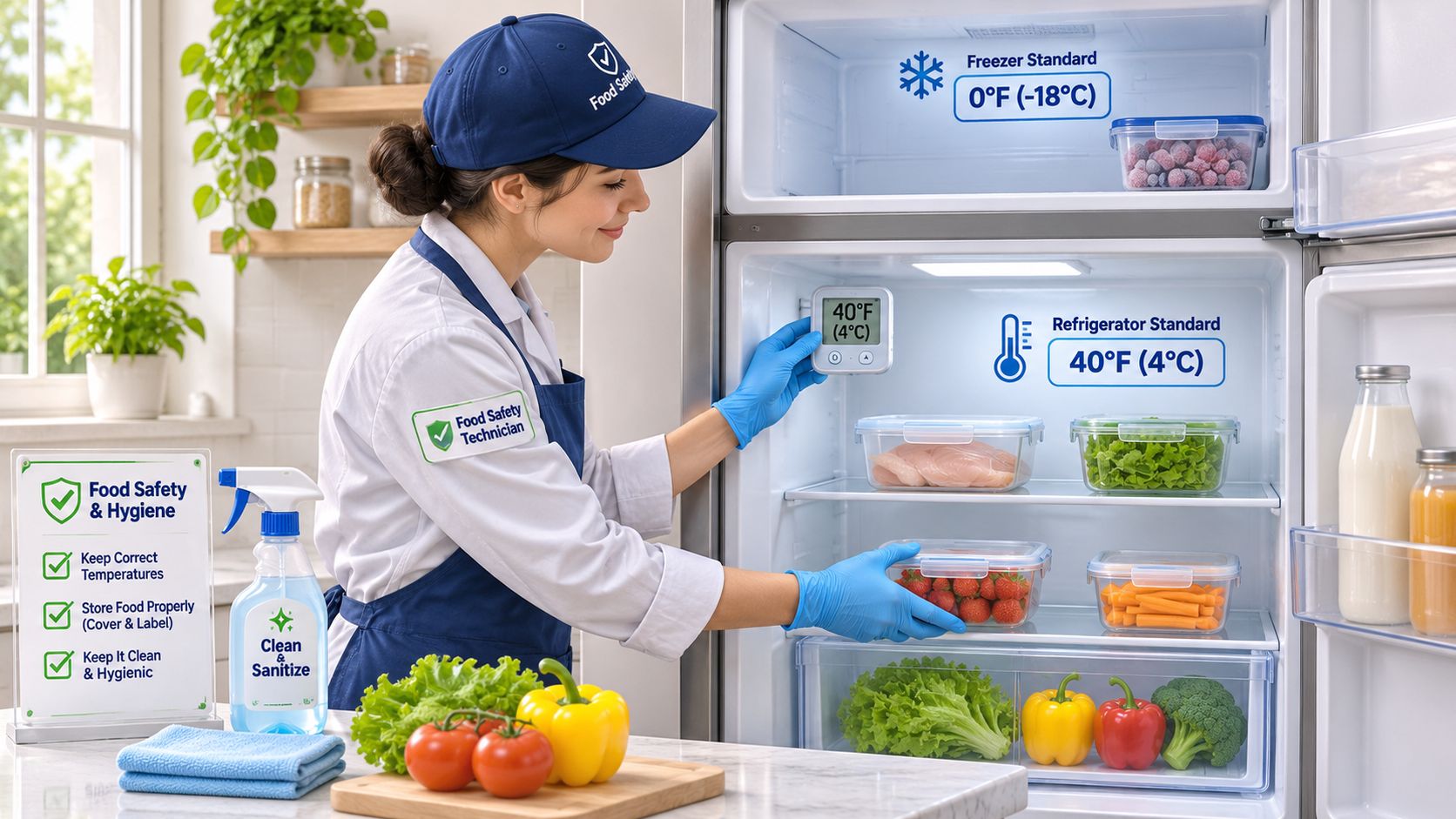
Listeria monocytogenes is the pathogen that makes this concrete. It can grow at refrigerator temperatures, which is unusual enough to matter. Most bacteria stall in the cold. This one keeps going, slowly, which is why a spill that sits for two weeks is a contamination problem rather than a cosmetic one.
Here's the cross-contamination path in one image. A package of raw chicken leaks on the second shelf. The drip runs to the front edge and down onto a tub of yogurt and a bag of grapes below. Nobody notices, because the fridge door is closed. A week later the yogurt is finished and the shelf looks fine, but the residue has been sitting there the whole time.
The weekly habit: check dates, throw out what's past its use-by date, wipe spills the moment they happen, and wash shelves, walls and bins on a regular cycle. Cold temperatures buy time. Cleaning is what removes the bacteria already there.
A professional visit adds two things a home wipe-down usually skips. The first is a thorough clean of the overlooked zones: the folds of the door gasket, the drip channel, the runners the drawers slide on. The second is a sanitizing pass over the surfaces food touches, so bacteria get removed rather than spread from one shelf to the next. Cleaning specialists arrive with professional-grade cleaning products, microfiber cloths and specialized tools, so the result doesn't depend on whatever spray happens to be under your sink.
Where this ends is worth saying plainly. A deep clean removes residue, odor and contamination risk from surfaces. It doesn't restore a failing door seal, revive a weak compressor or fix a fridge that's running warm. Problems like those get reported to you, not papered over with polish.
Protecting Your Food During the Visit
Food is the hard part of cleaning an occupied fridge. Everything else is technique. The groceries are the reason the job has a clock on it.
Before the technician arrives, move perishable food into a cooler with ice. Illinois Extension recommends exactly this, because unsafe temperatures let harmful bacteria grow while the fridge sits open. Keep the door shut until the visit starts, and don't unload early to "help."
During the visit the sequence runs in one direction: food comes out in a single batch, the interior and removable parts get washed, rinsed, sanitized and dried, and only then does anything go back. No half-loaded shelves, no food parked on the counter getting warm.
Ask us for our time limit on an open, unloaded refrigerator and confirm it when you book. That figure depends on the unit and the workload, and guessing at it is how people end up with a cooler full of lukewarm dairy.
One boundary is firm. Technicians don't decide whether questionable food is safe to eat. USDA guidance is to discard spoiled or questionable food, so if a container looks or smells wrong, it goes out. That's your call to make before the visit, or a disposal decision made with you, never an assumption made for you.
Product choice matters just as much. Solvent cleaners and abrasives get avoided around food and ice, since residues and fumes travel. And "sanitized" isn't automatically safer: over-applying chemicals creates its own contamination problem, which is why rinsing and drying are separate steps and not optional extras.
Before-visit checklist:
- Cooler ready: ice packs in, perishables out of the fridge just before the visit
- Questionable food pulled: anything past its date or smelling off, binned
- Fridge add-on confirmed: it appears on the quote, not just in conversation
- Time limit confirmed: you know how long the unit can stay open
- Products discussed: you know what touches food-contact surfaces
Odor and Residue Removal, Step by Step
A smell that survives a wipe-down usually has a source you haven't reached yet. The USDA Food Safety and Inspection Service guidance on removing refrigerator odors lays out the order, and the order is most of the value.
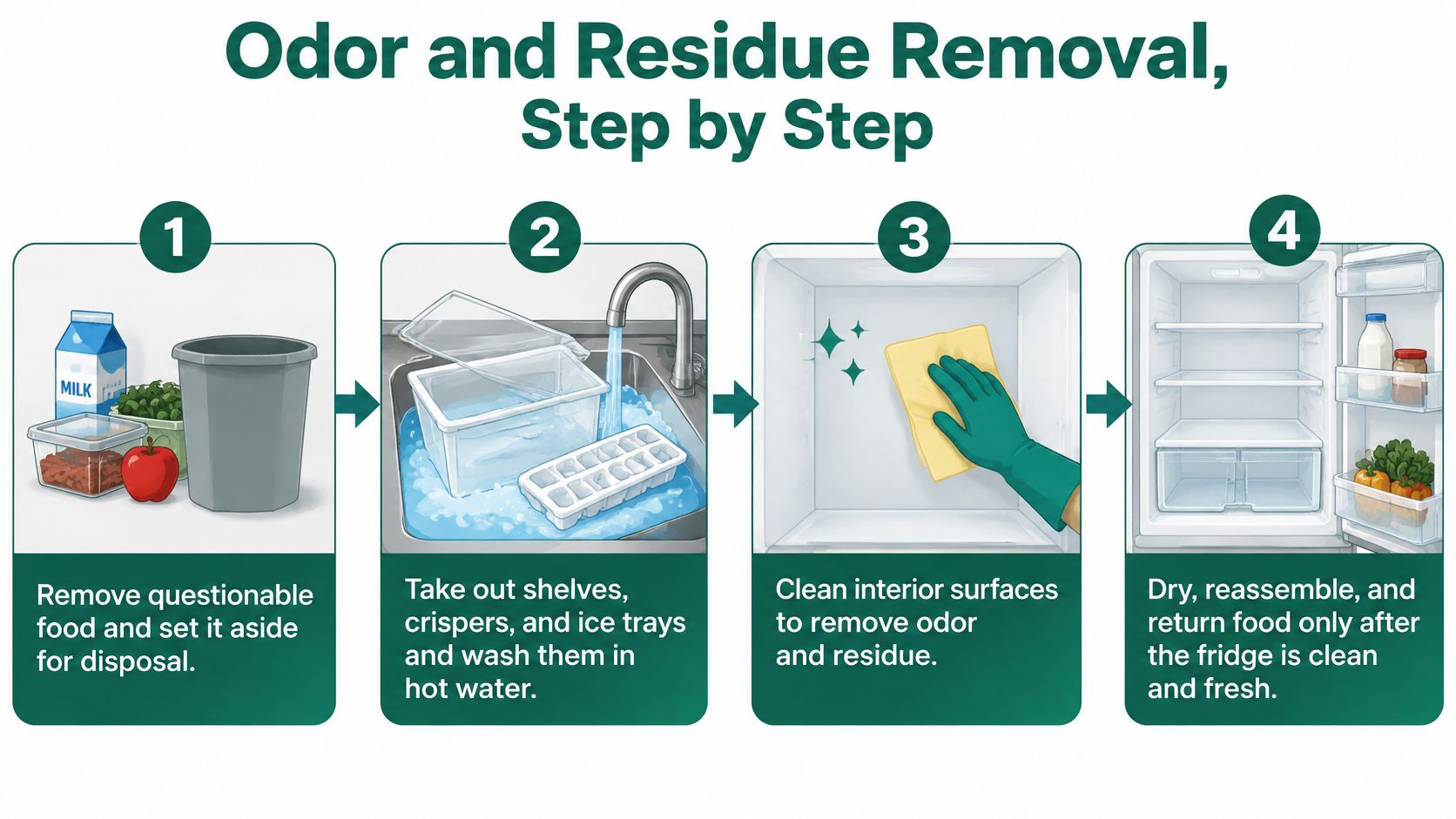
1. Remove questionable food and set it aside for disposal. Nothing downstream works if the source is still in the box. USDA's guidance starts here for a reason: spoiled food keeps releasing odor into a unit you're trying to clear.
2. Take out shelves, crispers and ice trays and wash them in hot water with mild detergent. Residue on removable parts is a common odor source, and a cloth wiped across a shelf in place never reaches the underside. Wash, rinse, set aside to air dry while you work on the interior.
3. Wash the interior, door and gasket, paying attention to the folds, then rinse everything. The gasket fold is where spills pool and stay. Run a cloth through the fold along its whole length rather than dabbing at the visible part.
4. Sanitize with 1 tablespoon of unscented liquid chlorine bleach per gallon of water. Apply it to cleaned surfaces only (a sanitizer on top of grease does nothing useful), keep it well away from food, and never mix it with vinegar or another cleaner.
5. Ventilate the empty unit with the door open for about 15 minutes. This clears fumes and lets you see whether any odor lingers at the back.
6. Dry every part fully before restocking. Damp shelves grow odor again within days. Dry the gasket folds too, then reassemble once the unit is back at temperature.
For the same reasons, skip abrasives and solvents on interior surfaces, since scrubbing baked-on residue off oven glass needs a very different product than a food-contact shelf does. What works on a scorched oven door can leave a film or a fume inside a fridge.
The repeat-odor rule: if a smell comes back within a week, don't reach for fragrance. Find the source. USDA notes that odor treatment may need repetition, which is a polite way of saying the first pass didn't reach the spill. Check under drawers, behind the crisper housing and in the drip tray.
Optional Add-Ons Worth Adding
Add-ons earn their place when they match the reason for the visit. Booking extras that duplicate what's already included is the most common way people overspend.
Customers can add oven interiors, refrigerator deep cleans, interior windows or baseboard detailing to the booking checklist, and each one fits a different situation.
The kitchen refresh. A fridge clean and an oven interior belong in the same visit. Both are appliance interiors that get skipped for months, and both take a similar kind of patient work. A standard kitchen clean already covers sanitizing countertops and sink basins, wiping the exterior of major appliances, cleaning the stovetop and backsplash, and deep scrubbing the floors, so pairing an oven interior with a fridge deep clean finishes the room rather than re-cleaning it.
The move-out. Interior windows and baseboard detailing suit a turnover clean, when the emptiest the home will ever be is right now. Baseboards near the fridge are often the grimiest stretch of wall in the kitchen, because they sit beside the spot where spills and crumbs collect.
The pre-sale. Same logic, different deadline. Windows and baseboards read as "cared for" to a buyer in a way that a clean fridge alone doesn't.
The bundle. One bundle option combines deep cleaning with premium appliance details for bundled savings, which is the sensible route if the oven and fridge both need work and neither has been touched in a year.
Decide in three questions: which surfaces are genuinely dirty, is that task already in the service I picked, and does the bundle beat booking the extras separately? If the answer to the second question is yes, cross it off.
How to Request a Fridge Cleaning Quote
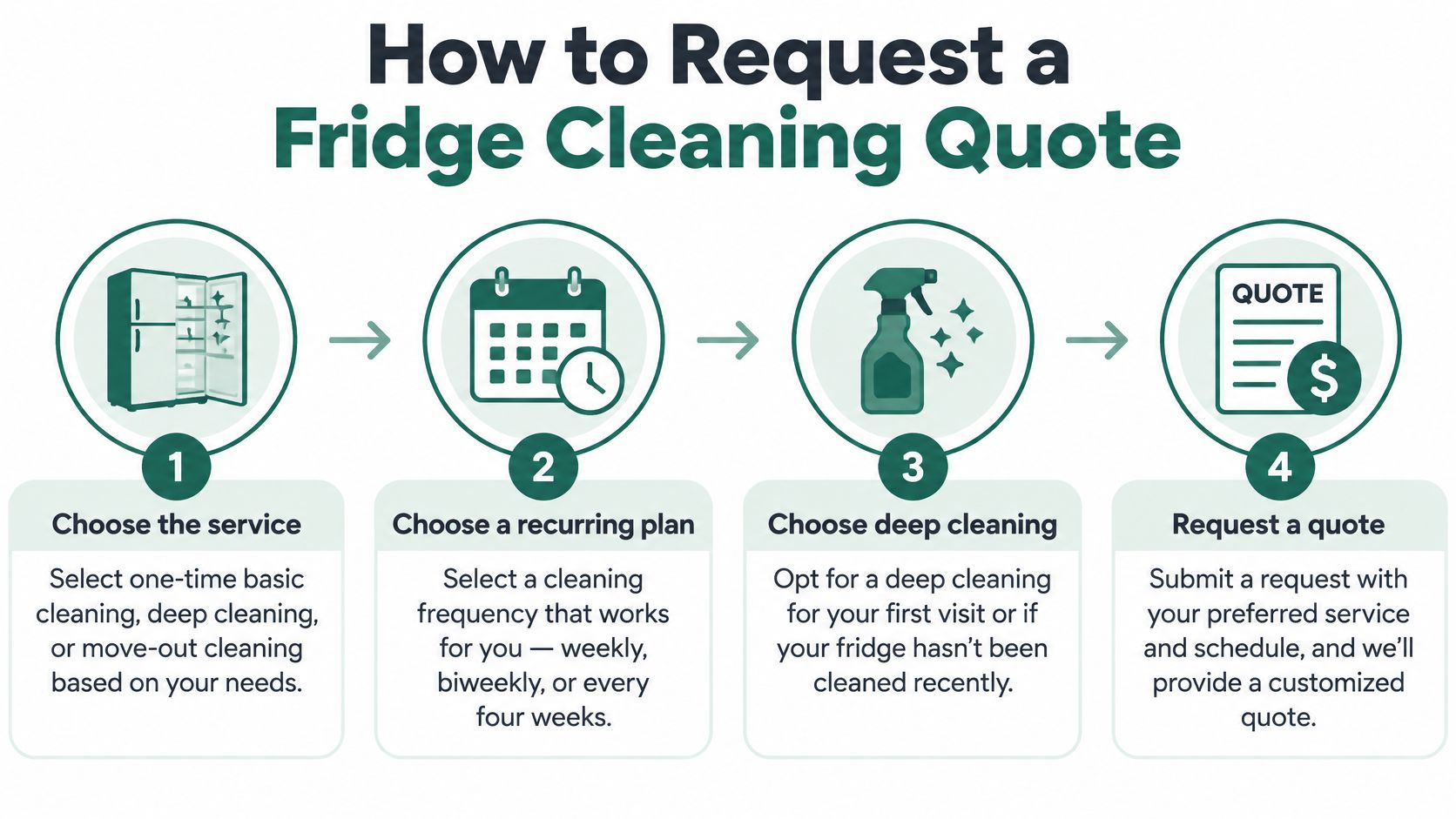
A clear quote gets built before anyone opens the fridge door. The order below keeps the add-on attached, the price fixed, and your food safe on the day.
Step 1. Choose the service. One-time options are basic, deep and move-in/move-out cleaning; recurring plans run weekly, biweekly or every four weeks. Deep cleaning is the right call for a first visit or a home that hasn't had professional cleaning in more than 30 days.
Step 2. Enter home size, bathroom count and extra tasks. The refrigerator deep clean goes in here, on the extras line. The most common mistake is booking without checking that the fridge appears on the quote. If it isn't listed, it isn't scheduled.
Step 3. Review the flat-rate quote. The price is set before booking, with no in-home estimate and no hourly billing. The exact rate shows in the quote tool once your service, home size and add-ons are entered.
Step 4. Pick a date that fits the cooler plan. Choose a day with the fridge add-on attached, and get perishables into a cooler that morning. You can select an available date online or arrange it by phone.
Step 5. Confirm the utilities are running. Hot running water, working electricity and a climate-controlled indoor temperature are required during the visit. A shut-off water main or a broken outlet means the clean can't run as planned.
Step 6. Ask what touches food-contact surfaces. You're entitled to know which products go inside the compartment where your food lives, and the answer tells you whether a company treats the job as food safety or as shine. The questions worth asking a house cleaner apply here in the same spirit.
Which to choose. If the fridge hasn't been cleaned in months, or you're moving, book a one-time deep clean, which starts at $355, with the refrigerator add-on. If it's already in decent shape, a recurring plan keeps it that way: weekly visits start at $117, biweekly at $168 and four-week visits at $191, with discounted flat rates, dedicated scheduling windows and consistent cleaners for recurring clients. Add the fridge to a visit now and then, and it stays a quick job instead of a restoration.
---
A fridge clean is a food-safety job wearing the label of a household chore: everything comes out, surfaces get washed, rinsed, sanitized and dried, the temperature gets checked, and only then does the food go back. Cleaning specialists arrive with professional-grade products, microfiber cloths and HEPA vacuums for that work, the refrigerator deep clean sits on the booking checklist as an add-on to one-time or recurring visits, and the flat rate is quoted before you book. Visit Carmen Family Cleaning to build your quote, add the fridge and pick a date.