Shared high-touch surfaces and restrooms need cleaning at least once every workday, while floors and dust-prone areas hold at weekly service, with the whole schedule climbing as traffic climbs. Search for how often should offices be cleaned and most guides hand back one number: daily, twice a week, or a quarterly deep clean. A single number answers the wrong question. Offices aren't cleaned as a building, they're cleaned as a set of zones and surfaces, and each one has its own contact rate, soil load and failure mode. A door handle on a 120-person floor fails in hours. The carpet under six empty hybrid desks fails in weeks.
What holds up is a tiered schedule: touchpoints and restrooms daily, floors and horizontal surfaces weekly, glass and vents on monthly and quarterly cycles, plus written triggers that move a zone up a tier when the way the space is used changes. Frequency is a budget. Spend it where hands land and where dirt enters, and cut it where nobody sits.
Recommended Cleaning Frequency by Office Area
Frequency is set area by area, not building by building. The U.S. Centers for Disease Control and Prevention facility cleaning guidance names door handles, desks, tables, phones, light switches and faucets as surfaces touched by multiple people and says they should be cleaned and disinfected at least once per day, with cleaning staff directed to offices, bathrooms and common areas with particular attention to high-touch points.
That's a floor, not a ceiling. In a busy office with shared desks, meeting rooms, kitchens, elevators or heavy staff turnover, one daily pass isn't enough, because repeated contact recontaminates surfaces during the working day, and the same guidance recommends more frequent cleaning or added disinfection for high-traffic areas. One door handle can collect every hand on the floor before lunch.
| Area | Recommended frequency | Reason |
|---|---|---|
| Door handles, light switches, elevator buttons | Daily, at least once per workday | Touched by many people each day |
| Shared desks, phones, keyboards | Daily wipe-down | Shared equipment passes between users |
| Restrooms | Daily; second pass in busy offices | Heavy use and frequent fixture contact |
| Kitchens and break rooms | Daily wipe-down; weekly full clean | Food residue and shared appliances |
| Reception and entrances | Daily vacuum or dust-mop | Dirt tracked in from outside |
| Corridors and high-traffic floors | Daily vacuum or dust-mop | Foot traffic lifts settled dust |
| Private desks and workstations | Weekly dusting | Lower contact when not shared |
| Low-traffic carpets | Weekly HEPA vacuum | Dust settles between visits |
| Hard floors in offices | Weekly mop | Soil builds up gradually |
| Interior glass and partitions | Monthly | Fingerprints and haze |
| Vents, ceiling fans, light fixtures | Quarterly | Dust collects slowly; confirm with facilities |
Two rows carry real risk and deserve the argument: restrooms and kitchens. Both need the daily clean, and in a busy office they need a second daytime pass that restocks paper and soap and wipes the fixtures and appliance handles people hit at lunch. If the budget stretches to only one tier, fund those and the touchpoints, and let the interior glass wait.
The monthly and quarterly rows are where schedules fail, because nobody notices a haze until a client visits. Interior glass and partitions collect fingerprints and film on a monthly cycle. Vents, ceiling fans and light fixtures collect dust slowly enough that a quarterly clean is right, but confirm who owns the HVAC side before you assign it to a cleaner.
If you want a model for how to group tasks by how fast they fail, our house cleaning checklist runs the same daily, weekly and monthly logic at room scale. Then list every area of your own office, assign each one to a row, and protect the daily touchpoints and the restrooms first.
What Actually Sets Your Office Cleaning Frequency
Square footage is the number every quote asks for and the one that matters least. A home hallway and a hotel lobby can measure the same and need completely different attention, because one sees a family and the other sees a revolving door. Offices work the same way, and the variable is contact.
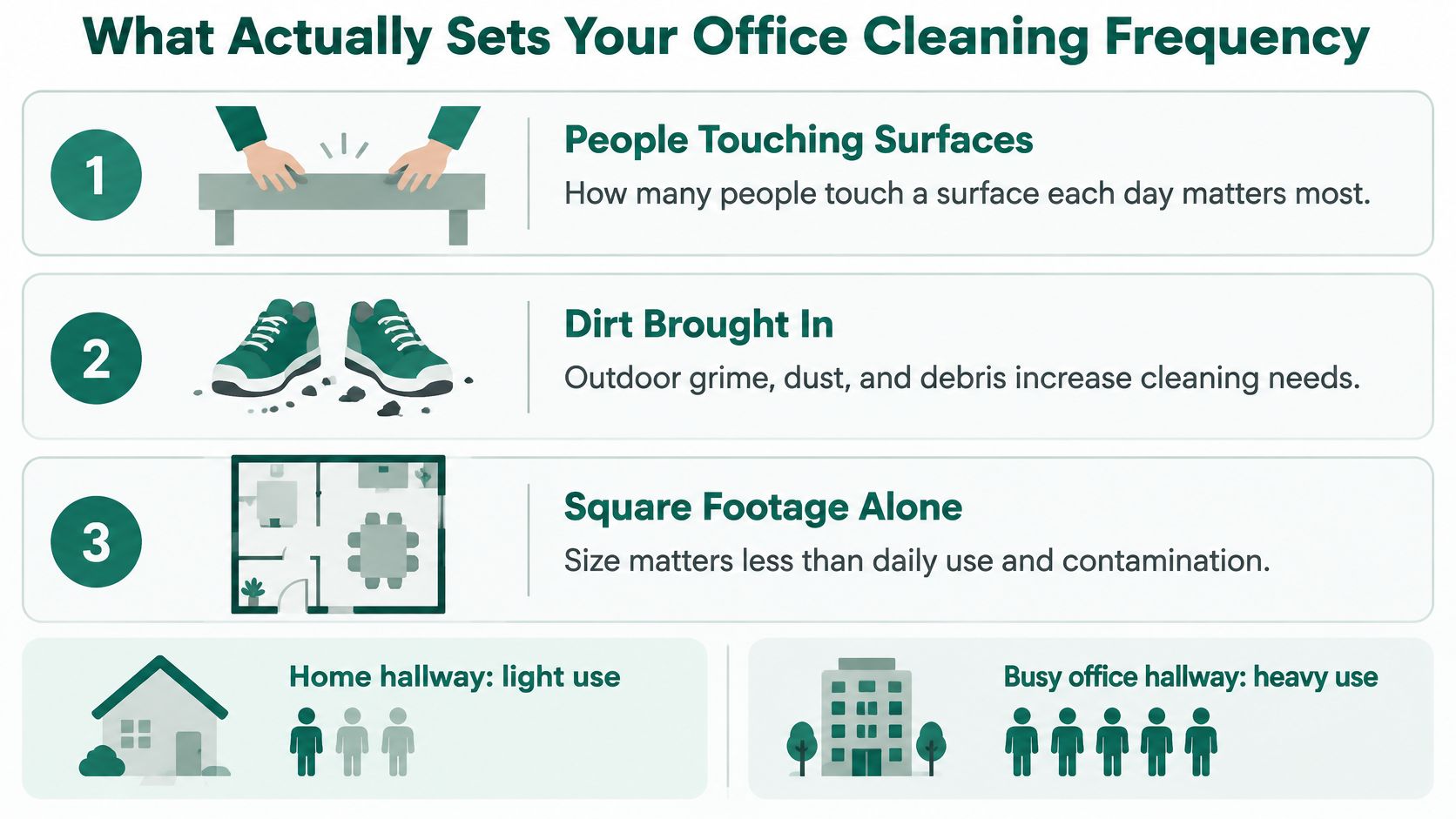
Track the people who arrive, not the roster. A 100-person company with 25 people in the building most days generates less restroom traffic, less food waste and fewer fingerprints than the same floor at full attendance. Delivery drivers, interviewees and clients add another set of feet through reception and another set of hands on the door.
Shared equipment and food reset everything. A kitchenette with a coffee machine, a fridge and a microwave generates daily soils that no private office produces, and hot-desking turns every desk into a shared surface.
The OSHA permanent workplace sanitation standard, 29 CFR 1910.141 keeps the rule risk-based. It requires that sweepings, waste, refuse and garbage be removed in a way that avoids creating a health hazard and "as often as necessary or appropriate" to maintain sanitary conditions. No weekly figure appears in it, so you're responsible for justifying your own interval.
The test I use: if you can't explain why a surface sits on a weekly cycle instead of a daily one, it's on the wrong cycle.
Take two offices with the same 40-desk floor plan. One runs 40 full-time staff on site five days a week. The other runs the same 40 desks at 50 percent hybrid attendance. The floor plan is identical; the touchpoint load isn't. The hybrid office can move private-desk dusting and low-traffic carpeting to a lower tier and keep touchpoints and restrooms daily, and it should concentrate the heavier work on the two or three days everyone shows up.
Four questions set your number:
- How many people arrive each day? Count badge data or a headcount, not contracts.
- How many visitors and deliveries come through reception? Each one adds entry-floor soil and a fresh pair of hands.
- What is shared? Desks, headsets, printers, microwaves and meeting-room remotes all shorten the interval.
- Where does dirt enter? A ground-floor entrance next to a parking lot is not the same as a fourth-floor suite reached by elevator.
Dust, Air Quality and Building Fixes
Dust is the second reason to clean, and the one most schedules ignore. Cleaning gets judged by how a surface looks, but dust on a sill or a vent doesn't stay there. Foot traffic and the act of cleaning both lift settled particles back into the air, which is why the ASHRAE indoor environmental quality guidance treats complaints about dust, mold, odor and stuffiness as inspection triggers rather than calendar items.
The benchmark that follows is tiered. Vacuum or dust-mop entrances, corridors, cafeterias and other high-traffic zones daily, give lower-traffic office floors and horizontal surfaces at least weekly attention, and raise the frequency wherever occupants report dust, odors, allergies or visible soil. HEPA-equipped vacuums and microfiber cloths cut redistribution compared with dry sweeping, but they don't replace ventilation and filtration maintenance.
When a Clean Floor Still Releases Dust
Say a call center moves twice as many agents onto a floor that used to run half empty. A month later, staff complain about dust and afternoon headaches, and weekly vacuuming is still happening on schedule. The fix isn't another disinfection round. It's more frequent vacuuming of the aisles and entry mats, plus a filter and airflow check, because the room now processes more air and sheds more lint than the old schedule assumed.
Three signals point to dust rather than germs: a visible film on sills, returns and vent grilles within a week of cleaning, several staff with allergy-type symptoms in the same zone, and renovation or construction within a block of the building.
Where Cleaning Stops and Building Work Starts
Cleaning handles soil on surfaces. It doesn't rebalance a ventilation system, and it can't fix humidity. The handoff matters because cleaning crews get blamed for problems they have no tool to solve.
| Problem | Cleaning response | Building or HVAC response |
|---|---|---|
| Stale or stuffy air in meeting rooms | Vacuum and dust the vents you can reach | Check ventilation rate and airflow balance |
| Dust returns within a day of cleaning | Switch to HEPA vacuuming and microfiber | Replace or upgrade air filters on schedule |
| Persistent odor in corridors | Remove waste sources and clean floors | Inspect drains, ducts and humidity levels |
| Humidity or mold on surfaces | Wipe and dry affected areas promptly | Control humidity and repair leaks |
| Allergy complaints from several staff | Raise vacuum and dust-mop frequency | Review filtration and ventilation with an HVAC contractor |
| Hot or cold zones | No cleaning fix | Rebalance HVAC zones |
The gap between what workers notice and what cleaning can fix is wide. In North American survey data reported by ISSA, 77% of Millennial and Gen Z workers reported at least one workplace indoor-air-quality concern, only 61% believed their employer was taking the right steps, and 45% said poor indoor air quality could make them consider leaving their employer. A second cleaning round answers none of that. Ventilation, filtration, humidity control and visible monitoring do.
The vents, ceiling fans and light fixtures on the quarterly cycle are restoration work rather than weekly work, which is where our deep cleaning service fits. Write the other half into the contract too: name who inspects filters, who logs the complaint, and who calls the HVAC contractor.
Adjusting the Schedule for Traffic, Hybrid Teams and Illness
A schedule written for an average week breaks on the weeks that aren't average. The baseline stays fixed, and the exceptions get written down in advance so nobody improvises them on a Monday morning.
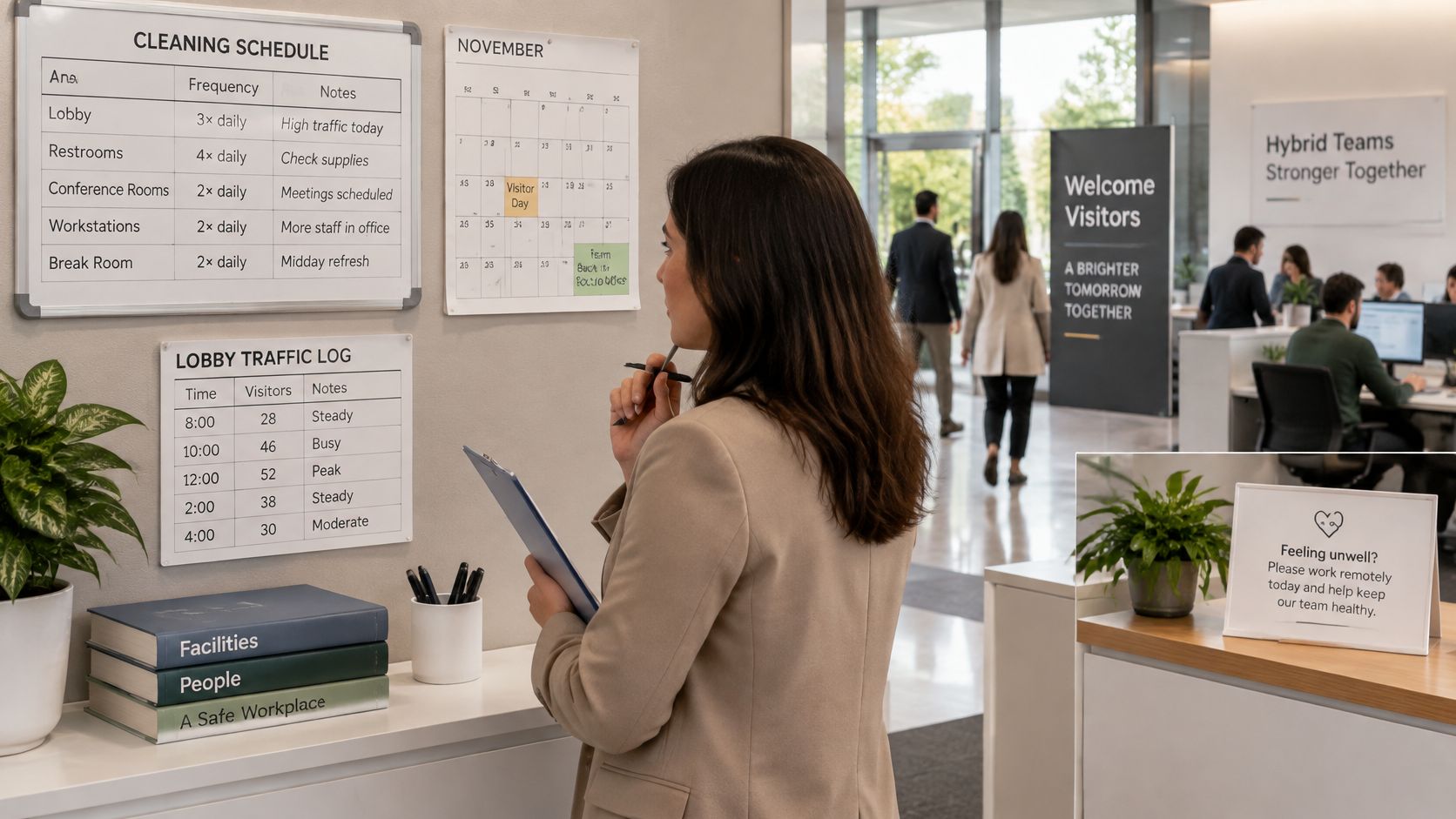
Hybrid is the biggest adjustment most offices still haven't made. A team that comes in three days a week doesn't need private-desk dusting five days a week, but those three days are heavier than the old daily average, so touchpoints and restrooms stay daily and the desk work drops to every two weeks. That's the point of a recurring commercial cleaning schedule: the baseline is fixed, and the adjustments are agreed in writing.
Illness is the one trigger that should move within hours. The CDC guidance on when and how to clean and disinfect a facility makes routine cleaning with detergent and water sufficient for everyday prevention, with disinfection added when someone has been visibly ill, when contamination is suspected, or when the space is especially high-traffic.
| Trigger | Adjust to | Example |
|---|---|---|
| Visitor or client traffic doubles | Add a midday restroom and reception pass | Front desk in a clinic-style office |
| Hybrid attendance below 50% | Move private-desk dusting to every two weeks; keep touchpoints daily | Team in the office three days a week |
| Staff member reports illness | Disinfect touchpoints the same day, then return to baseline | Seasonal flu period |
| Shared desks or hot-desking introduced | Daily wipe-down of every desk and keyboard | Coworking-style floor |
| Visible spills or food waste | Clean on the spot and check the kitchen the next day | Break room overflow |
| Renovation or construction nearby | Weekly dust-mop and HEPA vacuum of corridors | Floor refit on the same level |
| Recurring dust or odor complaints | Inspect vents and filters; raise dust-mop frequency | Stuffy meeting room |
Here's how those adjustments play out on a real floor:
Staff confidence is a real cost of cutting back, and it isn't always proportional to risk. A Stratus Building Solutions survey of 521 people found that in 2025, 66.6% of employees expected their workplace to be cleaned and sanitized every workday, while 24% expected cleaning one or two times per week. A visibly reduced schedule reads as a downgrade even when the occupancy math says otherwise, so explain the reasoning and keep the visible work visible.
Pick your two most likely triggers, write the matching rule next to each, and set the date the adjustment expires.
How to Check Whether Your Schedule Works
Every manager asks the same thing after signing off on a schedule: how do we know it's working? Appearance won't tell you, because a floor looks fine right up until it doesn't. Evidence will.
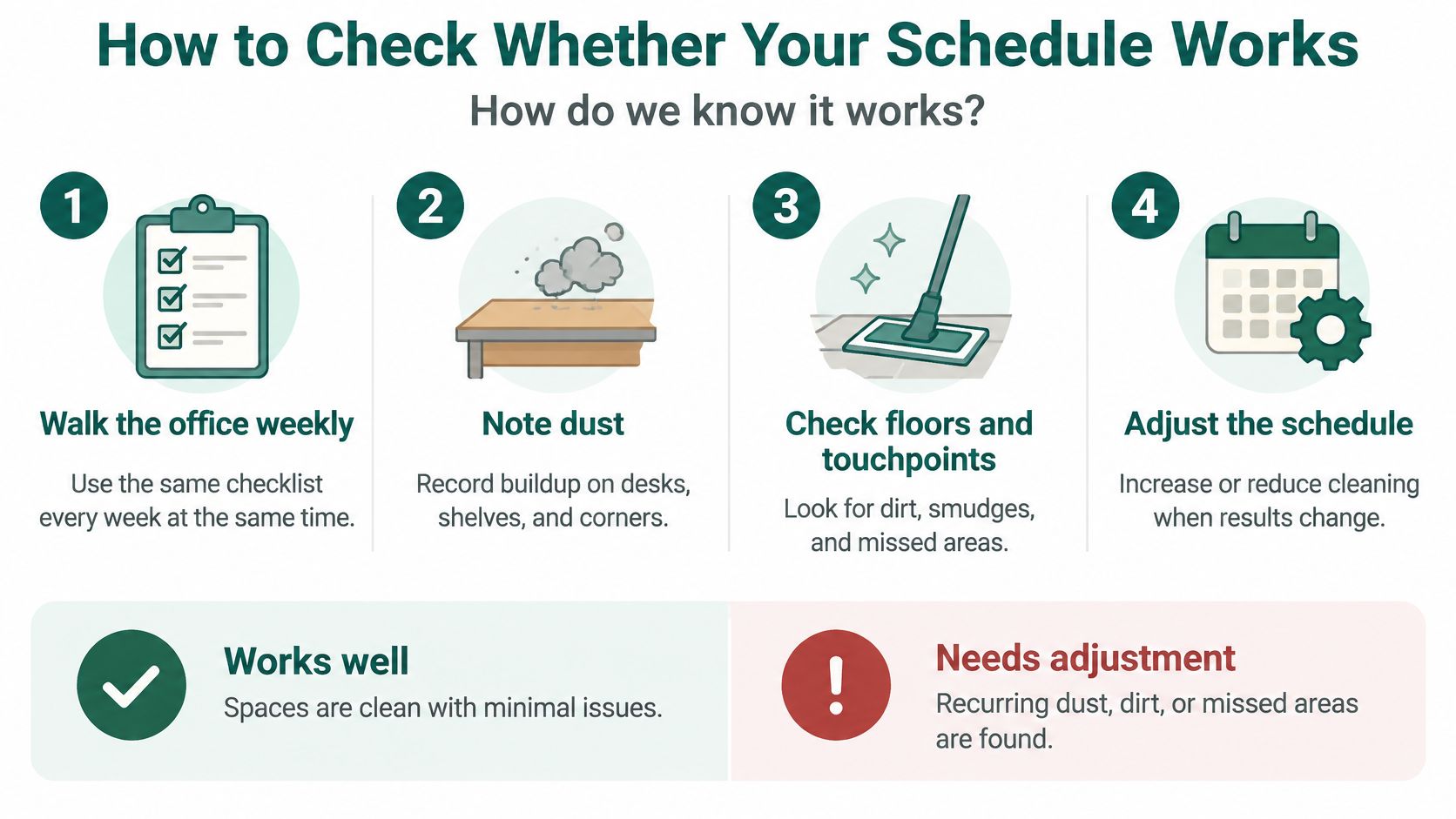
1. Walk the office weekly with the same checklist, at the same hour. Note dust on sills and vent grilles, sticky touchpoints and empty dispensers. The fixed hour matters because checking only on cleaning days hides what builds up by 3pm.
2. Log every complaint with date, area and type. Dust, odor, allergy and stuffiness complaints point at different causes, and a written log shows whether the same corner keeps failing.
3. Record filter change dates and HVAC service visits beside the cleaning log. When a dust complaint repeats, this is how you tell whether the building or the schedule is behind.
4. Photograph the same three zones every week. Side-by-side images show whether dust returns in two days or six, which is the number that sets your interval.
5. Track restroom supply run-outs and end-of-day bin levels. Both are early warnings that traffic has outgrown the current frequency, and both are cheap to count.
6. Compare the log with the schedule once a month. If the same complaint appears three weeks running, raise the frequency for that area or ask facilities to inspect the source rather than absorbing the complaint again.
7. Review the whole schedule quarterly, and after any change in headcount or layout. A plan that fit last year's hybrid pattern often doesn't fit this year's.
The routine you end up with looks a lot like the one in our guide to maintaining a clean home: a fixed baseline, a short checklist and a periodic adjustment based on what happened.
A schedule that works shows three signs. Repeat complaints drop to almost none, dust doesn't return within a few days of a clean, and restrooms are stocked every time anyone checks. If all three hold, the interval is right and you can leave it alone.
Set Your Office Cleaning Schedule This Week
A workable schedule is a list of areas, intervals and owners, not a slogan about cleanliness. Make five decisions before you book anything:
1. List every area of the office, including the ones nobody thinks about, such as the mailroom, the shower room and the storage corridor.
2. Assign each area to daily, weekly, monthly or quarterly using the frequency table, and note the second-pass zones.
3. Add the triggers that apply right now, whether that's hybrid attendance under half capacity, a renovation next door or a recurring stuffy meeting room.
4. Decide who does the daily touchpoint work, whether in-house staff handle a midday wipe or a contractor covers it.
5. Set a review date in the calendar, at least quarterly and again after any hire, floor move or layout change.
Then price the tier you chose. Commercial cleaning through Carmen Family Cleaning starts at $455 as a one-time clean, and recurring clients get dedicated schedule windows and consistent cleaners, which matters when the same person learns where your touchpoints are. A one-time clean can reset a neglected floor; recurring visits keep it there.
Recurring office cleaning runs weekly, every two weeks or every four weeks, so the daily touchpoint work you protected doesn't slide when a one-time crew finishes and leaves. If you'd rather hand the whole tier over than juggle it in-house, Carmen Family Cleaning serves Milwaukee and the surrounding communities. Request a quote with your area list and busiest day in hand, and choose the recurring interval that fits your schedule.