
You get home at 6 p.m. and the second shift starts immediately. Dinner needs cooking, homework needs checking, backpacks need unpacking, and the kitchen you cleaned on Sunday already looks used. By Friday, the weekend isn't rest. It's catch-up cleaning.
That pattern isn't a discipline problem. Time-use research consistently shows that mothers who work for pay still carry a heavy share of the housework, just with fewer hours to do it in. Paid work cuts the time available, but it doesn't cut the laundry, bathrooms, or floors.
Most schedules fail because they assume free evenings, predictable weekends, and energy left after the commute. A realistic cleaning schedule for working moms has to fit school runs, late meetings, sick kids, and tired Thursday nights. Below are seven methods, each judged on what it costs you in time and headspace, who it fits, and where it breaks down.
1. FlyLady Zone Cleaning
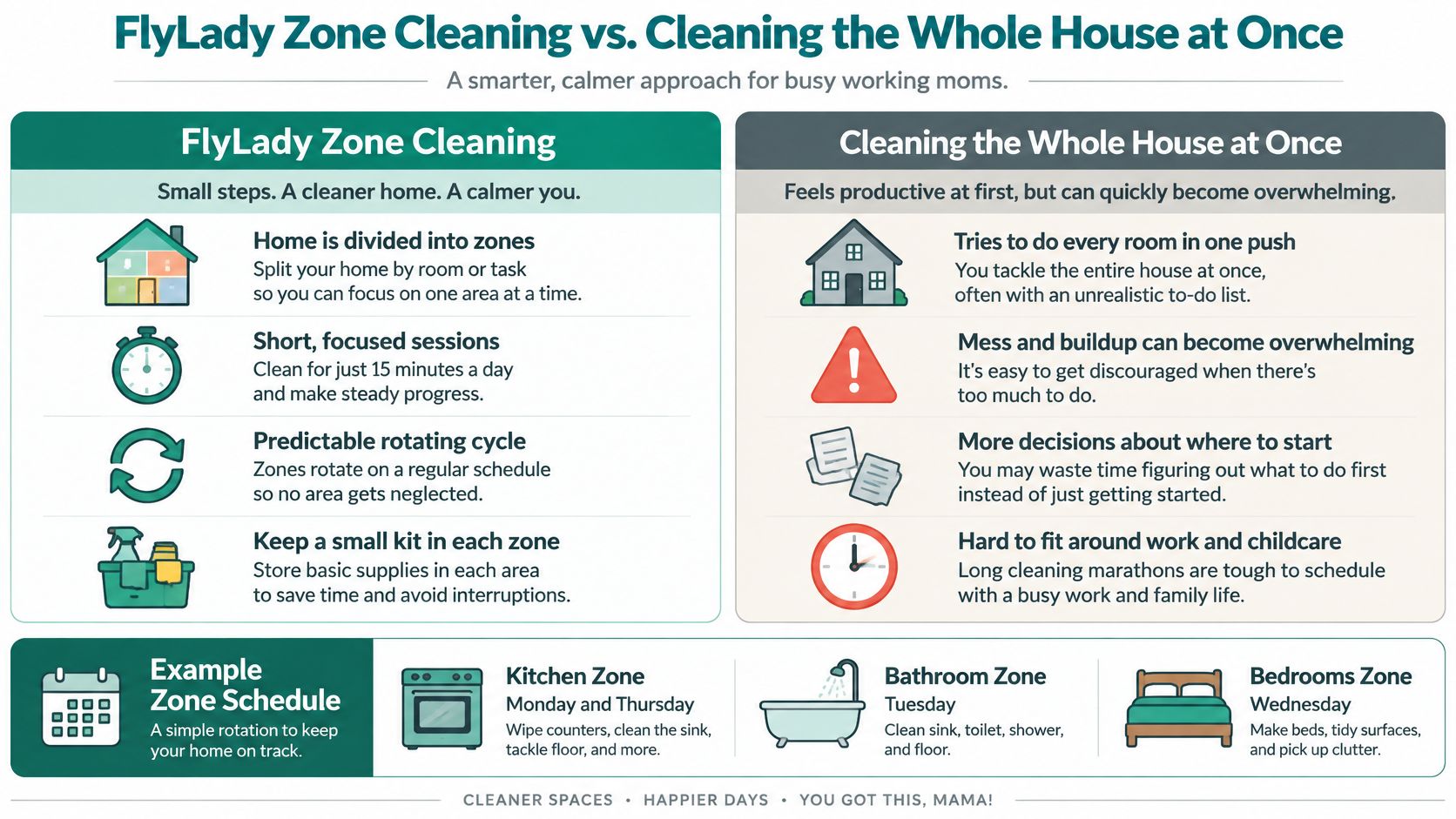
Zone cleaning splits your home into defined areas and works one area at a time on a rotation. You aren't cleaning the whole house. You're spending 15 minutes in the current zone, then stopping, even if the zone isn't perfect.
That stop point is why it survives busy weeks. A kitchen zone on Monday and Thursday, bathrooms on Tuesday, and bedrooms on Wednesday gives every room attention without a two-hour block you don't have. Miss Wednesday, and the rotation still rolls forward on Thursday.
How to Make It Stick
Start with one or two zones, not five. Add another only after the first ones feel automatic. Set a kitchen timer so the session has a hard end, and keep a small caddy in each zone with a microfiber cloth and all-purpose spray so you don't lose five minutes hunting supplies.
Capacity matters more than square footage here. The Bureau of Labor Statistics daily time-use summary for married mothers found full-time working mothers with a youngest child ages six to seventeen averaged 2.0 hours per day on household activities, while those with a child under six averaged 1.7 hours but spent far more time on direct care. If you've got a preschooler, shrink zones and rotate slower.
Verdict: Best for moms who can grab 15 minutes but never a free afternoon. Weakest on deep grime, which zones maintain rather than remove.
2. Themed Day Rotation Schedule
A themed day plan assigns one job category per day. Monday is laundry and bedding. Tuesday is bathrooms. Wednesday is dusting. Thursday is a kitchen deep wipe. Friday is vacuum and mop.
You don't decide what to clean each night. The calendar already decided, and that matters more than the cleaning itself. Research on 3,000 U.S. parents found mothers handled 71% of household tasks requiring mental effort, compared with 45% for fathers, per the British Psychological Society research digest on household mental load. A visible rotation moves that planning off one person's brain.
Sharing the Days
- Post it where everyone sees it: Put the rotation on the fridge or in a shared calendar, with a name beside each day, not just a task.
- Split ownership, not help: In a two-parent home, each adult owns specific themed days outright, including noticing when supplies run low.
- Protect one flex day: Leave Sunday or Wednesday open for catch-up, so a missed Tuesday doesn't cascade.
The failure mode is rigidity. Bathroom day landing on your latest work night turns a simple system into guilt. Swap the theme to your lightest evening, even if the order looks odd on paper.
Verdict: Best for families who like a repeatable calendar and want to share ownership. It struggles when workdays swing wildly week to week.
3. Daily 15-Minute Reset
The reset is the smallest method on this list and, in my judgement, the most important. Every evening, you spend 10 to 15 minutes returning high-traffic spaces to baseline. Clear the counters, load the dishwasher, wipe the stove, put shoes and bags in the entryway, fold the throw blanket.
It isn't deep cleaning. It's damage control that stops Tuesday's small mess from becoming Saturday's project. Recent pooled U.S. time-use research found full-time working mothers spend about 1.6 times as much time on childcare and household work as full-time working fathers, according to the American Institute for Boys and Men data spotlight on gender gaps in unpaid work. A short shared reset is one realistic way to close that gap without a family negotiation.

Keep the list to five to seven tasks and tape it inside a kitchen cabinet. Pair it with a habit you've already got, like right after dinner or while kids brush teeth. Every person carries their own items out of the room before the timer ends.
Practical rule: If a task takes under two minutes, it belongs in the reset. If it needs a bucket, it doesn't.
Pair the reset with weekly recurring cleaning or your own weekly session for floors and bathrooms. On its own, it keeps things tidy but never fully clean.
Verdict: Fits almost every working parent. It's an anchor, not a complete system.
4. Weekend Batch Cleaning
Batch cleaning does the opposite of a daily routine. You group the main work into one focused weekend block, then coast on light tidying during the week. Saturday morning might cover bathrooms, kitchen, dusting, and floors in a single push, with a short Sunday evening reset before the school week.
For parents whose weekdays are gone, this is honest. You're not pretending you'll scrub a tub at 8:30 p.m. after a commute and bedtime stories. Two adults splitting the block, one on floors and one on bathrooms and kitchen, can finish in about half the solo time.

Keeping the Block From Eating the Weekend
Set a start time and a stop time before you touch a sponge. Gather every supply first, since stop-and-go trips to the store cupboard double the session. A playlist or timer keeps the pace up better than willpower does.
The trade-off is real, though. One sick kid, one soccer tournament, or one visit from grandparents and the whole week's cleaning vanishes, with no weekday habit to fall back on. Homes with pets or toddlers also don't stay clean for six days after a Saturday push.
If weekends are your only window but they're shrinking, a one-time basic cleaning can reset the house so your batch sessions maintain instead of rescue.
Verdict: Best for predictable weekends and weekday schedules with zero slack. Fragile when weekends fill up.
5. Speed Cleaning Method
Speed cleaning isn't a schedule by itself. It's a technique you drop into any schedule when you've got a short window and need a visible result. You work top to bottom and back to front so dust and debris fall once, onto surfaces you haven't done yet.
Say guests are coming in half an hour. You dust high surfaces, wipe kitchen and bathroom counters, swish the toilet, empty visible trash, and vacuum only the main living area. The house reads clean because you spent every minute on what eyes and noses notice first.
The method respects a hard truth. One recent report found 92% of working parents surveyed across the United States, United Kingdom, and India reported symptoms of burnout, cited in a recent paper on household work and working families. On a depleted week, a fast hygiene pass beats an ideal routine you abandon by Wednesday.
Watch the sequence in action before you try to time yourself.
Three Rules That Save the Most Time
- Carry everything in one caddy: Spray, cloths, and a small trash bag travel with you from room to room.
- Dust before you vacuum: Anything you knock down gets picked up instead of resettled.
- Time each room once: A real benchmark turns "clean the bathroom" into a known quantity you can slot into a busy evening.
Verdict: Best for pre-guest scrambles and low-energy weeks. It hides buildup, so it can't replace regular scrubbing forever.
6. Monthly Deep-Clean Rotation
Some tasks don't belong in a weekly routine at all. A monthly rotation assigns one deeper job per week. Week one is baseboards and door frames. Week two is interior windows and light fixtures. Week three is appliance interiors. Week four is under and behind furniture.
This solves the forgetfulness problem, not the daily mess problem. Baseboards and oven interiors don't announce themselves like a sticky floor does, so they slide for months until they need a miserable half-day rescue. One small rotation item a week prevents that backlog.

The long view supports this kind of maintenance thinking. Over recent decades, the share of housework done by mothers has fallen while fathers' share has risen, so the jobs that remain need a system rather than spare time that no longer exists. A dated rotation is that system. Twenty minutes on a Saturday morning beats losing a whole Sunday in October.
A rotation works because each deep task gets a date, not a vague intention to get to it someday.
Write the four tasks on your calendar with a reminder. Start with whichever has the most visible payoff, usually windows or the refrigerator. If a rotation item takes longer than your free hour, shrink its scope rather than skipping it: one oven rack beats zero.
For the longest jobs, like oven interiors and grout, monthly recurring cleaning can absorb the detail work while you keep the weekly basics, and you don't need to be home during the visit.
Verdict: Best as a layer on top of weekly cleaning. Useless as your only schedule.
7. Hybrid Professional and DIY Schedule
The hybrid model pairs recurring professional cleaning with light family upkeep between visits. The service handles the labor-intensive work, bathrooms, floors, kitchen scrubbing, and dusting, at a fixed interval. You handle the daily reset and put things away so visit time goes to cleaning, not tidying.
A common setup is biweekly maintenance plus a 15-minute nightly reset. Households with young kids, pets, or long commutes often start with a deep clean, then move to weekly visits during heavy seasons like back-to-school. Optional tasks such as interior windows or oven cleaning get added quarterly instead of piling onto your monthly rotation.
What to Sort Out Before the First Visit
Clear surfaces and pick up floors beforehand, since every minute spent moving clutter is a minute not spent scrubbing. Tell the service about delicate surfaces and preferred products upfront. Our technicians arrive with commercial-grade, family-safe supplies and equipment unless you request a customized arrangement, and you don't need to be home during recurring visits.
Before booking, review questions to ask a house cleaner so you're clear on what's included, what's optional, and how scheduling windows work. Recurring clients receive dedicated schedule windows and consistent cleaners, which removes the rebooking and re-explaining that makes hired help feel like another chore.
Cost test: Compare weekly, biweekly, and four-week pricing against the weekend hours you'd honestly spend cleaning, not the hours you wish you'd spend.
Verdict: Best when your time is worth more than the visit cost and DIY systems keep collapsing. The daily reset still matters between visits.
7 Cleaning Schedules for Working Moms at a Glance
Every method below was weighed against commute windows, school runs, and weekend trade-offs, so read the Main Drawback column first.
| Schedule | Time Commitment | Best For | Main Drawback |
|---|---|---|---|
| FlyLady Zone Cleaning: Rotating zones on a daily or weekly cycle | Short focused sessions, often 15 minutes | Households that want a predictable weekly routine | Skipped zones create a growing backlog |
| Themed Day Rotation: One cleaning category assigned to each weekday | About 15–30 minutes each weekday | Families who want a clear, shareable weekly plan | Rigid when workdays run long |
| Daily 15-Minute Reset: Brief evening routine for high-traffic areas | About 10–20 minutes daily | Keeping things tidy with limited free time | Does not replace deeper cleaning |
| Weekend Batch Cleaning: One or two focused sessions on the weekend | Often 2–4 hours per week | Parents with packed weekdays and open weekends | Consumes a large block of family time |
| Speed Cleaning Method: Quick, ordered cleaning sessions as needed | About 20–30 minutes per session | Fast visible results before guests or after hectic weeks | Hidden buildup may be missed |
| Monthly Deep-Clean Rotation: One deeper task each week, alongside routine cleaning | One deep-clean task weekly, plus regular cleaning | Preventing buildup in overlooked areas | Requires extra planning |
| Hybrid Professional and DIY Schedule: Recurring professional visits with family resets between visits | Visits weekly, biweekly, or every four weeks, plus light upkeep | Working parents who want consistent results and more free time | Ongoing service cost |
Build Your Schedule or Hand Off the Heavy Work
Don't try to run all seven methods. Pick one daily anchor and one weekly structure, then let everything else support those two. For most working moms, that means the 15-minute reset every night plus either themed days, zone cleaning, or a professional visit handling the heavy weekly work.
Match the pairing to your actual bottleneck. If evenings are impossible but weekends are open, choose weekend batch cleaning with a speed-clean pass midweek. If you can find 15 minutes but never two hours, choose zones plus a monthly rotation. If the problem is that you're the only one who notices, plans, and checks, choose themed days with named owners so the mental work gets shared, not just the scrubbing.
Build in a minimum viable week for illness, travel, and deadline crunches. That floor is kitchen food surfaces, bathroom touchpoints, trash out, and one load of laundry. Everything cosmetic waits. A schedule with no collapse mode isn't realistic. It's a guilt generator.
For Milwaukee-area families who'd rather hand off the heavy work, Carmen Family Cleaning has operated locally since 2016. Recurring maintenance runs at weekly, biweekly, or four-week intervals starting at $117, $168, and $191 per visit respectively, with background-checked technicians, family-safe supplies, and flat-rate quotes given before booking. The company holds a 5.0 Google rating from 32 reviews, and you can get an upfront quote online at Carmen Family Cleaning or by phone, with no in-home estimate needed. You keep the nightly reset. Someone else keeps the bathrooms.
Whatever you choose, judge it after three normal weeks, not one perfect week. The right schedule is the one still running when work gets busy.
---
If your evenings keep disappearing into catch-up cleaning, Carmen Family Cleaning can take the bathrooms, floors, kitchen, and dusting off your plate with recurring weekly, biweekly, or four-week visits at a flat rate quoted before you book. You keep the quick daily reset, and consistent, background-checked technicians handle the heavy upkeep on a dedicated schedule window. Visit Carmen Family Cleaning to get your upfront quote online today, no in-home estimate needed.